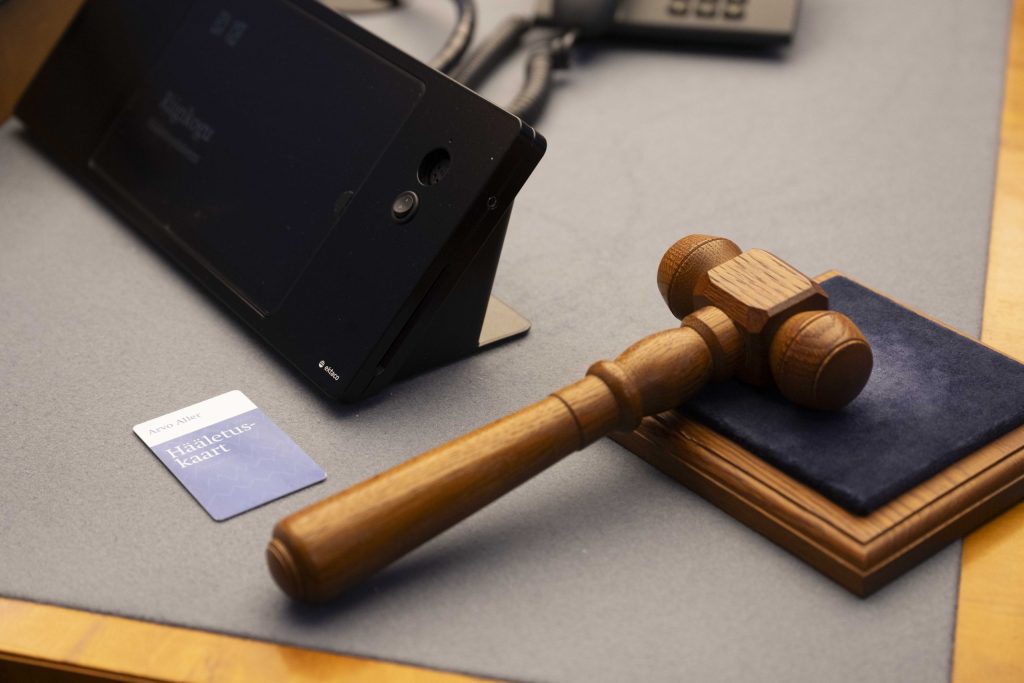
At Wednesday’s sitting, the Riigikogu passed three Acts, three Resolutions, and two Statements and concluded the first reading of eleven Bills.
The Riigikogu passed the Act on Amendments to the Fishing Act and Amendments to Other Associated Acts (887 SE), initiated by the Government. It brings the Acts into line with the European Union’s updated rules on fisheries control.
Under the new requirements, the collection and submission of fishing data will become more precise, and the movement of fish must be digitally traceable throughout the entire supply chain—from catch to marketing. The use of the location tracking system for fishing vessels will also be gradually expanded, and the capacity of supervisory authorities to detect violations will be strengthened.
The amendments primarily affect commercial sea fishing and businesses operating in the fisheries sector. Amendments relating to the weighing of fish will come into force on 1 January 2027, the provision relating to continuous measurement of engine power will come into force on 10 January 2028; and the obligation of location tracking for all fishing vessels under 12 metres in length operating at sea will enter into force by 1 January 2030 at the latest.
Andres Metsoja from Isamaa Parliamentary Group, Madis Kallas from the Social Democratic Party Group and Urmas Kruuse from the Reform Party Group took the floor during the debate.
47 members of the Riigikogu were in favour of passing the Act and 24 voted against.
The Riigikogu passed the Act on Amendments to the Occupational Health and Safety Act and Amendments to Other Associated Acts (888 SE), initiated by the Government. Its aim is to reduce the administrative burden on both employers and the Labour Inspectorate.
The Act eliminates duplicative obligations, reduces reporting, and makes the occupational safety system clearer, while at the same time preserving employee protection. Among other things, the organization of first aid is specified, allowing for joint solutions between companies, and it is provided that employers will no longer be required to notify the Inspectorate of the appointment of a working environment specialist or working environment representative. Nor will a company with fewer than 10 employees be required to submit a risk assessment of the working environment or conduct an analysis of the occupational health situation. The administrative burden on employers will also be reduced with regard to posted workers.
To strengthen oversight, the Act grants the Labour Inspectorate access to data from the employment register and the subcontracting chain, which will help more effectively detect undeclared work and violations, especially in the construction sector.
During the proceedings, amendments were made to the Act, under which in the future the Social Insurance Board, which already holds the necessary data, would make entries regarding suspensions of employment arising from paternity and maternity leave in the employment register. This will avoid the need to transmit data additionally and enter it multiple times.
The amendments also correct an inaccuracy in the Taxation Act. Under the Act, Statistics Estonia receives tax data for the purpose of compiling national statistics. Under an amendment, the performance of the tasks set out in the Gender Equality Act are included in the grounds for sharing tax data. At the employer’s request, Statistics Estonia will be tasked with calculating the gender pay gap, or indicators in the salary comparison tool; the amendment does not entail any new obligation for employers to submit data.
Tanel Kiik took the floor behalf of the Social Democratic Party Group in the debate.
59 members of the Riigikogu supported the passing of the Act, and one voted against it.
The Riigikogu passed the Act on Amendments to the Funded Pensions Act and the Taxation Act (935 SE), initiated by the Government. It is intended to strengthen the second pension pillar and more clearly restore the principle that funds are accumulated there for retirement.
The Act provides that people who leave the second pillar will be able to rejoin it after just five years, instead of the previous 10 years. For example, those who left the pension fund in 2021 or 2022 will be able to submit an application to resume contributions once the amendments take effect.
Another important amendment concerns early withdrawal of funds. In the future, a person will no longer have to withdraw the entire accumulated amount when taking money out of the second pension pillar before retirement age; instead, they will be able to use only part of the money if necessary. After a partial withdrawal, the person will be able to start accumulating funds again once five years have passed.
At the same time, the rule is changed so that if a person has already used the option to withdraw second-pillar pension funds before retirement age and later re-joins, they will then continue to accumulate money until retirement. Rejoining the second pillar will remain voluntary, and the conditions for retiring will not change: it will be possible to retire from the second pillar five years before the retirement age or in the event of no work ability.
Under the Act, the amendments will come into force on 1 November; however, partial withdrawal of funds and resuming accumulation without restrictions after suspension of contributions will enter into force on 1 January 2028, as they require IT developments in the pension register.
Õnne Pillak from the Reform Party Group and Urmas Reinsalu from Isamaa Parliamentary Group took the floor during the debate.
56 members of the Riigikogu supported the passing of the Act and there was one abstention.
Three Resolutions were passed
The Riigikogu passed the Resolution of the Riigikogu “Appointment of an Auditor to Supervise the Activities of the National Audit Office in 2026–2028” (1014 OE), submitted by the Finance Committee, which designated AVAC Audit OÜ to supervise the activities of the National Audit Office.
The parliament designates an auditor to audit the activities of the National Audit Office in a financial year on the proposal of the Finance Committee. When making its proposal, the committee had taken into account the results of the procurement procedure organised by the National Audit Office.
60 members of the Riigikogu voted in favour of passing the Resolution.
The Riigikogu passed the Resolution of the Riigikogu “Appointment of Members of the Estonian Public Broadcasting Council from among the Acknowledged Experts in the Field of Activity of the Estonian Public Broadcasting” (1027 OE), submitted by the Cultural Affairs Committee. Veronika Kalmus, Merit Kopli and Marek Tamm were appointed as members of the Estonian Public Broadcasting Council as experts in the relevant field.
The Cultural Affairs Committee began seeking new experts for the Estonian Public Broadcasting Council in connection with an Act passed at the start of this summer, under which the Estonian Public Broadcasting Council must include more acknowledged experts in the field of activity of public broadcasting than representatives of the parliamentary groups in the Riigikogu. As there are currently six parliamentary groups in Parliament, three experts had to be found to supplement the existing four.
The committee announced a public competition to find three new members for the Estonian Public Broadcasting Council from among acknowledged experts. By the deadline, 40 candidates had declared their intention to run, 38 of whom met the requirements. A vote among these candidates was held in the Cultural Affairs Committee, with Kalmus, Kopli, and Tamm receiving the most support.
The mandate of the members of the Council who are acknowledged experts in the field of activity of the Public Broadcasting lasts for five years. Other members who are experts in the field include Paavo Nõgene, Raul Rebane, Rein Veidemann and Chairman of the Council Sulev Valner. The Estonian Public Broadcasting Council also includes a representative from each parliamentary group of the Riigikogu until the date of termination of the authority of the composition of the Riigikogu.
Martin Helme from the Estonian Conservative People’s Party Group, Priit Sibul from Isamaa Parliamentary Group, Vadim Belobrovtsev from the Centre Party Group and Madis Kallas from the Social Democratic Party Parliamentary Group took the floor during the debate.
58 members of the Riigikogu supported the passing of the Resolution and 24 were against it.
The Riigikogu passed the Resolution of the Riigikogu “Appointment of Members of the Judicial Council” (1023 OE), submitted by the Constitutional Committee, under which Members of the Riigikogu Lea Danilson-Järg and Madis Timpson were appointed to the Judicial Council to be established.
The primary task of the Judicial Council, which begins its work this October, is to guide the strategic management of the court system. Its membership comprises the Chief Justice of the Supreme Court, two judges of circuit courts of appeal, three judges of courts of first instance, two members of the Riigikogu, an attorney-at-law appointed by the Board of the Estonian Bar Association, and the Chancellor of Justice and the minister in charge of the policy sector or their representatives.
The establishment of the Judicial Council is provided for in an Act adopted in June this year, which introduced changes to the organisation of the courts, civil and administrative court proceedings, as well as court fees, with a view to speeding up the administration of justice. Among other things, the aim of the changes is to streamline court administration and improve the organization of the work and specialization of the courts.
66 members of the Riigikogu supported the passing of the Resolution.
Two Statements were passed
The Riigikogu adopted the Statement of the Riigikogu “To Ensure Victory for Ukraine and Security for Europe” (1015 AE), submitted by 67 Members of the Riigikogu. It confirms Estonia’s unwavering support to the victory of Ukraine in Russia’s war of aggression. It underlines that Ukraine’s victory and strategic defeat of Russia are necessary preconditions for ensuring a lasting and fair peace and security in Europe.
The Riigikogu calls on the allies and partners to prioritise the delivery of air defence systems and missiles to Ukraine in the conditions of the approaching winter and Russia’s increasing terror in the sky and emphasises that Ukraine’s defence industry basis needs to be supported and the economic capability of the country ensured through long-term financial aid.
In the Statement, countries are called to ensure the critical stocks for Ukraine for the coming winter. The Statement also supports increasing economic pressure against Russia, more efficient application of sanctions, and the prosecution of violators.
The Riigikogu condemns the terror, including sabotage, cyberattacks, torchings, murders, and other violent acts perpetrated by Russia in European countries and calls on allies to fight against Russia’s state-organised terror as a united front. The Riigikogu also condemns the planning and organisation of the 20 September “elections” to the State Duma of Russia in the temporarily occupied territories as a gross violation of the sovereignty and territorial integrity of Ukraine.
In the Statement, the Riigikogu reaffirms its support for Ukraine’s accession to NATO and the European Union, also highlighting political unity of Ukraine, democracy, rule of law, human rights, and the continuation of the necessary reforms. It also emphasises the importance of combating corruption, strengthening democratic institutions, and respecting the rights of the opposition and political pluralism.
The Riigikogu calls for the completion of the establishment of the special international tribunal for the crime of aggression and compensation mechanisms for aggression, and underlines that a lasting peace in Europe cannot be born out of rewarding the aggression or restoring the spheres of influence. “A fair and lasting peace requires the preservation of Ukraine’s sovereignty and territorial integrity as well as reliable security guarantees that prevent any new aggressions from the part of the Russian Federation,” the Statement says.
Eerik-Niiles Kross from the Reform Party Group and Raimond Kaljulaid from the Social Democratic Party Parliamentary Group took the floor during the debate. Henn Põlluaas made a speech on behalf of Isamaa Parliamentary Group.
78 members of the Riigikogu supported the adoption of the Statement, and one voted against it.
The Riigikogu also passed the Resolution of the Riigikogu “On the Authoritarian Regime and the Silencing of the Riigikogu of the Republic of Estonia in 1934“ (915 AE), submitted by 29 members of the Riigikogu. It describes the events of 1934 and the following years, which resulted in the silencing of the democratically elected parliament, the banning of political parties, the subjection of the press to censorship, and the establishment of an authoritarian regime.
In its statement, the Riigikogu condemns the actions taken at that time to suppress Estonia’s constitutional order and democracy, and, referring to the words of the Preamble to the Constitution, emphasises the need to prevent the recurrence of such events and practices in Estonia. “In the current geopolitical situation, where both regional and global uncertainty have been on the rise from Estonia’s perspective, the Riigikogu’s statement is a significant way of recalling the lessons of history, as well as emphasising the importance of national unity,” the proposers noted.
During the debate, Jaanus Karilaid took the floor on behalf of Isamaa Parliamentary Group, Eerik-Niiles Kross spoke on behalf of the Reform Party Parliamentary Group and Leo Kunnas participated in the debate on behalf of the Centre Party Group.
28 members of the Riigikogu voted in favour of passing the Statement and nine were against it.
Eleven Bills passed the first reading
The Bill on the State’s Second Supplementary Budget for 2026 (1019 SE), initiated by the Government, passed the first reading. It will specify the volume of state expenditure.
Under the bill, revenues will increase by €14.1 million due to the projected income from prison leasing. Expenditure will decrease by six million euro and investments will increase by €5.8 million, but the total volume of expenditure and investments remains unchanged under the bill.
The draft supplementary budget amends the allocation of expenditure across the years: expenses and investments that cannot be carried out this year are being shifted from this year’s budget to future years. Budget reallocations between areas of government also constitute a significant part of the bill. Among other things, funds are being allocated from the government reserve to the budgets of areas of government to cover the increased cost of membership fees and to prepare for the organization of the Ukraine reconstruction conference.
Revenues totalled EUR 18.6 billion and expenditures 19.5 billion, while investments totalled EUR 1.3 billion and financing transactions 1.5 billion in the 2026 state budget adopted by the Riigikogu last December. The first supplementary budget adopted in June reduced revenues by €24 million and increased expenditures by €4.4 million. Investments decreased by €1.5 million, and the budget for financing transactions increased by €37.9 million.
Aivar Kokk from Isamaa Parliamentary Group took the floor during the debate.
Isamaa Parliamentary Group moved to reject the Bill at the first reading, but the motion was not supported. 28 members of the Riigikogu supported rejection but 50 were against.
The Bill on Amendments to the Medicinal Products Act (917 SE), initiated by the Social Democratic Party Parliamentary Group and Members of the Riigikogu Andre Hanimägi, Tanel Kiik and Züleyxa Izmailova, passed the first reading. Its aim is to reduce the cost of medicines intended for the treatment of rare diseases, cancer and other malignant tumours, and to support charitable funds in purchasing such medicines.
The bill proposes the establishment of a new type of grant that would enable support to be provided to private legal entities when they use donations to purchase medicines intended for the treatment of rare diseases, cancer, and other malignant tumours, with a view to improving the availability of treatment. Under the bill, the Health Insurance Fund would be able to reimburse non-profit organisations, foundations and religious associations an amount equal to the VAT paid on the purchase of medicines.
During the debate, Tanel Kiik took the floor on behalf of the Social Democratic Party Group and Aivar Kokk made a speech on behalf of Isamaa Parliamentary Group.
The Social Affairs Committee moved to reject the Bill at the first reading, but the plenary did not support the motion. Two members of the Riigikogu supported rejection but 74 were against.
The Bill on Amendments to the Public Health Act and Amendments to Other Associated Acts (changing of the rehabilitation system) (998 SE), initiated by the Government, passed the first reading. It will reorganise the rehabilitation service.
The aim of the bill is to simplify the person’s path to receiving assistance, align the content of rehabilitation services with the person’s need for assistance, and reduce duplication within the healthcare and social system. According to the explanatory memorandum, the current rehabilitation service is fragmented between the social and healthcare systems; access to the service has depended on formal assessments; services with similar content are provided in two sectors; and their funding and organisation are based on different principles.
Under the bill, a person will be referred to a service on the basis of their need for rehabilitation arising from their state of health. In the future, a healthcare professional authorised to provide online consultations will refer the person to a rehabilitation team comprising a medical specialist or nurse, a mental health expert, a physiotherapist, a speech therapist or an occupational therapist, a social worker, and other specialists, who will assess the need for the service and provide it for as long as it is required.
The bill provides that, from 1 October 2027, the rehabilitation service will be integrated into the healthcare system, and the organisation and funding thereof will be transferred from the Social Insurance Board to the Health Insurance Fund.
During the debate, Jaanus Karilaid took the floor on behalf of Isamaa Parliamentary Group, Diana Ingerainen made a speech on behalf of Estonia 200 Parliamentary Group, and Tanel Kiik spoke on behalf of the Social Democratic Group. Signe Riisalo from the Reform Party Parliamentary Group also took the floor.
The Bill on Amendments to the Public Health Act and Amendments to Other Associated Acts (cooperation between health and social sectors) (999 SE), initiated by the Government, passed the first reading. It will integrate the currently separate healthcare and social systems into a more unified whole and improve the organization of care for people who require support from both sectors simultaneously.
At present, healthcare is primarily the responsibility of the state and the Health Insurance Fund, whilst social services fall under the remit of local authorities; as a result, differences in the organisation of work and inadequate data exchange may lead to delays and duplication in assistance.
The bill provides for the establishment of county-level welfare regions and cooperation councils, and for the creation of a cooperation organisation for the healthcare and social sectors – known as TERVIK – in each region which will bring together local authorities, family physicians, and hospitals. A health and welfare profile will be used to link the needs of a region’s residents with service usage and costs. The role of the Health Insurance Fund will expand from the funding of treatment to include support for regional cooperation, prevention, and health promotion.
Under the bill, a coordination service will be established for people with complex service needs. A health navigator will draw up a welfare plan for a person, consolidate information from the health and social sectors, and coordinate support and health services as well as information exchange. Health navigators will begin helping people with multiple chronic health conditions to navigate the maze of support services, enabling them to access help sooner.
According to the explanatory memorandum, regional integrated care organisations (TERVIK-s) will be established by 1 November 2027, and the work of health navigators will commence on 1 May 2028. The estimated total cost of the reform for the period 2026–2032 is nearly €64 million, and the payback period for the reform is estimated at four years.
Helmen Kütt from the Social Democratic Party Group and Riisalo from the Reform Party Group took the floor during the debate.
The Bill on Amendments to the Environmental Impact Assessment and Environmental Management System Act and the Heritage Conservation Act (950 SE), initiated by the Government, passed the first reading. Its aim is to speed up the environmental impact assessment procedure and to reduce the administrative burden on developers, licensing authorities and the agencies participating in the procedure.
The bill will eliminate duplicative procedural steps that offer little added value and will simplify the environmental impact assessment process. For example, in certain cases, it will be possible to omit the preparation of the environmental impact assessment programme – or the terms of reference – if the extent and nature of the impact are already known on the basis of previous similar assessments. This can shorten the proceedings by up to five months.
The bill will also amend the rules regarding the mandatory nature of environmental impact assessment. For several activities, the automatic obligation to conduct an assessment will be replaced by an obligation to provide a preliminary assessment, so that a comprehensive environmental impact assessment takes place only when the risk of significant impact actually warrants it. The procedure for preparing a preliminary assessment will also be harmonized, which will help to decide more quickly whether an environmental impact assessment is necessary.
In addition, the bill will improve public involvement by incorporating the public discussion of environmental impact assessment reports into the public display period. The aim of the amendments is to speed up the implementation of developments and make the procedures clearer.
The Bill on the Ratification of the Agreement under the United Nations Convention on the Law of the Sea on the Conservation and Sustainable Use of Marine Biological Diversity of Areas Beyond National Jurisdiction (988 SE), initiated by the Government, passed the first reading. The aim of the agreement to be ratified by the bill is to contribute to the conservation and sustainable use of marine biological diversity in marine areas beyond national jurisdiction.
This agreement represents the first global legal framework for the conservation and sustainable use of biodiversity in marine areas that fall outside the jurisdiction of any single state. Such areas cover nearly two-thirds of the global ocean, encompassing the high seas and the seabed, where living natural resources and deposits of potentially valuable natural resources are found.
Estonia, the European Union and other Member States signed the agreement in September 2023; a total of 92 countries had acceded to the agreement as of the end of July this year.
The Bill on Amendments to the Equal Treatment Act and Amendments to Other Associated Acts (948 SE), initiated by the Government, passed the first reading. It will transpose two European Union directives into Estonian law in order to strengthen the role of equality bodies and improve the protection of individuals against discrimination. In Estonia, the amendments concern the Gender Equality and Equal Treatment Commissioner and the Commissioner’s Office.
The bill will expand the Commissioner’s powers and tasks: in future the Commissioner will be able to represent victims of discrimination in court, resolve discrimination disputes at the request of the parties, gather more comprehensive statistics, and conduct more awareness-raising and prevention work. Requirements regarding the availability of services and information will also be set out, and the need to take into account the impact of intersectional discrimination will be emphasised.
The bill will also strengthen the Commissioner’s institutional independence by specifying the procedure for their appointment and the safeguards relating to the budget.
The Bill on Amendments to the Planning Act, the Building Code and an Act to Implement the Building Code and the Planning Act (949 SE), initiated by the Government, passed the first reading. Its aim is to speed up planning and building procedures.
The bill will restructure the Land and Spatial Development Board’s current procedure for approving plans, replacing it with a solution based on the principle of coordination. The tasks to be addressed through the detailed spatial plan, as well as their scope and necessity, will also be specified, and clearer deadlines will be established for both the initiation of a spatial plan and the intermediate stages of the procedure.
To increase the transparency of proceedings, under the bill, applications for initiating detailed spatial plans will be submitted via the database of spatial plans. In addition, a principle will be established that agencies participating in the procedure must submit their proposals and comments at the earliest possible stage in order to avoid subsequent delays.
The Bill on Amendments to the Labour Market Measures Act and Amendments to Other Associated Acts (972 SE), initiated by the Government, passed the first reading. It will amend the conditions for receiving labour market services, unemployment insurance benefits, and work ability allowances in order to increase the activity of jobseekers and support their faster return to the labour market.
The bill will specify the conditions for registration as unemployed, the associated obligations, and the grounds for termination of such registration; it will update the definition of ‘suitable work’; and it will direct the services provided by the Unemployment Insurance Fund more than before towards people who are ready to take up employment.
The bill will also bring the Social Tax Act into line with the amendments to the employment programme by removing the reference to the abolished work practice service.
The Bill on Amendments to the Bank of Estonia (Eesti Pank) Act (1013 SE), initiated by the Finance Committee, passed its first reading. It will establish rules for the prevention of conflicts of interest at the Bank of Estonia at the legislative level.
The bill will enable the implementation of the European Central Bank’s guidelines regarding the avoidance of conflicts of interest and restrictions on post-employment activities. To this end, provision is made for the possibility of restricting the financial transactions of employees who have regular access to market-sensitive information, and for imposing a cooling-off period following the termination of their service or employment relationship. The bill will also establish a legal basis for conducting vetting for posts involving heightened trust requirements.
In addition, the bill will modernise other provisions of the Bank of Estonia (Eesti Pank) Act, clarify the division of powers, and update the regulations governing the capital and reserves of the Bank of Estonia.
The Bill on Amendments to the Traffic Act (911 SE), initiated by Members of the Riigikogu Toomas Uibo, Tanel Tein, Varro Vooglaid, Kalle Laanet, Madis Timpson and Rene Kokk, also passed the first reading. It is intended to allow motorcycles in public transport lanes.
Under the bill, the right to use public transport lanes will be extended to motorcycles as well, in order to make traffic management smoother, safer, and more efficient.
According to the initiators, the amendment will enable the existing road infrastructure to be used more efficiently and will not have a negative impact on the operation of public transport. According to them, the amendment is also in line with the general trend towards promoting more space-efficient and flexible modes of transport in urban traffic.
A draft Resolution was dropped from the proceedings
The Riigikogu rejected the Draft Resolution of the Riigikogu “Making a Proposal to the Government of the Republic to establish the institution of a financial ombudsman” (912 OE), submitted by the Social Democratic Party Group. The draft Resolution proposed that the Government develop and submit to the Riigikogu a bill to establish the institution of a financial ombudsman in Estonia.
In the view of the proposers, establishing the institution of a financial ombudsman is necessary to ensure that individuals and businesses have a better, faster, and more accessible way to resolve disputes related to financial services. “The role of the Financial Ombudsman would be to resolve disputes between financial service customers and financial service providers out of court, independently, swiftly and at a cost that people can afford,” they said.
Andre Hanimägi took the floor on behalf of the Social Democratic Party Group in the debate.
At the final vote, 15 members of the Riigikogu supported the draft Resolution while at least 51 votes would have been needed for the Resolution to be passed.
The first reading of the Bill on Amendments to the Rescue Act and Other Acts (989 SE), initiated by the Government, was cancelled at Wednesday’s sitting due to the absence of the presenter. The first reading of the bill was originally due to take place on Tuesday, but it was postponed to Wednesday’s agenda due to the end of the working hours.
The sitting ended at 12.17 a.m.
Verbatim record of the sitting (in Estonian)
Video recording will be available to watch later on the Riigikogu YouTube channel.