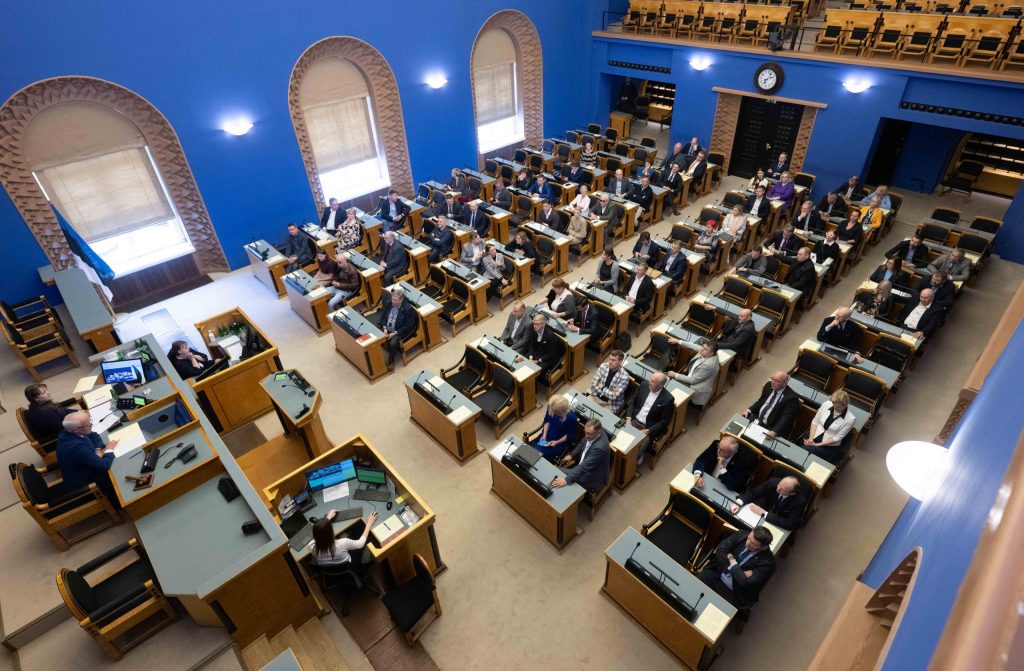
The Riigikogu passed eight Acts and concluded the second reading of two bills and the first reading of nine bills at its sitting on Wednesday.
The Riigikogu passed the Act on Amendments to the Law of Obligations Act (895 SE), initiated by the Government. Its aim is to improve consumer awareness and encourage consumers to make more sustainable consumption decisions. To this end, the requirements for providing pre-contractual information are amended so that consumers can gain a better understanding of the characteristics of products before making purchase decisions.
The amendments transpose the requirements of a European Union directive into Estonian law, specifying the obligations of businesses and the rights of consumers with a view to promoting more environmentally friendly consumption. Under the Act, the obligation for businesses to provide consumers with additional information before a contract is concluded is extended. In future, consumers will have to be informed about the availability of free software updates and the reparability of products.
The reparability score is a score based on EU requirements that indicates how easy it is to repair a product. At present, the obligation to provide a reparability score applies to smartphones and tablets. If a reparability score is not applicable, the business will have to provide information about the availability of spare parts and repair and maintenance instructions and about any potential repair restrictions. Consumers will also have to be provided with information about environmentally friendly delivery methods, where these are offered.
In addition, the Act provides that businesses will have to adopt a harmonised notice and label reminding consumers of their rights in the event of non-conformity of goods. Shops and online stores will display a standardised notice regarding consumers’ statutory rights.
Rain Epler from the Estonian Conservative People’s Party Group took the floor during the debate.
61 members of the Riigikogu supported the passing of the Act, 10 were against and there was one abstention.
The Riigikogu passed the Act on Amendments to the Identity Documents Act and Amendments to Other Associated Acts (905 SE), initiated by the Government. It transfers the e-Residency programme to a cardless and remotely operating electronic identification scheme. The purpose of the amendments is to reduce bureaucracy, simplify the application for e-residency, and increase the economic impact of the e-residency programme.
Under the Act, starting in March 2027, the identities of e-residents will be verified and checked remotely using biometric data. For this, applicants’ biometric data and travel document information will be compared with data held in national databases. Starting in March 2028, there will be a transition to a cardless electronic identification means, meaning that e-residents will have the right to use a digital identity solution without a physical card instead of the current digital ID.
The right to use the electronic identification means will be granted by the Police and Border Guard Board, and the technical solution will be organized by the Estonian Business and Innovation Agency.
During the proceedings, amendments were made to the Act that granted notaries access to the automated biometric identification system, enabling them to securely perform remote authentication of notarial acts via video link and to prevent fraud. Currently, there is no equally secure method available for verifying identity during remote authentication while the share of transactions conducted in the digital environment and remote authentications has grown and consequently the risk of identity fraud has also risen.
Pipi-Liis Siemann from the Reform Party Parliamentary Group took the floor during the debate.
67 members of the Riigikogu were in favour of passing the Act, five were against and there was one abstention.
The Riigikogu passed the Act on Amendments to the Veterinary Act and Amendments to Other Associated Acts (918 SE), initiated by the Government. It will make it mandatory to have dogs, cats, and ferrets microchipped and to register them in a national registry starting from the middle of next year.
The Act provides that, from 1 June next year, all dogs, cats, and ferrets will have to be microchipped and registered in the national pet register to be established under the Estonian Agricultural Registers and Information Board. Current pet owners are granted a transition period until 1 January 2029 to have their pets microchipped and registered.
A statutory fee of EUR 12 will apply upon the initial registration of an animal and upon a change of owner; state agencies and shelters will be exempt from this fee. If an animal is microchipped and registered before the amendments come into force, the register data will be automatically transferred to the new register, and the animal owner will incur no additional costs.
Siim Pohlak from the Estonian Conservative People’s Party Group took the floor during the debate.
60 members of the Riigikogu voted in favour of passing the Act, 10 were against and there was one abstention.
The Riigikogu passed the Act on Amendments to the Plant Protection Act (919 SE), initiated by the Government. It will make the regulations governing plant protection training more flexible from June next year. Under the amendments, the primary prerequisite for obtaining a plant protection certificate will not be merely completing plant protection training, but also possessing the relevant knowledge, as evidenced by successfully passing the plant protection training examination.
The Act also provides for the possibility of using plant protection products from unmanned aerial vehicles. The use of plant protection products from airplanes and helicopters remains prohibited, but spraying them from drones will be permitted under certain conditions. In addition, the Act eases the annual training requirement for persons conducting technical inspections of plant protection equipment and makes procedural processes more flexible.
70 members of the Riigikogu supported the passing of the Act, two were against and there was one abstention.
The Riigikogu passed the Act on Amendments to the Taxation Act, the Money Laundering and Terrorist Financing Prevention Act and the Code of Civil Procedure and the Code of Enforcement Procedure Implementation Act (924 SE), initiated by the Government. It specifies the rights of the Tax and Customs Board and the Financial Intelligence Unit to obtain from third parties data necessary for tax controls and for carrying out anti-money laundering tasks, in particular regarding bank accounts and account data. Under the Act, the Tax and Customs Board also has the right to request information from credit institutions in tax proceedings and this right also includes bank secrecy.
The Act specifies and delimits the data that the Tax and Customs Board may request through the information exchange channel of the enforcement register. When the Tax and Customs Board requests information through the enforcement register, in the future, the order will have to include an explanation of the factual circumstances, including a justification as to why it has not been possible to obtain the necessary data from the taxable person. This will make requesting data more transparent and help limit unjustified interference with individuals’ rights.
Under the Act, the Financial Intelligence Unit has the right to obtain account data, including account balances and account statements, through the enforcement register in justified cases. During the legislative proceedings, amendments were made to the Act to shorten the time limits for notifying of bank account statement requests. As a general rule, the account holder will be notified of an inquiry into their data four years after receiving the bank account statement instead of the original five years and this period may be extended by up to two years beyond the original five-year period in justified cases. The notification obligation will apply to queries that are made after the Act enters into force.
The amendments made during the proceedings also define the powers of the Financial Intelligence Unit and provide that bank account statements may be requested only to the extent necessary for specific proceedings where it is not possible to obtain the necessary data by other means. In addition, a clear basis is established for the Unit to process personal data, including special categories of personal data, and an obligation to comply with the necessary security measures is set out.
The background to the amendments lies in the Chancellor of Justice’s observations that the Tax and Customs Board’s access to the enforcement register outside criminal proceedings is unclearly regulated in the current Act and that the Financial Intelligence Unit’s right to obtain bank account statements is not sufficiently clearly provided. In addition, the Act streamlines the regulation of the supervision by the Financial Intelligence Unit and improves the wording of the provisions in light of a recent interpretation by the Supreme Court and the need to make the regulation of anti-money laundering supervision more precise in terms of terminology.
55 members of the Riigikogu were in favour of passing the Act and 20 were against.
The Riigikogu passed the Act on Amendments to § 5 of the Strategic Goods Act (958 SE), initiated by the National Defence Committee. Its aim is to permit the transport of anti-personnel mines. The Act repeals, in connection with withdrawal from the Ottawa Convention, the provision which currently prohibits the transport of anti-personnel mines and the provision of related services in Estonia, except where this is strictly necessary for the purposes of training or mine disposal.
The Riigikogu decided to withdraw from the convention banning anti-personnel mines in June last year, citing the deteriorated security situation, and Estonia’s withdrawal took effect at the end of December last year. Along with Estonia, Finland, Latvia, Lithuania, and Poland also withdrew from the convention, with Finland reportedly planning to launch the production of anti-personnel mines.
The explanatory memorandum notes that, whilst the intention behind withdrawing from the Convention was to give the Estonian Defence Forces greater flexibility and freedom to select additional weapon systems and solutions to be used where necessary, it cannot be ruled out, for example, that anti-personnel mines might be transported from Finland through Estonian territory to countries in the Baltic Sea region. The explanatory memorandum also draws attention to the fact that the United States—a NATO member with units stationed on Estonian territory—has not acceded to the Ottawa Convention.
Meelis Kiili took the floor on behalf of the Centre Party Group and Peeter Tali spoke on behalf of Estonia 200 Parliamentary Group during the debate.
64 members of the Riigikogu supported the passing of the Act.
The Riigikogu passed the Act on Amendments to the Income Tax Act and Amendments to Other Associated Acts (994 SE), initiated by the Government. It simplifies and modernises the filing of tax returns in order to reduce both the administrative burden on taxpayers and the workload on the state.
Instead of the current static return forms, in the future the legislation will set out lists of the data to be provided, which will enable the Tax and Customs Board to design their online environment more flexibly and to develop automated data exchange between business software and the Tax and Customs Board’s systems.
The Act also restricts the submission of returns on paper. From now on, employers must submit their income tax and social security contribution returns electronically, regardless of the number of employees. Until now, it was possible to submit returns on paper for up to five employees. In certain cases, private individuals will also be required to submit their income tax returns electronically, for example when declaring income derived from financial investments of a significant amount. In justified cases, however, the option to submit returns on paper remains available.
60 members of the Riigikogu voted in favour of passing the Act and four were against it.
The Riigikogu also passed the Act on the Ratification of the Agreement under the United Nations Convention on the Law of the Sea on the Conservation and Sustainable Use of Marine Biological Diversity of Areas Beyond National Jurisdiction (988 SE),initiated by the Government. It ratifies an agreement aimed at contributing to the conservation and sustainable use of marine biological diversity in marine areas beyond national jurisdiction.
The agreement represents the first global legal framework for the conservation and sustainable use of biodiversity in marine areas that fall outside the jurisdiction of any single state. Such areas cover nearly two-thirds of the global ocean, encompassing the high seas and the seabed, where living natural resources and deposits of potentially valuable natural resources are found.
Estonia, the European Union and other Member States signed the agreement in September 2023, and 92 countries had acceded to the agreement as of the end of July this year.
61 members of the Riigikogu supported the passing of the Act, and one was against it.
Two Bills passed the second reading
The Bill on Amendments to the Citizenship Act and Amendments to Other Associated Acts (932 SE), initiated by the Government, passed the second reading. It provides that, in the future, children born in Estonia to stateless parents will acquire Estonian citizenship through naturalization if at least one of the parents has legally resided in Estonia for at least five years by the time of the child’s birth and the other parent also resides in Estonia on the basis of a residence permit. Under current law, children born in Estonia to stateless parents remain stateless.
The bill also aims to ensure that applicants for Estonian citizenship have a genuine and direct link to the Estonian state, and to verify that they comply with Estonian laws and adhere to its constitutional order. The bill will specify the requirement to reside permanently in Estonia when applying for Estonian citizenship, as well as the provisions concerning the revocation of Estonian citizenship and the conditions under which a person is deemed to have ceased to be an Estonian citizen.
Anti Poolamets and Evelin Poolamets from the Estonian Conservative People’s Party Group and Helir-Valdor Seeder from Isamaa Parliamentary Group took the floor during the debate.
Isamaa Parliamentary Group moved to suspend the second reading of the Bill, but the plenary did not support the motion. 10 members of the Riigikogu supported suspension of the deliberation but 45 voted against it.
The Bill on Amendments to the Value-Added Tax Act (992 SE), initiated by the Estonian Centre Party Group, passed the second reading. It will transpose amendments to the European Union’s VAT Directive which aim to reduce the administrative burden on businesses operating across borders.
The amendments expand the scope of the use of the special scheme for distance sales so that businesses will be able to fulfil their VAT obligations arising in other Member States through their country of establishment and will not have to register for VAT separately in each country. From 1 July 2028, the special scheme may be used more broadly for the sale of goods to consumers in another Member State, for example, for sales of goods at trade fairs, exhibitions, and markets; for the sale of goods that require installation or assembly; and for sales taking place on board watercraft or aircraft. From 2027, the special regime will be extended to natural gas transmitted via the network, as well as to electrical, thermal, and cooling energy.
VAT rules for platform services will also be changed. In the future, the place where the turnover from the underlying transaction arises will be the place of the provision of an online marketplace service. For example, in future, a service provided by an accommodation-booking platform will be taxed in the country where the accommodation service is provided, rather than in the client’s country of residence.
In addition, the bill will eliminate the option to use a VAT taxable period longer than a calendar month and raise the tax-exempt threshold for goods transferred for advertising purposes from EUR 10 to EUR 21.
During the second reading, amendments were made to the bill to provide that therapeutic services provided by qualified specialists would be exempted from VAT even when they are provided outside a healthcare facility holding an operating licence.
The second reading of a Bill was suspended
The Riigikogu suspended the second reading of the Bill on Amendments to the Electricity Market Act, the Natural Gas Act and the Industrial Emissions Act (892 SE), initiated by the Government. The Bill will transpose the amendments made with a European Union directive with the aim of improving the organisation of electricity market so that the energy market would be well integrated. This will enable Member States to gain economic benefits from a single energy market under all market conditions, ensure security of supply and support the reduction of CO2 emissions to achieve the Union’s climate neutrality target.
In the context of the energy crisis, the current structure of the electricity market has revealed various bottlenecks that are related to the impact of high and volatile fossil fuel prices in short-term electricity markets and are forcing households and businesses to face sharp price fluctuations and their impact on electricity bills. The amendments proposed in the Bill will ensure that consumers are protected against energy price crises and against disconnection from the grid during out-of-court dispute resolution proceedings.
The ability of network connection users to enter into flexible connection agreements in regions where the capacity of electricity network for new connections is limited also encourages network operators to develop sparsely populated areas, as they can be confident that reinforcement of the planned network is a priority. Flexible connections will be permitted as a permanent solution in areas where reinforcement of the network is not effective, and the expected restrictions applicable to flexible connection agreements will be made as visible as possible to network users applying for a network connection.
Ahead of the second reading, the Economic Affairs Committee made extensive amendments to the bill, which, among other things, would update the system of guarantees for balance providers and specify the provisions concerning underutilisation charges and the procedure for preparing reverse auctions for the reserve capacity mechanism. Therefore, the Economic Affairs Committee made a proposal to the plenary to suspend the second reading of the bill.
Nine Bills passed the first reading
The Bill on Amendments to the Estonian Public Broadcasting Act (1041 SE), initiated by the Government, passed the first reading. It will bring a nearly 20-year-old legal framework into line with the modern media and digital environment, as well as with European Union law.
According to the bill, the Estonian Public Broadcasting and the Minister of Culture will enter into a four-year framework agreement on funding, which will set out the amount of support for each year. The agreed support may not be reduced during the term of the framework agreement. Nor may the support for the new four-year period be reduced except in the event of a significant economic downturn, national defence requirements or other exceptional circumstances.
The amendment will provide the Estonian Public Broadcasting with greater funding certainty and the opportunity to plan its activities further in advance. According to the bill, the first long-term agreement is to be concluded next autumn for the years 2028–2031.
Another significant amendment concerns the introduction of a requirement to assess the market impact of launching new media services. If the Estonian Public Broadcasting wishes to launch a new media service or further develop an existing service technologically, and this could significantly affect the media market, then its impact on competition and the demand for the service will have to be assessed. The impact will be assessed by the Consumer Protection and Technical Regulatory Authority, which may request a competition analysis from the Competition Authority. It will also be assessed whether a new service aligns with the public-service objectives of the Estonian Public Broadcasting.
Furthermore, under the bill, the terms of office of the Editor-in-Chief, Head of Editorial, and Ethics Adviser at the Estonian Public Broadcasting will become fixed-term. According to the bill, a public competition will have to be held to fill these posts, and an employment contract of up to five years will be concluded with those appointed to these offices. As an exception, for a valid reason, a person may be appointed to office without a competition for a period of one year. The open-ended employment contracts concluded with the people currently in office will become five-year contracts effective from 1 January of next year.
The Bill on Amendments to the Natural Gas Act and the Taxation Act (995 SE), initiated by the Government, passed the first reading. It will establish a legal framework in Estonia for reducing methane emissions in the energy sector and transpose the requirements of a European Union regulation.
According to the bill, the Environmental Board will be designated as the competent authority; it will verify compliance with requirements, conduct oversight and inspections, and cooperate with other Member States and the European Commission. Liability for violation of the requirements of the regulation will also be established.
The amendments will introduce stricter requirements for gas network operators regarding the measurement and reporting of methane emissions, and the detection and repair of methane leaks. It will also be necessary to provide more detailed reporting on methane emissions associated with imported fossil fuels. The goal is to reduce emissions of a potent greenhouse gas and contribute to the achievement of Estonia’s and the EU’s climate targets.
Mart Maastik from Isamaa Parliamentary Group took the floor during the debate.
Isamaa Parliamentary Group moved to reject the Bill at the first reading, but the motion was not supported. Seven members of the Riigikogu supported rejection but 43 were against.
The Bill on the Ratification of the Partnership Agreement between the European Union and its Member States, of the one part, and the Common Market of the South, the Argentine Republic, the Federative Republic of Brazil, the Republic of Paraguay and the Oriental Republic of Uruguay, of the other part (996 SE), initiated by the Government, passed the first reading. It will provide for the ratification of a partnership agreement between the European Union and Mercosur. Mercosur is a common market in the southern part of South America, comprising Argentina, Brazil, Paraguay, and Uruguay.
In 1999, the Council of the EU authorized the European Commission to begin negotiations for a partnership agreement with Mercosur—negotiations that lasted over 25 years. As a result of the negotiations, two agreements were drawn up: a partnership agreement and an interim trade agreement, to accelerate the entry into force of provisions on the liberalisation of trade and investment.
The partnership agreement, which falls under the shared competence of the EU and its Member States, includes provisions on political cooperation in various fields, in addition to the liberalisation of trade and investment. The interim trade agreement, which falls within the exclusive competence of the EU, establishes a coherent, comprehensive, up-to-date and legally binding framework for trade and investment relations between the EU and Mercosur. The interim trade agreement will initially take effect separately, but the plan is to replace it later with a partnership agreement.
The partnership agreement establishes the world’s largest free trade area in a market of over 720 million people, offering EU businesses a first-mover advantage and thereby fostering the growth of exports for both industrial and agricultural products, the gradual elimination of tariffs, and an improved legal framework for market access in a region that previously had high customs duties and other trade barriers.
Arvo Aller from the Estonian Conservative People’s Party Group took the floor during the debate.
The Estonian Conservative People’s Party Group moved to reject the Bill at the first reading, but the motion was not supported. Two members of the Riigikogu voted for rejection but 40 voted against.
The Bill on the Ratification of the Political, Economic and Cooperation Strategic Partnership Agreement between the European Union and its Member States, of the one part, and the United Mexican States, of the other part (997 SE), initiated by the Government, passed the first reading. It will provide for the ratification of a partnership agreement between the European Union and Mexico.
Since 2000, relations between the EU and Mexico have been based on an agreement on economic partnership, political coordination, and cooperation. In 2016, the Council of the EU authorised the European Commission and the High Representative of the Union for Foreign Affairs and Security Policy to conduct negotiations with Mexico on the modernisation of the general agreement, which were concluded in 2018. As a result of the negotiations, two agreements were drawn up: a partnership agreement and an interim trade agreement, to accelerate the entry into force of provisions on the liberalisation of trade and investment.
The partnership agreement, which falls under the shared competence of the EU and its Member States, includes provisions on political cooperation in various fields, in addition to the liberalisation of trade and investment. The interim trade agreement, which falls within the exclusive competence of the EU, establishes a coherent, comprehensive, up-to-date and legally binding framework for trade and investment relations between the EU and Mexico. The interim trade agreement will initially take effect separately, but the plan is to replace it later with a partnership agreement.
The partnership agreement will establish a significant free trade area with a strategic partner with whom the EU’s trade amounted to nearly EUR 82 billion in 2024. Mexico is the second-largest economy in Latin America, and its market of nearly 132 million consumers represents the EU’s second-largest export destination in the region. The partnership agreement to be concluded will open up significantly better access to this market by eliminating almost all customs duties, reducing technical and regulatory barriers, and establishing a clear framework for services, investments, digital trade, and public procurement.
Peeter Ernits took the floor on behalf of the Centre Party Group during the debate.
The Bill on the Implementation of the Regulation (EU) 2024/2747 of the European Parliament and of the Council establishing a framework of measures related to an internal market emergency and to the resilience of the internal market and amending Council Regulation (EC) No 2679/98 (Internal Market Emergency and Resilience Act) (1002 SE), initiated by the Government, passed the first reading. It will establish preparedness in Estonia to implement the common rules of the European Union that will help keep the internal market functioning even during major crises. The rules, based on experiences from the COVID-19 pandemic, the energy crisis, and Russia’s war of aggression, aim to prevent obstacles to the free movement of goods, services, and people, as well as shortages of essential goods and services.
According to the bill, the Ministry of Economic Affairs and Communications will coordinate the exchange of information and cooperation relating to crises in Estonia, involving the Estonian Stockpiling Agency in the performance of practical tasks. In the event of a crisis, the new rules will, amongst other things, enable the monitoring of supply chains for essential goods, the organisation of joint procurement, and, as a last resort, the requesting of necessary information from businesses or asking them to prioritise the production and supply of goods essential for resolving the crisis.
The Bill on Amendments to the Equipment Safety Act (1004 SE), initiated by the Government, passed the first reading. It will streamline the rules governing the use of personal data held in the information system of the Consumer Protection and Technical Regulatory Authority and harmonise the certification of the competence of persons working in the electrical sector.
With regard to personal data, the bill will set out more clearly which data may be processed and disclosed, and for how long it may be retained. At present, some of the conditions governing the processing of personal data are regulated by a regulation, and the Act does not set out clearly enough what data may be processed in the supervisory information system, for how long it may be retained, and when it may be disclosed. Nor is it defined with sufficient precision which matters relating to the maintenance of databases may be regulated by a regulation of a minister. The bill will provide key legal bases for the processing of personal data at the level of an act and specify the provision delegating authority.
Another amendment will establish a unified system for certifying competence in the electrical sector, as the current parallel existence of both ‘certificates of competence’ and ‘professional certificates’ has caused confusion among companies and other clients commissioning electrical work. According to the bill, as of the beginning of 2031, in the electrical sector, competence will be certified by a professional certificate issued within the meaning of the Professions Act and the issuance of certificates of competence will be discontinued. The amendment will affect nearly 2,900 people who are currently working in the electrical sector on the basis of a certificate of competence. Electricians who hold a valid certificate of competence may continue to use it until its expiry date; however, in the future, they will need to apply for a professional certificate to prove their competence.
The Bill on Amendments to the Electronic Identification and Trust Services for Electronic Transactions Act, the Statutory Fees Act and the Penal Code (1045 SE), initiated by the Government, passed its first reading. It will bring Estonian Acts into line with the European Digital Identity Framework to ensure the secure adoption of the European Digital Identity Wallet. The Digital Wallet is a voluntary pan-European electronic identification means that allows individuals to prove their identity digitally and use online services both in Estonia and elsewhere in the European Union.
The bill will establish the domestic rules, roles, and sanctions necessary for the introduction of the digital wallet. The Information System Authority will become the primary supervisory body, and an authorisation procedure will be established for providers of digital wallets. A personal identification code will also be included in the digital wallet issued in Estonia, so that it can be used as widely as possible in Estonian online services. The Data Protection Inspectorate will perform the supervisory role in matters of data protection.
The amendments will also update the requirements for trust services and establish fine rates that comply with EU requirements. Digital wallet application software must, as a general rule, be open-source. The aim of the new solution is to provide people with a secure additional option for using digital services alongside existing electronic identification means and at the same time to enhance the resilience of Estonia’s electronic government.
The Bill on Amendments to the Personal Data Protection Act and Amendments to Other Associated Acts (1006 SE), initiated by the Government, passed its first reading. It will clarify who may use a person’s personal data without their consent in scientific and historical research, public sector studies, and the compilation of official statistics, and under which circumstances and in what manner this can be done.
While currently public sector agencies are permitted to use personal data for research primarily in order to shape policies, the Bill would allow analysing such data more broadly to improve performance of public duties, including development of services and innovation. For example, a government agency could analyse the data of service users to determine in which regions or for which groups of people a service is less accessible, and use the information obtained to improve the service or find new solutions.
According to the Bill, clear restrictions will apply to the use of personalised data: it may be used only if the aim of the study cannot be achieved by other means. Furthermore, the study must serve an overriding public interest, and the rights of individuals must not be excessively damaged. According to the Bill, the Data Protection Inspectorate will have to be notified of who will be processing which data and for what purpose.
The Bill will retain additional supervision regarding the use of more sensitive personal data, that is, special categories of personal data, such as health data. Depending on the study, the conditions for processing data will have to be reviewed by an ethics committee or the Data Protection Inspectorate before the study begins.
To promote innovation and the development of data-driven solutions, the Bill will establish the possibility of using a data processing system with a high data protection level that has been pre-approved by the Data Protection Inspectorate. According to the Bill, it will be possible to use personal data for research and analysis in such a secure environment more quickly, as it will not be necessary to go through all the existing coordination and evaluation procedures. For example, this will enable faster analyses that combine different datasets, which can then be used to develop new public services or test innovative solutions.
The Bill on Amendments to the Patents Act and Other Acts (1032 SE), initiated by the Government, passed its first reading. It will simplify and update the regulation in the field of inventions.
The Bill will remove excessively detailed procedural rules from the Act and bring them under one Patent Regulation. Currently, there are 17 separate regulations in place for patents, utility models, and the proceedings relating to them.
The Bill will also update terminology and language usage, remove outdated and duplicative requirements, and clarify, among other things, the regulations governing licenses and pledges on patents.
Six draft Resolutions were dropped from the proceedings
The Riigikogu rejected the Draft Resolution of the Riigikogu “Making a proposal to the Government of the Republic to maintain transparency regarding data on beneficial owners” (952 OE), submitted by Isamaa Parliamentary Group. It was intended to propose to the Government to cease the unjustified classification of data on beneficial owners and ensure equal, transparent and lawful access to such data in accordance with the principles of public interest and legitimate use.
According to the presenters, a registry of beneficial owners would be an important tool for ensuring the transparency of ownership structures of companies and preventing corruption and money laundering. In their opinion, unjustified restrictions on access to these data reduce public oversight and make it more difficult for the media, civil society and other parties with a legitimate interest to identify potential conflicts of interest and hidden influences.
15 members of the Riigikogu supported the draft Resolution in the final vote while at least 51 votes would have been needed for the Resolution to be passed.
The Riigikogu rejected the Draft Resolution of the Riigikogu “Making a proposal to the Government of the Republic to develop a legislative initiative to allow the use of the second pension pillar when applying for a home loan” (954 OE), submitted by the Social Democratic Party Group. It was intended for the Government to develop a solution that is comprehensive, legally clear, and well-considered from the perspective of the financial system and would allow using the assets accumulated in the second pension pillar as a down payment or security when buying a home.
According to the presenters, the solution should have been structured so that a person would not have to leave the second pension pillar or withdraw all their pension assets in order to purchase a home but could instead use the accumulated assets in a targeted and responsible manner to support the purchase of their home. At the same time, it is necessary to avoid a situation where pension assets are used in a way that weakens a person’s future pension security or excessively increases their credit risks.
Andre Hanimägi took the floor on behalf of the Social Democratic Party Group in the debate. Õnne Pillak from the Reform Party Group and Mart Maastik from Isamaa Parliamentary Group also took the floor.
Eight members of the Riigikogu supported the draft Resolution in the final vote while at least 51 votes would have been needed for the Resolution to be passed.
The Riigikogu rejected the Draft Resolution of the Riigikogu “Making a proposal to the Government of the Republic to develop a forestry reform plan” (967 OE), submitted by the Social Democratic Party Group. It requested the Government to develop a forestry reform plan to bring Estonia’s forests out of their current decline.
The presenters considered it necessary to analyse the impact of the changes that have taken place in Estonia’s forests over the past 25 years and the impact of changes in forest land ownership structure, to develop measures to enhance the competitiveness of the forest industry and to preserve forests as a living environment and a stabiliser of the climate. In summary, they called for a comprehensive reform plan that would be long-term and sustainable and ensure the ecological, climate policy, economic, social, and regional sustainability of forests.
Tiit Maran from the Social Democratic Party Group and Yoko Alender from the Reform Party Parliamentary Group took the floor during the debate.
Nine members of the Riigikogu supported the draft Resolution, and one was against in the final vote. At least 51 votes would have been needed for the Resolution to be passed.
The Riigikogu rejected the Draft Resolution of the Riigikogu “Making a proposal to the Government of the Republic to complete the Tallinn–Pärnu section of the Rail Baltica railway by 2030” (1035 OE), submitted by the Social Democratic Party Group. It called on the Government to ensure the timely completion of the Tallinn–Pärnu section of the Rail Baltica railway to support regional development and targeted use of public investments.
The draft Resolution called on the Government to present a plan for the construction and financing of the Tallinn-Pärnu section that would ensure the completion of this railway section by 2030. The Government was also requested to give, at least once every six months, an overview of the implementation of the plan and any changes to deadlines and costs, and to submit proposals for additional funding decisions if necessary.
Jaak Aab took the floor on behalf of the Social Democratic Party Group and Aivar Kokk spoke on behalf of Isamaa Parliamentary Group during the debate.
Eight members of the Riigikogu supported the draft Resolution and there was one abstention in the final vote. At least 51 votes would have been needed for the Resolution to be passed.
The Riigikogu rejected the Draft Resolution of the Riigikogu “Making a proposal to the Government of the Republic to establish new electricity generation capacities in Estonia” (955 OE), submitted by the Social Democratic Party Group. It called on the Government to quickly make decisions and launch the activities necessary for establishing new electricity generation capacities in Estonia.
According to the presenters, the aim of the proposal was to strengthen energy security, improve security of supply, reduce dependence on electricity imports, and contribute to the stability and reduction of electricity prices. According to them, investment decisions in the energy sector are time-consuming, and if the Government does not make decisions regarding reverse auctions, guarantee measures and grid developments soon, the completion dates for new generation capacities will be pushed further into the future.
Mart Maastik from Isamaa Parliamentary Group, Mario Kadastik from the Reform Party Group and Evelin Poolamets from the Estonian Conservative People’s Party Parliamentary Group took the floor during the debate. Jaak Aab made a speech on behalf of the Social Democratic Party Group.
Six members of the Riigikogu voted in favour of the draft Resolution and five voted against in the final vote. At least 51 votes would have been needed for the Resolution to be passed.
The Riigikogu rejected the Draft Resolution of the Riigikogu “Making a proposal to the Government of the Republic to develop measures to reduce electricity bills in the winter of 2026/2027” (1030 OE), submitted by the Social Democratic Party Group. It called on the Government to immediately make the decisions and launch the activities necessary to mitigate the high electrical energy prices for household consumers and companies in the coming winter.
The presenters wanted the Government to exempt end users from paying the power network charge from 1 December this year to 28 February next year. They also requested that consumers be permanently exempted from renewable energy charge.
Riina Sikkut from the Social Democratic Party Group and Mario Kadastik from the Reform Party Group took the floor during the debate.
13 members of the Riigikogu supported the draft Resolution in the final vote while at least 51 votes would have been needed for the Resolution to be passed.
The first reading of the Bill on Amendments to the Health Insurance Act (983 SE), initiated by Members of the Riigikogu Lea Danilson-Järg, Aivar Kokk, Helir-Valdor Seeder and Priit Sibul, and the Bill on Amendments to the Security Authorities Act (963 SE), initiated by Members of the Riigikogu Ants Frosch, Meelis Kiili, Leo Kunnas, Henn Põlluaas, Peeter Tali, Alar Laneman, Vladimir Arhipov, Enn Eesmaa, Eerik-Niiles Kross and Priit Sibul, was cancelled at today’s sitting due to the absence of the presenter.
The sitting ended at 10.51 p.m.
Verbatim record of the sitting (in Estonian)
Video recording will be available to watch later on the Riigikogu YouTube channel.