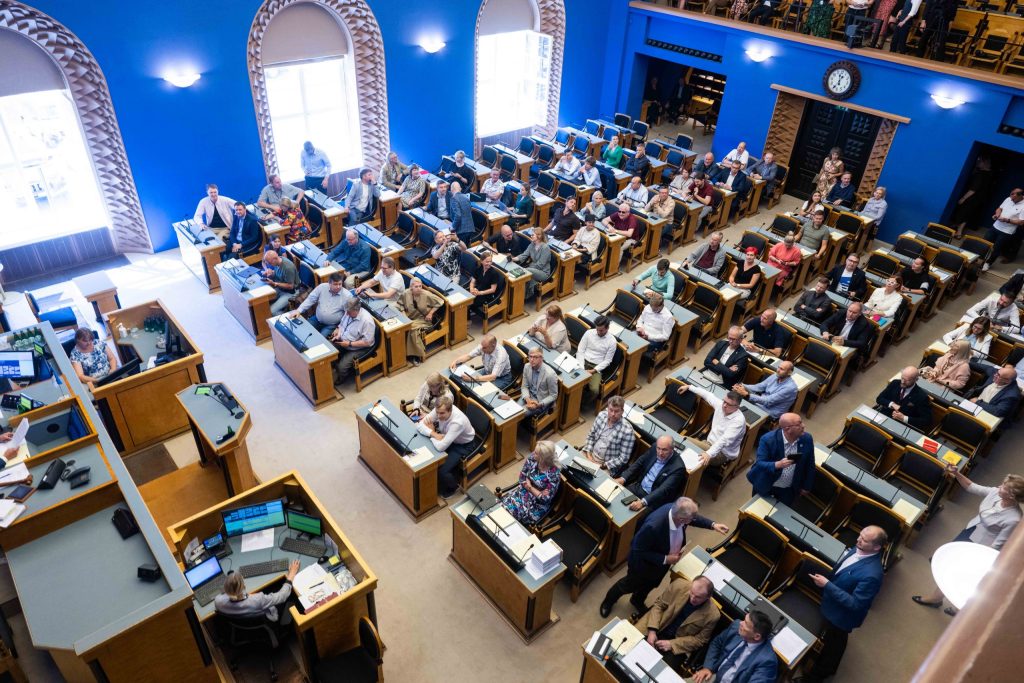
Seven interpellations were replied
Prime Minister Kristen Michal replied to the interpellation concerning the funding for the agricultural sector (No. 961), submitted by Members of the Riigikogu Anti Allas, Andre Hanimägi, Madis Kallas, Riina Sikkut, Tanel Kiik, Lauri Läänemets and Helmen Kütt.
The interpellators pointed out that as the issue of the 546 million euro in funding for the agricultural sector had been resolved satisfactorily and, in accordance with current decisions, that funding would be channelled into agriculture, the focus of the interpellation would shift to achieving food security, in which agricultural funding played a vital role. The interpellators wished to know how that had been done.
Michal confirmed that the government would stand up for the interests of Estonian farmers in the European Union’s budget discussions. In addition to the earmarked allocation of 1.59 billion under the Common Agricultural Policy, the Government had decided to allocate 546 million to agriculture and food security.
Prime Minister explained that ensuring food security had been a key priority in the discussions on European Union funding for 2028–2034. In the context of food security and the continuity of the sector’s operations, it is important that the funds allocated in the European Union budget go to the food sector. The decision took into account the principle of increasing the food sector’s self-sufficiency, crisis resilience, and competitiveness.
Michal said that Estonia’s self-sufficiency rate for agricultural produce had stood at 131 per cent in the previous year. The projected level for 2026 is 115 per cent. To ensure food security, it is important to secure Estonia’s self-sufficiency, strengthen local value chains, and reduce dependence on long and vulnerable supply chains. The goal is to ensure an adequate and safe food supply in normal, crisis, and wartime situations.
According to Michal, the aim is for people in Estonia to have access to sufficient and safe food at all times. The three strategic lines of action underpinning food security are, first, self-sufficiency and the integrity of supply chains, including reducing import dependency for critical production inputs. Second, competitiveness—specifically value added per employed person, agricultural product exports, value added generated within the supply chain, the sector’s investment capacity, and capital expenditure. And third, resilience—specifically, the capacity for autonomous crisis-time production within priority value chains, the coverage of the network of crisis-ready stores, the adequacy of food reserves, and the crisis preparedness of households.
Michal said that direct payments to the agricultural sector were being increased in order to reduce dependence on food imports and enhance Estonia’s food security. It is important that the focus remains on the sector’s competitiveness, self-sufficiency and the strengthening of food security during the 2028–2034 European Union funding period.
He added that productivity in agriculture had increased. According to Eurostat data, agricultural labour productivity in Estonia increased by almost 31% in 2025. “Land is a finite resource and, therefore, it is essential in particular to keep valuable agricultural land in agricultural production and to reduce its conversion for construction and other development activities. In addition, to increase the productivity of agricultural land in a sustainable manner by improving soil fertility, supporting precision and regenerative farming, and encouraging investments that boost production efficiency and value added,” Michal emphasised. He specified that, as practical measures, regenerative agriculture and practices to improve soil health were being promoted: liming on acidic soils, diverse crop rotations and cultivation of protein-rich crops, increasing the organic matter content and growing cover crops to reduce nutrient leaching and improve soil structure, and regulation of the soil water regime.
“To enhance production efficiency, support is provided for variable rate technology, regular soil analyses, and needs-based fertilization. We also support investments that enhance production efficiency and value added, as well as the adoption of risk management measures to minimise the impact of weather, market conditions, and plant pests, and to ensure more stable production,” Michal said.
Prime Minister also replied to the interpellations concerning the security risks associated with the economic activities of Russian citizens (No. 963) and an increase in the state budget deficit and the sustainability of public finances (No. 987).
Minister of the Interior Igor Taro replied to the interpellation concerning the ever-deepening staffing crisis in the police (No. 1011) and Minister of Regional Affairs and Agriculture Hendrik Johannes Terras replied to the interpellations concerning the increase in the share of foreign workers in the taxi and ride-hailing sector (No. 1014), the price of home delivery of newspapers and the government’s subsidy policy (No. 1037) and the rise in ticket prices for flights to the island of Saaremaa (No. 1057).
Verbatim record of the sitting (in Estonian)
The sitting ended at 8.52 p.m.
Video recording of the sitting will be available to watch later on the Riigikogu YouTube channel.