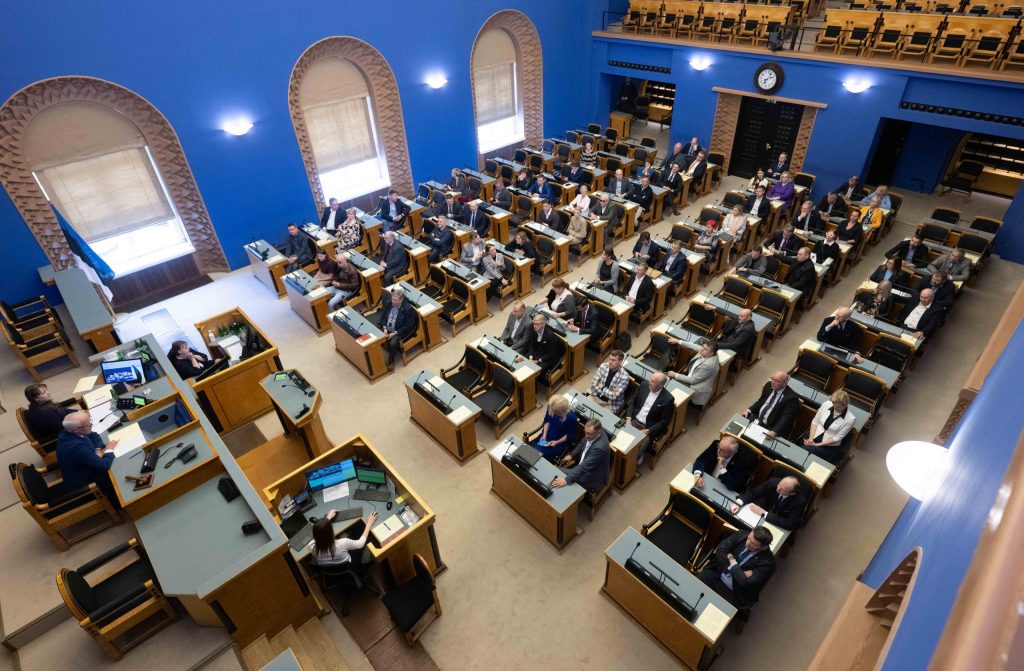
At its sitting today, the Riigikogu discussed six Bills and heard the annual report by the Minister of Culture.
At the beginning of the sitting, new ministers took the oath of office before the Riigikogu and assumed office: Minister of Defence Martin Herem and Minister of Economy and Industry Liina Vahtras.
A Bill passed the second reading
The Bill on Amendments to the Cybersecurity Act (897 SE), initiated by the National Defence Committee, passed the second reading in the Riigikogu. It will specify the terms used in the Act following the transposition of the Network and Information Security Directive 2 as well as the scope of the implementation of security measures for network and information systems.
The Bill will harmonise the terms of the Network and Information Security Directive 2 and the Cybersecurity Act and will provide parties with a clearer understanding of the scope of the Information System Authority’s supervision regarding network and information systems. In addition, the security requirements established by the implementing regulation of the directive will be more clearly linked to the services covered by the implementing regulation.
The European Union’s Network and Information Security Directive 2 transposed into Estonian law aims to harmonize the rules for managing cyber threats and enhance the level of cybersecurity in the EU.
Four Bills passed the first reading
The Bill on Amendments to the Health Insurance Act and the Health Services Organisation Act (referral for psychiatric care, online consultation, and non-specialised doctors) (922 SE), initiated by the Government, passed the first reading in the Riigikogu. It will establish the legal basis for the use of online consultations, introduce a requirement for a referral letter in psychiatry, and specify the framework governing the practice of non-specialised physicians.
The bill will establish a legal framework that will enable online consultation to be used more widely than at present. According to the explanatory memorandum, this will support cooperation among healthcare professionals and enable patients and referring physicians to receive feedback within a set timeframe regarding the need for further treatment or a specialist consultation.
As another amendment, appointments with a psychiatrist will be made on the basis of a referral. While previously a person could consult a psychiatrist directly, in the future the patient’s condition will first be assessed by a family physician or a mental health nurse, and the Health Insurance Fund will cover the cost of a psychiatric consultation only if a referral is present. The aim of the amendment is to provide psychiatric care more quickly to patients who need it most.
In addition, the bill will specify the regulations concerning non-specialized physicians. Under an amendment, non-specialised physicians will not be allowed to perform activities falling within the competence of medical specialists, and healthcare providers will not be allowed to assign such tasks to them. The bill will also simplify reporting by hospitals, as it will remove the obligation to submit separate budget data to the Ministry of Social Affairs that is available in the balance statement of the Ministry of Finance.
Helle-Moonika Helme from the Estonian Conservative People’s Party Group took the floor during the debate.
The Estonian Conservative People’s Party Group moved to reject the Bill at the first reading, but the motion was not supported. Five members of the Riigikogu supported rejection but 43 were against.
The Bill on Amendments to the Law of Obligations Act (895 SE), initiated by the Government, passed its first reading. Its aim is to improve consumer awareness and encourage consumers to make more sustainable consumption decisions. To this end, the requirements for providing pre-contractual information will be amended so that consumers can gain a better understanding of the characteristics of products before making purchase decisions.
The amendments will transpose the requirements of a European Union directive into Estonian law, specifying the obligations of businesses and the rights of consumers with a view to promoting more environmentally friendly consumption. Under the bill, the obligation for businesses to provide consumers with additional information before a contract is concluded will be extended. In future, consumers will have to be informed about the availability of free software updates and the reparability of products.
The reparability score is a score based on EU requirements that indicates how easy it is to repair a product. At present, the obligation to provide a reparability score applies to smartphones and tablets. If a reparability score is not applicable, the business will have to provide information about the availability of spare parts and repair and maintenance instructions and about any potential repair restrictions. Consumers will also have to be provided with information about environmentally friendly delivery methods, where these are offered.
In addition, the bill provides that businesses will have to adopt a harmonised notice and label reminding consumers of their rights in the event of non-conformity of goods. Where a producer offers a commercial guarantee of durability for products, information to this effect will have to be provided to the consumer via harmonised labelling. Shops and online stores display a standard notice regarding consumers’ statutory rights.
Rain Epler from the Estonian Conservative People’s Party Group took the floor during the debate.
The Estonian Conservative People’s Party Group moved to reject the Bill at the first reading, but the motion was not supported. Seven members of the Riigikogu supported rejection but 39 were against.
The Bill on Amendments to the Plant Protection Act (919 SE), initiated by the Government, also passed the first reading. It will introduce more flexible regulations on plant protection training. Under the bill, the primary prerequisite for obtaining a plant protection certificate will not be merely completing plant protection training, but also possessing the relevant knowledge, as evidenced by successfully passing the plant protection training examination.
The bill also provides for the possibility of using plant protection products from unmanned aerial vehicles. The use of plant protection products from airplanes and helicopters remains prohibited but spraying them from drones will be permitted under certain conditions. In addition, the bill will ease the annual training requirement for persons conducting technical inspections of plant protection equipment and make procedural processes more flexible.
The Bill on Amendments to the Veterinary Act and Amendments to Other Associated Acts (918 SE), initiated by the Government, also passed the first reading. It will make the microchipping and registration of dogs, cats, and ferrets mandatory from the middle of next year.
The bill provides that, from 1 June next year, all dogs, cats, and ferrets will have to be microchipped and registered in the national pet register to be established under the Estonian Agricultural Registers and Information Board. The bill will grant current pet owners a transition period until 1 January 2029 to microchip and register their pets.
A statutory fee of 12 euro will apply upon the initial registration of an animal and upon a change of owner; state agencies and shelters will be exempt from this fee. If an animal is microchipped and registered before the amendments come into force, the register data will be automatically transferred to the new register, and the animal owner will incur no additional costs.
A draft Resolution was dropped from the proceedings
The Riigikogu rejected the Draft Resolution of the Riigikogu “Making a proposal to the Government of the Republic to develop legislative amendments to prevent the dissemination of non-consensual and artificially generated images depicting identifiable individuals, and to effectively protect victims” (893 OE), submitted by the Social Democratic Party Group. The draft Resolution called for the Government to draft amendments that would provide a clear, technology-neutral and effective basis for preventing the spreading of non-consensual AI-created revealing or sexually suggestive images, and for better protection of the victims. According to the presenters, it should be ensured that the dissemination of intimate artificial images without a person’s consent is unequivocally prohibited and punishable.
Andre Hanimägi took the floor on behalf of the Social Democratic Party Group in the debate.
18 members of the Riigikogu supported the draft Resolution in the final vote. At least 51 votes would have been needed for the Resolution to be passed.
The Minister of Culture delivered the annual report
The Riigikogu heard this year’s report on the implementation of the long-term national development strategy “Estonia 2035” by Minister of Culture Heidy Purga. Purga gave the parliament an overview of both what had been done last year and future plans. She emphasised that investing in culture, sport and integration was not a non-essential expense for the state that could be put on hold in difficult times; rather, it is an investment in Estonia’s security, people’s health, and the future of the economy.
“Culture shapes our language and identity, as well as our creativity, critical thinking, and ability to understand one another. Sport and physical activity strengthen people’s physical and mental health and, thereby, the resilience of the entire country. A shared cultural and information space has a direct impact on how cohesive our society is and how well we cope with crises,” Purga said. She stated that at the heart of it all were people: cultural workers, creative professionals, group leaders, coaches, teachers, and volunteers. “Culture requires freedom, talent, and dedication, but it also requires wise investments. Without them, culture might not reach people, communities, or future generations.”
According to Purga, Estonia’s strength cannot be measured solely by economic indicators or national defence spending. “The strength of our country is also reflected in whether children have the opportunity to experience culture and be physically active, whether people feel supported within their communities, and whether we share a common language and information space, and mutual trust,” she said.
Purga also stated that a country was not held together solely by borders. “Our country is held together by the stories we tell, the values we share, and the belief that our shared Estonia is worth preserving,” the minister said. She added that, therefore, culture, sport, and integration needed to be viewed not as an expense, but as a prerequisite for Estonia’s enduring survival and progress. “These are not peripheral issues or add-ons for times of convenience—they are choices that determine how cohesive, healthy, and secure Estonia remains, even in more challenging times.”
Mihkel Lees from the Reform Party Group, Vadim Belobrovtsev from the Centre Party Group, Tõnis Lukas from Isamaa Parliamentary Group, Siim Pohlak from the Estonian Conservative People’s Party Group, Riina Sikkut from the Social Democratic Party Group and Kadri Tali from Estonia 200 Parliamentary Group took the floor during the debate.
The sitting ended at 7.31 p.m.
Photos (Erik Peinar / Chancellery of the Riigikogu)
Verbatim record of the sitting (in Estonian)
Video recording will be available to watch later on the Riigikogu YouTube channel.