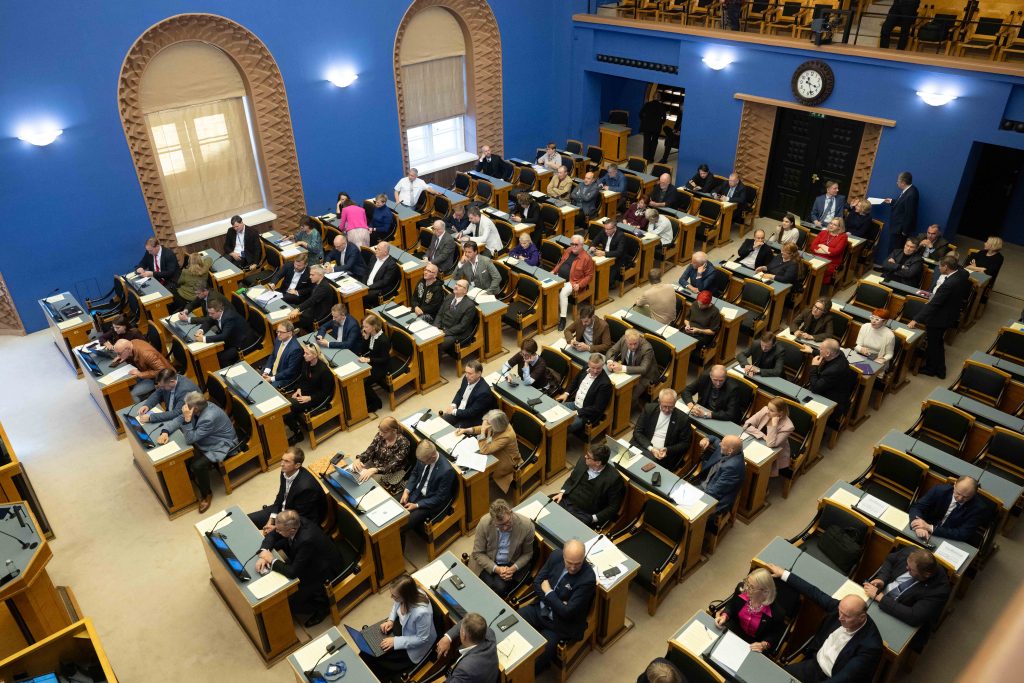
The Riigikogu heard replies to nine interpellations.
Minister of Education and Research Kristina Kallas replied to the interpellation concerning simultaneous educational reforms (No. 1067), submitted by Members of the Riigikogu Tõnis Lukas, Ants Frosch, Priit Sibul, Andres Metsoja, Aivar Kokk, Henn Põlluaas, Lea Danilson-Järg, Jaanus Karilaid, Urmas Reinsalu and Mart Maastik.
The interpellators wished to know whether schools, teachers and students were aware of the information and technical solutions required for the academic year.
Kallas explained that the previous academic year, that is, the 2025–2026 academic year, had been the first academic year in which the compulsory education obligation had come into effect. In other words, the compulsory education obligation came into force for those students who started school on 1 September 2025. This Act was passed in December 2024, so in fact the conditions governing the compulsory education obligation had been known well in advance, even at the time the Act was passed. “So, the compulsory education obligation did not exactly come as a surprise to schools,” the minister said. She added that the exam dates had been confirmed by a regulation of the minister in April 2025, in accordance with the established rule, meaning that the exams for 2026 had been confirmed a year in advance.
Kallas said that decoupling the completion of basic school from exam thresholds had been a major request from heads of schools to which she had eventually agreed, while confirming to them that, in that case, the change would take effect in the middle of the school year. “We set out to amend this regulation and decoupled the completion of basic school from the examination threshold required to receive the graduation certificate. Grades must be positive, but passing the exam threshold is not a condition for being denied a basic school certificate,” the minister explained. She added that the amendments had been established in December 2025. “This was discussed very thoroughly with the schools,” Kallas noted. She admitted that it had been done halfway through the academic year, which was not a very good practice.
Speaking about the compulsory education, Kallas said that there were still no entries in the Estonian Education Information System for 204 students. “There are 204 young people for whom we do not know why they are not in education; they are not enrolled at any school. Local authorities are generally aware of the situation, and we will receive their feedback by 1 November at the latest, when the Ministry of Education will have a clearer picture of the situation,” the minister said.
“Now, 204 children is a significantly smaller number than the 800 children seen last year and the year before that. These were children who did not continue their studies anywhere,” the minister noted. “94 of these 200 children are in the city of Tallinn,” Kallas specified.
According to her, the number of students enrolling in vocational schools has risen significantly. “In other words, while 3,700 students enrolled in vocational education the year before last and 3,600 students last year, this year the figure stands at 3,900. I also predict that the number of people entering vocational education will increase in the coming years,” the minister said.
So, the summary of the first year of the compulsory education reform is that we have managed to get these children into education. Local governments have put a great deal of work into this.
Kallas also spoke about the start time of the school day. “I believe that local governments should be guided by the child’s interests. And it is not in the child’s best interest to start the school day at eight o’clock. Daylight saving time affects a person’s daily rhythm in exactly the same way as the time a child wakes up in the morning affects their rhythm and how they function,” the minister said.
Kallas also replied to the interpellation concerning the future of regional higher education in Estonia (No. 1084).
Minister of Energy and the Environment Erkki Keldo replied to the interpellations concerning the actions of the Environmental Board in the case of the cutting of Leili Mihkelson’s forest, and measures to prevent similar incidents (No. 1059), the obligation to dismantle wind farms, financial guarantees, and the protection of the rights of landowners and their legal successors (No. 1097), the electricity price rise (No. 1003) and the secret sale of oil shale reserves to a private company (No. 1007).
Minister of Justice and Digital Affairs Liisa Pakosta replied to the interpellations concerning the functioning of the legal system and the legal treatment of leaving the scene of an accident in the context of the termination of criminal proceedings concerning fatal road traffic accidents (No. 1093), the excessive workload in the administrative courts and the impact of increased migration pressure on the Estonian judicial system (No. 1094) and lobbying meetings (No. 1063).
Helmen Kütt took the floor during the open microphone session.
Verbatim record of the sitting (in Estonian)
The sitting ended at 10.17 p.m.
Video recording will be available to watch later on the Riigikogu YouTube channel.