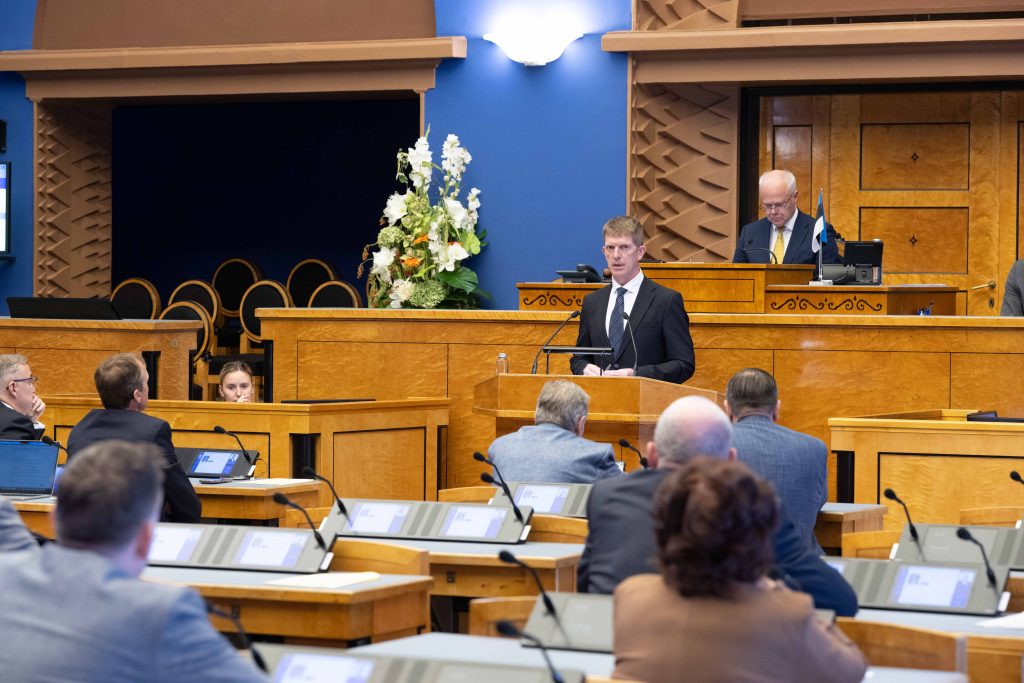
At today’s sitting, the Riigikogu concluded the first reading of eight draft Resolutions concerning the Defence Forces’ missions abroad and three bills relating to business and taxation one of which, among other things, will exempt a large proportion of businesses from mandatory sustainability reporting.
The Draft Resolution of the Riigikogu “Use of the Defence Forces in the Fulfilment of the International Commitments of the Estonian State in the Composition of the North Atlantic Treaty Organization Readiness Units” (1047 OE), submitted by the Government, passed the first reading. It will enable Estonia to contribute with up to 76 servicemen to the composition of the NATO readiness units next year.
The NATO Allied Rapid Reaction Force, which was established after the 2023 Vilnius Summit, is able to conduct not only deterrence and defence activities on land but also operations in the air, at sea and in cyberspace.
Estonia plans to continue contributing to NATO’s readiness units next year with a mine countermeasures vessel, and staff officers. Since the vessel, which is held in readiness as part of Standing Naval Forces, can also be used by the NATO Rapid Reaction Force, if necessary, they will be granted a joint mandate under the draft Resolution. A broader mandate will give Estonia the opportunity to support NATO’s activities more extensively, if necessary.
The Draft Resolution of the Riigikogu “Use of the Defence Forces in the Fulfilment of the International Commitments of the Estonian State in the Composition of the United Kingdom’s Joint Expeditionary Force” (1048 OE), submitted by the Government, passed the first reading. It will enable to contribute with up to 24 servicemen to the composition of the United Kingdom’s Joint Expeditionary Force (JEF) next year.
The JEF is a coalition of ten countries, formed on the initiation of the United Kingdom, which is generally ready to contribute quickly and flexibly to operations ranging from humanitarian crises to conventional warfare. The JEF is capable of operating on its own as well as as part of other larger military units and NATO. The use of the JEF is flexible – activities and operations can be initiated and carried out by all or some Member States under the leadership of the United Kingdom.
Based on a joint decision of countries, the JEF focuses on ensuring security in the Baltic Sea region, the High North, and the Atlantic Ocean region, thereby directly enhancing the defence and deterrence posture in the Baltic states.
The Draft Resolution of the Riigikogu “Extension of the Time Limit for the Use of the Defence Forces in the Fulfilment of the International Commitments of the Estonian State in the European Union Military Operation EUNAVFOR MED IRINI” (1049 OE), submitted by the Government, passed the first reading. It will enable to participate with up to six servicemen in operation EUNAVFOR MED IRINI next year.
The primary aim of the operation is to support the implementation of the UN arms embargo on Libya. This also includes conducting inspections of vessels on the high seas off the coast of Libya suspected to be carrying arms or related material to and from Libya. The operation also supports the implementation of UN measures to prevent the illicit export of petroleum, as well as the capacity building and training of the Libyan Navy and Coast Guard, and the disruption of smuggling and human trafficking networks. The mandate of the operation was expanded last spring and now it also includes ensuring the operational images necessary for the protection of critical undersea infrastructure.
This year, two staff officers from Estonia are participating in the operation, and next year, the country also plans to contribute two servicemen. By participating in the operation, Estonia, in solidarity with other Member States, is contributing to the EU’s Common Security and Defence Policy and to security on the Union’s southern border. Altogether 23 EU countries are participating in the operation this year.
The Draft Resolution of the Riigikogu “Extension of the Time Limit for the Use of the Defence Forces in the Fulfilment of the International Commitments of the Estonian State in the European Union Military Assistance Mission in Mozambique” (1050 OE), submitted by the Government, passed the first reading. It will enable to participate with up to three servicemen in the EU Military Assistance Mission in Mozambique.
The mission was launched in 2021 as a training mission to support the development of the military capability of the Mozambican Armed Forces so that they could independently fight against terrorist groups in Cabo Delgado Province. In autumn 2024, it was restructured into a military assistance mission that advises the national armed forces in organising the training cycle and ensuring its sustainability. The military assistance mission has smaller personnel and focuses more on strategic-level advising so that the country would be capable of training its own rapid response units.
Estonia will fill a position in the field of operations command from September 2025 and plans to continue contributing with one serviceman next year as well. By participating in the mission led by Portugal, Estonia is contributing to meeting the objectives approved in the EU’s Strategic Compass where crisis management plays a significant role. It is also in Estonia’s interest to develop cooperation with strategic allies on the EU’s southern flank. A total of 12 countries are participating in the mission.
Rain Epler took the floor on behalf of the Estonian Conservative People’s Party Group during the debate.
The Draft Resolution of the Riigikogu “Extension of the Time Limit for the Use of the Defence Forces in the Fulfilment of the International Commitments of the Estonian State in the North Atlantic Treaty Organization Mission in Iraq” (1051 OE), submitted by the Government, passed the first reading. It will enable to participate with up to three servicemen in the NATO mission in Iraq next year.
NATO Mission aims to address threats to the Alliance from the south and assists Iraq in building sustainable, transparent, and effective security institutions. In order to enhance Iraq’s capabilities in countering terrorism, preventing Daesh from returning, and stabilizing the country, NATO advises Iraqi security structures and trains Iraqi instructors who provide training within the country’s security structures.
Estonia plans to continue participating in the mission with a staff officer. By participating in operations along NATO’s southern flank, Estonia contributes to ensuring international security and supports the fight against terrorism. All NATO member states, as well as Australia and Austria, are participating in the mission.
The Draft Resolution of the Riigikogu “Extension of the Time Limit for the Use of the Defence Forces in the Fulfilment of the International Commitments of the Estonian State in the Post-Conflict Peacekeeping Operation in Lebanon, Israel, Egypt, Jordan, and Syria” (1052 OE), submitted by the Government, also passed the first reading. It will enable to participate with up to three servicemen in the UN peacekeeping operation UNTSO in the Middle East next year.
UNTSO is the first UN peacekeeping operation to focus purely on observation, and its area of operation includes Egypt, Israel, Jordan, Lebanon and Syria.
This year, Estonia is contributing two servicemen to the operation, and next year it plans to continue with a military observer. Estonia is closely monitoring the developments in the Middle East and the security policy impact of the events there on the stability in the Middle East and other parts of the world. The participation in the operation gives serviceman the opportunity to gain international staff work experience. A total of 30 countries are taking part in the operation.
The Draft Resolution of the Riigikogu “Use of the Defence Forces in the Fulfilment of the International Commitments of the Estonian State in the European Union International Military Operation EUNAVFOR ASPIDES” (1053 OE), submitted by the Government, passed the first reading. It will enable to participate next year with up to three servicemen in the EU military operation in the Red Sea region which has been established to safeguard freedom of navigation.
The purpose of the operation is to achieve naval presence and situational awareness and to ensure freedom of navigation in the Red Sea. The main activities are protecting vessels against attacks and accompanying them within the entire area of operations. Developing the operational image also includes observing the activities of the shadow fleet. The maritime security operation is strictly defensive in nature; in other words, no military attacks are carried out as part of it.
This year, Estonia is participating in the operation with a serviceman who monitors the situation at the operations command centre. Participation in the operation enables Estonia to contribute to the implementation of the EU’s Common Security and Defence Policy, to international security, and to safeguarding freedom of navigation for merchant vessels, as well as to develop international cooperation. A total of 21 EU countries is participating in the operation.
The Draft Resolution of the Riigikogu “Determination of the Maximum Number of Servicemen for Participation in Other International Military Operations in the event of an Urgent Need” (1054 OE) which was submitted by the Government and passed its first reading, will allow the use of up to 100 servicemen in the interest of national security for participation in other international military operations in the event of an urgent need.
The Resolution will ensure Estonia’s capability of deploying units of the Defence Forces to crisis and conflict regions quickly and flexibly where necessary in order to contribute to ensuring international stability and so to also protect Estonia’s security interests. Granting a mandate will enable Estonia to respond more flexibly to rapidly escalating situations that do not fall under other exemptions allowing for a rapid response.
Estonia’s specific contribution will depend on the needs of a specific operation, and the Government will decide it where necessary, taking into account the position of the National Defence Committee of the Riigikogu. The size of the contingent to be deployed on an operation will have to fall within the limit established by the Riigikogu.
The Bill on Amendments to the Accounting Act and the Auditors Activities Act (991 SE), initiated by the Government, passed the first reading. It will transpose a European Union directive and exempt a proportion number of businesses from the obligation to prepare a sustainability report and carry out assurance thereof.
According to the bill, only very large companies with a net turnover exceeding EUR 450 000 000 and an average of more than 1 000 employees will be required to submit a sustainability report. This is estimated to affect around ten companies and consolidated groups in Estonia. The purpose of the amendment is to reduce the administrative burden on undertakings and make the reporting obligation more proportionate.
Small and medium-sized enterprises can, if they wish, continue to prepare sustainability reports based on a voluntary standard. In order to protect smaller businesses within the value chain of large sustainability reporters from an excessive reporting burden, it will be provided that businesses with up to 1,000 employees may be required to provide only the information set out in a voluntary sustainability standard.
The reporting and assurance costs for businesses exempted from this obligation could decrease by up to EUR 30 million in total. The actual savings may be lower if some undertakings continue reporting voluntarily.
In addition, the bill will specify the rules for auditing sustainability reports. In the future, only a person who also holds the professional qualification of a statutory financial auditor can be a statutory sustainability auditor. Since sustainability reporting is closely linked to a company’s financial position and risks, the aim is to ensure better quality of assurance.
The Bill on Amendments to the Investment Funds Act and Other Acts (1043 SE), initiated by the Government, passed the first reading. It will amend the requirements for venture capital and real estate funds, as well as for investment funds aimed at retail investors, and pension funds and simplify the operations of such funds.
Under the bill, management companies will be able to offer a wider range of investment services in the future, and more flexible options will be created for alternative funds, including, among other things, the granting of loans and the use of depositary services. It will not be permitted to grant loans to consumers from a fund’s assets.
New requirements for mitigating liquidity risks will be established for UCITS and other funds that allow for frequent withdrawals. The requirements applicable to pension funds will also be simplified, and the current extensive key information document on the website of the Estonian Funded Pension Registry will be replaced by fund comparison tables, where it will be possible to compare, for example, risk, fees and returns. Key information on pension funds in their new format will become available on 1 May next year.
The Bill on the Ratification of the Convention between the Republic of Estonia and the United Kingdom of Great Britain and Northern Ireland for the Elimination of Double Taxation with respect to Taxes on Income and on Capital and the Prevention of Tax Evasion and Avoidance and its Protocol (1063 SE), initiated by the Government, also passed the first reading. It will provide for the ratification of a new Convention between Estonia and the United Kingdom for the elimination of double taxation and the prevention of tax evasion and avoidance and its protocol.
The convention, signed at the end of August, replaces the tax treaty that has been in force since 1994 and amends the countries’ taxing rights, including the introduction of more favourable income tax rates than before for certain cross-border payments. The rules against the abuse of tax treaties will also be strengthened, and provision will be made for cooperation in the recovery of tax debts.
The purpose of the agreements for the elimination of double taxation is to promote cross-border investment. The convention limits the income taxes that the country of the source of income can establish for the residents of the other country, ensures equal treatment of persons, and eliminates potential double taxation. The obligation of mutual exchange of information creates additional possibilities for prevention of tax evasions. Estonia had agreements for the elimination of double taxation with 66 countries as of the beginning of this September.
Verbatim record of the sitting (in Estonian)
Video recording will be available to watch later on the Riigikogu YouTube channel.