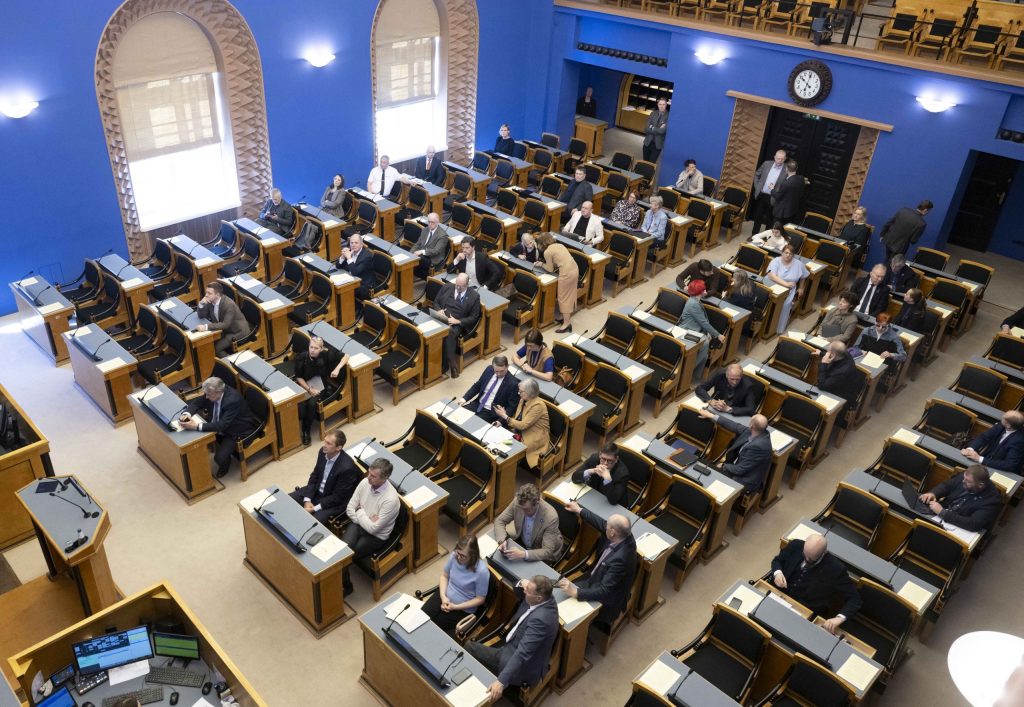
Two Acts were passed
The Act on Amendments to the Aliens Act (specification for sectors with labour shortages) (785 SE), initiated by the Government, will alleviate the shortage of qualified labour which is limiting the competitiveness of Estonian companies and holding back economic growth.
Forecasts by the Estonian labour and skills needs monitoring and forecasting system (OSKA) show that Estonia lacks around 1,400 top specialists and 700 skilled workers every year and this need is not covered by graduates of the Estonian education system. The Act replaces the specification for short-term employment with a specification for sectors with labour shortages which will allow companies to recruit foreign labour more flexibly. In such sectors, no immigration quotas will apply, no permission from the Estonian Unemployment Insurance Fund will be required, and the salary criterion will be set at 80 percent of the average gross monthly salary in Estonia.
The list of sectors experiencing labour shortages will be compiled taking into account OSKA forecasts, the share of exports, and the average wage level in the sectors. According to a preliminary analysis, the greatest need is in the manufacturing industry, and transportation and warehousing, but the list will be updated according to changes in the economic environment, and the government will establish it for up to five years.
In order to maintain a balance between the needs of the labour market and the absorption capacity of society, an annual volume limit is established for residence permits issued on the basis of the specification which depends on the state of the economy: up to 0.2 percent of the permanent population, or approximately 2,600 permits, during growth periods, and up to 0.1 percent of the permanent population, or approximately 1,300 permits, under other circumstances. The assessment of the state of the economy will be based on the Ministry of Finance’s forecast for real GDP growth for the current year.
During the second reading, the Riigikogu made an amendment to the bill that updated the conditions of the specification established for growth companies.
During the debate, Peeter Ernits took the floor on behalf of the Centre Party Group, Arvo Aller on behalf of the Estonian Conservative People’s Party Group, Riina Sikkut on behalf of the Social Democratic Party Group, Õnne Pillak on behalf of the Reform Party Group and Helir-Valdor Seeder on behalf of Isamaa Parliamentary Group.
45 members of the Riigikogu voted in favour of passing the Act and 31 voted against.
The Act on Amendments to the Aliens Act and Other Associated Acts (single permit) (786 SE), initiated by the Government, transposes into Estonian law a European Union directive that regulates the right of residence and work of third-country nationals and ensures equal treatment of foreign workers.
In the future, during the period of validity of a temporary residence permit issued for employment, it will be possible to change employers without applying for a new residence permit, and it will be sufficient for the new employer to register the change of employment with the Police and Border Guard Board. When working for a new employer, the usual employment requirements will apply, such as salary criteria and permission from the Estonian Unemployment Insurance Fund.
In the future, a foreign employee may be unemployed for up to three months if their residence permit has been valid for less than two years, and for up to six months if their residence permit has been valid for at least two years, on the basis of a residence permit issued for employment. In exceptional cases, the period of unemployment may extend to up to nine months. In the event of unemployment lasting more than three months, the person will have to provide evidence of having sufficient financial resources to maintain themselves in Estonia.
According to the Act, aliens staying in Estonia on the basis of a long-term visa are entitled to several social security benefits, such as parental benefit as well as work ability and pension benefits, if they work in Estonia and meet the general eligibility conditions. Family benefits will not extend to foreign workers.
Considering the increase in the number of violations in the employment of foreigners in recent years and the fact that fine rates date back to 2010, the Act also updates the fine rates for legal entities and provides that fines of up to EUR 100,000 may be imposed in cases of significant violations in the future.
During the debate, Martin Helme took the floor on behalf of the Estonian Conservative People’s Party Group and Helir-Valdor Seeder on behalf of Isamaa Parliamentary Group.
41 members of the Riigikogu voted in favour of passing the Act and 21 voted against.
Five interpellations were replied
Minister of the Interior Igor Taro replied to the interpellations concerning traffic supervision (No. 957) and the reduction in the funding of voluntary rescue service and in rescue capacity (No. 965) submitted by members of the Riigikogu.
Minister of Energy and the Environment Andres Sutt replied to the interpellations concerning the blurry trails left in the atmosphere by aircraft (No. 962), the Environmental Board’s working methodology, in which the goal is to break local governments (No. 968) and the crisis resilience of energy infrastructure (No. 974.
The interpellation concerning the costs of CO2 quota in connection with the decisions of Estonia and Italy (No. 937), submitted to Minister of Energy and the Environment Andres Sutt, was removed from the agenda for the day at the request of the interpellators.
The sitting ended at 7.50 p.m.
Verbatim record of the sitting (in Estonian)
Video recording will be available to watch later on the Riigikogu YouTube channel.