At today’s sitting, the Riigikogu passed an Act to lower the voting age for European Parliament elections and issued a statement emphasising the importance of higher education in securing the well-being and future of the people of Estonia.
The Riigikogu passed the Act on Amendments to the European Parliament Election Act (lowering of the voting age and the age for standing as a candidate) (414 SE), initiated by 45 Members of the Riigikogu. It allows young people aged at least 16 to vote and people aged at least 18 to stand as candidates in the European Parliament elections from 2029.
While currently citizens aged at least 18 can vote and people aged at least 21 can stand as candidates in European Parliament elections, the amendment lowers the voting age to 16 and the age for standing as a candidate to 18. Estonian citizens, as well as European Union citizens without Estonian citizenship who have their permanent residence in Estonia, have the right to vote and stand as candidates.
45 members of the Riigikogu initiated the amendment in March 2024 with the aim of involving more young people than before in the discussion and decision-making on European affairs. They pointed out in the explanatory memorandum that, as Estonia’s population was ageing, political engagement and decision-making was increasingly skewed towards the elderly electorate. According to the initiators, the amendment will put youth issues more in the public spotlight, will encourage young people to participate in social life as active citizens, and will help influence European-level decisions concerning young people’s interests, needs, and future.
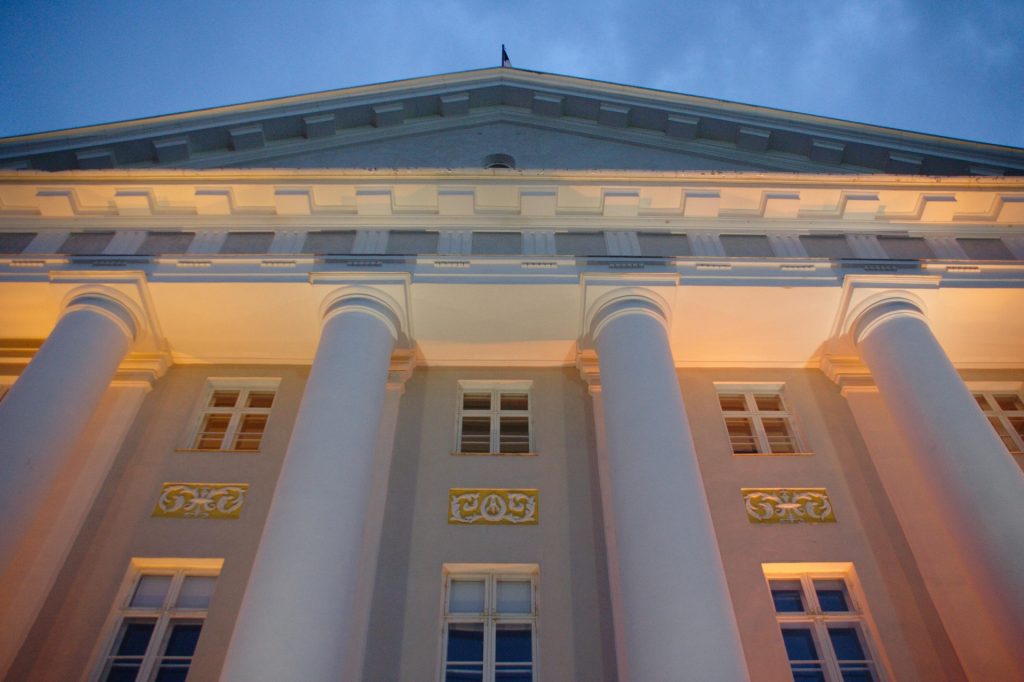
The first reading of the bill took place in May 2024, and it reached the second reading this June. During the proceedings, the Constitutional s Committee discussed the bill in a total of nine meetings, four of which were held in public. In addition to meetings with experts, researchers, and interest groups, the committee commissioned an overview of the lowering of the voting age and its impact in European countries from the Legal and Research Department of the Chancellery of the Riigikogu. The Committee also commissioned a study on the decision-making capacity of young people and the factors that influence it from the University of Tartu through the Foresight Centre.
The Act passed today will be implemented for the first time in the European Parliament elections to be held in 2029. The voting age for local council elections has already been lowered in Estonia and 16- and 17-year-olds have also been able to vote in these elections since 2017.
Hanah Lahe from the Reform Party Group, Ando Kiviberg from Estonia 200 Parliamentary Group, Lauri Laats from the Centre Party Group, Evelin Poolamets from the Estonian Conservative People’s Party Group and Urmas Reinsalu from Isamaa Parliamentary Group took the floor during the debate. Züleyxa Izmailova took the floor on behalf of the Social Democratic Party Group.
59 members of the Riigikogu supported the passing of the Act and 28 were against.
The Riigikogu also passed the Statement of the Riigikogu “In Support of Higher Education” (894 AE), submitted by 23 members of the Riigikogu, which emphasizes the importance of higher education in securing the well-being and future of the people of Estonia.
According to the statement, the Riigikogu holds the view that current and future generations of young people must become the leaders and implementers of a major leap forward in development. “They are the people upon whose shoulders rests the responsibility of sustaining the Estonian state at a time when there are fewer hands to do the work, yet the need for wisdom, skills, and resilience is greater than ever before. Therefore, Estonia must provide them with the best possible educational foundation and an environment that fosters initiative and an entrepreneurial spirit,” the statement reads.
The Riigikogu calls upon both the current and future governments to ensure that the large cohorts of young people reaching higher education age would have at least 1,000 additional tuition-free study places annually in fields critical to a major leap forward in Estonia’s development, starting with the 2027 intake and continuing over several years. It is also called for that the target of 45 per cent of young people attaining higher education be maintained, and that funding for higher education in Estonian continue to be increased in a way that ensures competitive remuneration for teaching staff and improves the quality of higher education.
According to the statement, particular attention is to be paid to increasing the number of doctoral students and to doctoral studies. It also calls to support and promote the integration of new technologies, including artificial intelligence, into the learning process, so that education meets the needs of a rapidly changing world, and to remove barriers to cooperation between higher education institutions, businesses, and public sector organisations, so that knowledge, skills, and innovation can contribute more rapidly to the development of society.
In its statement, the Riigikogu calls for an analysis of the targeting, coverage, and adequacy of the student grant system, and for it to be amended if necessary, so that the opportunity to pursue higher education does not depend on a student’s financial situation. In addition, it calls to ensure the availability of higher education at regional colleges and study facilities.
Tõnis Lukas from Isamaa Parliamentary Group, Margit Sutrop from the Reform Party Group and Kadri Tali from Estonia 200 Parliamentary Group took the floor during the debate.
65 members of the Riigikogu voted in favour of passing the Statement.
Five Bills passed the second reading
The Bill on Amendments to the Weapons Act and the Explosives Act (855 SE), initiated by the Government, passed the second reading. It will update the legal framework governing the possession and handling of weapons in order to strengthen national defence readiness, improve society’s defensive capabilities, and enhance internal security.
The amendments will bring the Weapons Act into line with the European Union’s Firearms Directive and clarify the definitions of weapons and ammunition. The regulation of the handling, storage, use, and supervision of weapons and ammunition will also be streamlined. At the same time, the bill will make the requirements for storing weapons more risk-based, reduce the administrative burden on owners of smaller quantities of weapons, and allow for holding larger stocks of ammunition to increase national defence readiness.
The bill will also specify the rules for the use of weapons and the transport of weapons and ammunition and establish a procedure for notifying of economic activities for shooting ranges and for businesses engaged in the sale of certain weapons. In addition, the regulation of the weapons register will be updated, the validity period of acquisition permits and the deadlines for handling inherited weapons will be extended, and the Police and Border Guard Board will be given more precise discretionary power when revoking permits.
During the second reading, amendments were incorporated into the bill to establish a clear framework for the participation of minors in hunting and shooting sports, and to specify the regulations concerning the right of staff at foreign diplomatic and consular missions to acquire, own, and possess weapons in Estonia.
The amendments also added to the bill a list of paid services—such as the storage of ammunition, the transport of military weapons and ammunition, and the management of a defence industrial park—that the National Centre for Defence Investments can offer to businesses. An opportunity will also be created for entrepreneurs to use the training areas of the Defence Forces and the Defence League for a fee, in order to support the development and production capabilities of defence industry companies.
Non-attached Member of the Riigikogu Henn Põlluaas took the floor during the debate.
The Bill on Amendments to the Law of Obligations Act and Associated Acts (prevention and deterrence of financial fraud) (936 SE), initiated by the Government, passed the second reading. Its purpose is to improve the prevention, detection, and deterrence of financial fraud.
The bill is intended to protect people from falling victim to fraud and to curb fraudsters. In future, banks will have the opportunity to detect fraud before a payment transaction takes place and, in the event of a risk of fraud, to delay the payment. The bank will also be able to refuse to process a transaction if it appears that the money is likely to go to a fraudster. Currently, banks have no legal basis for suspending payments.
Under the bill, banks and payment institutions will be granted the right to exchange information related to suspected fraud with other credit institutions, payment institutions and e-money institutions, the Police and Border Guard Board, and CERT-EE, the Computer Emergency Response Team of the State Information System Authority. The amendments will enable payment service providers to intervene more quickly and cooperate in cases of suspected fraud, helping to reduce losses caused by fraud and enhance the security of the financial system.
During the second reading, amendments were incorporated into the bill with the aim of ensuring the mutual exchange of data between credit providers and credit institutions, which is necessary for detecting and identifying fraud related to the granting of credit.
Non-attached Members of the Riigikogu Peeter Ernits and Maria Jufereva-Skuratovski, as well as Lea Danilson-Järg from Isamaa Parliamentary Group and Riina Sikkut from the Social Democratic Party Parliamentary Group took the floor during the debate.
The Bill on Amendments to the Consular Act and Other Acts (896 SE), initiated by the Government, passed the second reading. Its purpose is to direct the focus of the work of foreign missions to their core functions and to make the provision of consular services more efficient.
According to the bill, the provision of consular services in foreign missions will be discontinued for services for which alternatives exist in the form of online services or direct applications, such as the issuance of driving licenses and official authentications, or which have been used very rarely, such as translation services and the initiation of succession proceedings. This will give foreign missions the opportunity to fulfil their foreign policy responsibilities to a greater extent.
The bill will abolish the requirement for special qualifications for consular officers which previously required a higher education in law and allowed them to perform notarial acts. According to the explanatory memorandum, there are currently seven consular officers with special qualifications working in foreign missions, but they have not performed a single notarial act of attestation in the past two years. In exceptional cases, the possibility of performing acts of attestation at foreign missions remains, for example, if the health of an Estonian citizen does not allow them to leave a foreign country or they are in prison there.
In addition, the bill will bring the statutory fees for consular services into line with actual costs. A higher fee will be imposed on people whose place of residence according to the population register is in Estonia, but who use a service at a foreign mission.
The Bill on Amendments to the Animal Protection Act and the Veterinary Act (899 SE), initiated by the Government, passed its second reading. With a view to protecting animal welfare, it will prohibit the permanent keeping of dogs on chain, and zoophilia, and increase the sanctions provided for violations of the Animal Protection Act.
The Bill will ban the keeping of dogs permanently on chain from 1 January 2027. As an exception, those who have kept their dogs on chain until now and cannot safely let them off the chain may continue this until 2032.
The Bill will establish stricter requirements for animal shelters, which will be subject to an operating license requirement from 2028. Among other things, the Bill will specify what data a shelter will have to provide to a new owner of an animal.
The Bill will also specify the role of a veterinarian in performing euthanasia on an animal and will explicitly prohibit zoophilia and the production and distribution of material depicting it. The Bill will also increase the sanctions provided for violations of the Animal Protection Act.
Aleksandr Tšaplõgin, Andrei Korobeinik and Anastassia Kovalenko-Kõlvart from the Centre Party Group, non-attached Members of the Riigikogu Kalle Grünthal and Peeter Ernits, Anti Allas and Reili Rand from the Social Democratic Party Parliamentary Group and Urmas Kruuse from the Reform Party Parliamentary Group took the floor during the debate.
The Centre Party Parliamentary Group moved to suspend the second reading of the Bill, but the plenary did not support the motion. 13 members of the Riigikogu supported suspension but 52 voted against it.
The Bill on Amendments to § 5 of the Strategic Goods Act (958 SE), initiated by the National Defence Committee, also passed the second reading. Its aim is to permit the transport of anti-personnel mines. The bill will repeal, in connection with withdrawal from the Ottawa Convention, the provision which currently prohibits the transport of anti-personnel mines and the provision of related services in Estonia, except where this is strictly necessary for the purposes of training or mine disposal.
The Riigikogu decided to withdraw from the convention banning anti-personnel mines in June last year, citing the deteriorated security situation, and Estonia’s withdrawal took effect at the end of December last year. Along with Estonia, Finland, Latvia, Lithuania, and Poland also withdrew from the convention, with Finland reportedly planning to launch the production of anti-personnel mines.
The explanatory memorandum to the bill notes that, whilst the intention behind withdrawing from the Convention was to give the Estonian Defence Forces greater flexibility and freedom to select additional weapon systems and solutions to be used where necessary, it cannot be ruled out, for example, that anti-personnel mines might be transported from Finland through Estonian territory to countries in the Baltic Sea region. The explanatory memorandum also draws attention to the fact that the United States—a NATO member with units stationed on Estonian territory—has not acceded to the Ottawa Convention.
Six Bills passed the first reading
The Bill on Amendments to the Maritime Safety Act (987 SE), initiated by the Government, passed the first reading in the Riigikogu. It will amend the regulation of fairway dues.
The bill will establish fairway dues discounts based on the environmental indicators of vessels, in order to encourage the use of environmentally friendly ships and investments in green technologies. The unit price for cruise ships and the upper limit for the fairway dues payable per entry of a ship into a port will be increased in order to align them with the fee rates for other types of vessels.
In addition, the bill will eliminate the exception under which bunkering in an anchorage area was exempt from the payment of fairway dues. As this may be an environmentally hazardous activity, maintaining the exception is not justified. At the same time, the exemption from the fairway dues remains in effect for the bunkering of alternative and renewable fuels.
The Bill on Amendments to the Road Transport Act (971 SE), initiated by the Government, passed its first reading. Its aim is to implement a European Union regulation establishing a framework for the electronic exchange of information between economic operators and competent authorities in relation to the transport of goods.
The amendments will enable freight transport information to be provided and received electronically in order to reduce the use of paper documents and support the digitalisation of the transport and logistics sectors. This is intended to reduce administrative costs, improve enforcement capabilities of competent authorities, and enhance the efficiency and sustainability of transport.
The Bill on Amendments to the Traffic Act (986 SE), initiated by the Government, passed its first reading. Its purpose is to reduce the number of accidents involving personal light electric vehicles.
The Bill will impose on providers of personal light electric vehicle rental and leasing services an obligation to verify the identity, age, and the right to ride of service users in order to prevent minors from accessing vehicles they are not permitted to ride. The Bill will also provide for liability on the part of the owner or possessor of a personal light electric vehicle or a light moped who allows a person who does not have the right to ride or does not meet the established minimum age requirement to ride the vehicle.
According to the Bill, all 10–15-year-old riders of personal light electric vehicles will have to have a cyclist’s licence to ride on all roads. Previously, a cyclist’s license was required only for riding on the carriageway.
Under the current Act, a minimum age of 14 has already been established for riders of light mopeds, and a requirement of a cyclist’s licence has been imposed on 14- and 15-year-old riders of light mopeds. As a new provision, it will be stipulated that if a person does not have the right to ride a bicycle but has the right to ride a moped, they will also be permitted to ride a personal light electric vehicle and a light moped under their right to ride a moped.
In addition, the police will be granted the right to confiscate personal light electric vehicles used in traffic that do not meet the maximum design speed and engine power requirements established for them and are therefore not permitted to be used in traffic.
Mario Kadastik from the Reform Party Group took the floor during the debate.
The Bill on Amendments to the Maritime Safety Act (930 SE), initiated by 13 members of the Riigikogu, passed its first reading. The Bill specifies the misdemeanour procedure competence of the Police and Border Guard Board on navigable waterways.
According to the explanatory memorandum, the current regulations do not allow the Police and Border Guard Board to monitor all requirements to a sufficient extent or to investigate all relevant violations; this has reduced the effectiveness of oversight and caused situations where the detection of a violation is not followed by immediate proceedings. Furthermore, competence is divided between several agencies in a way that does not always ensure sufficient operational efficiency, while the growth in water traffic increases the need for a clearer and more operational oversight system.
According to the initiators, the amendments will not impose new behavioural obligations on participants in water traffic but will specify the division of competence regarding the monitoring of compliance with existing requirements and the handling of violations.
The Bill on Amendments to the Rescue Act and Other Acts (989 SE), initiated by the Government, passed its first reading. The Bill will make it possible to prevent making malicious calls to emergency number, improve the Rescue Board’s ability to support the work of ambulance service, and specify participation in international rescue operations and explosive ordnance disposal.
Nearly 13,000 malicious or hoax calls were made to the Emergency Response Centre last year. According to the Bill, the Emergency Response Centre will be able to place malicious calls on hold if they jeopardise the reception of emergency notifications. In addition, the Bill will allow for the prosecution of individuals who disrupt the work of the Emergency Response Centre.
The Bill will also define the role of the Rescue Board in assisting the ambulance service. At present, it is not sufficiently clear when the Rescue Board may assist the ambulance service, for example in a situation where a crew needs help in opening a door to reach a person in need of assistance. According to the Bill, if necessary, the Rescue Board will be allowed to open a door or gate or remove any other obstacle during an ambulance call.
In addition, the Bill will update the regulation on international rescue operations and explosive ordnance disposal. The legal bases and social guarantees for participation in rescue operations and explosive ordnance disposal will be specified, and a regulation of urgent cross-border cooperation will be provided.
The Bill on Amendments to the Restrictions on Acquisition of Immovables Act and Amendments to Other Associated Acts (990 SE), initiated by the Government, also passed the first reading. It will make it possible to restrict the ability of citizens of Russia and Belarus, companies from those countries, and legal entities under their control to acquire real estate in Estonia.
The aim of the bill is to strengthen Estonia’s national security and reduce the risk of hostile states using real estate located in Estonia for intelligence and influence activities, preparing for sabotage, or establishing strategically important positions. According to the explanatory memorandum, the Russian Federation’s war of aggression against Ukraine has shown that Russia uses all possible means to subdue and influence the opposing side, including the acquisition of real estate.
The bill will grant the government the right to designate countries whose citizens’ or companies’ ownership of real estate may pose a threat to Estonia’s security or public order. This will make it possible to prohibit the acquisition of real estate anywhere in Estonia by citizens of Russia and Belarus who do not hold a long-term residence permit or have the right of permanent residence, by companies registered in those countries and by legal entities in which citizens of those countries are beneficial owners.
At the same time, the option to lease or rent real estate remains and in justified cases the government may grant permission for the acquisition of real estate, provided that the transaction does not undermine the purpose of the restriction. Under the bill, the ban will not be retroactive and will not apply to citizens of Russia and Belarus who hold a long-term residence permit or have the right of permanent residence in Estonia.
Four bills were dropped from the proceedings
The Riigikogu rejected at the first reading the Bill on Amendments to the Constitution of the Republic of Estonia for Changing the Procedure for the Election of the President of the Republic (872 SE), initiated by 24 Members of the Riigikogu. It was intended to introduce direct presidential elections in order to increase the direct participation of Estonian citizens in public life, strengthen the President’s democratic mandate and bring the state and the people closer together.
In the explanatory memorandum, the initiators noted that the current indirect election system had proven complex and dependent on political agreements, whereas direct elections would make the process clearer and more transparent and strengthen the President’s bond with the people. The bill was not intended to change the President’s powers, but only the election procedure.
Martin Helme from the Estonian Conservative People’s Party Group, Vadim Belobrovtsev from the Centre Party Group and Urmas Reinsalu from Isamaa Parliamentary Group took the floor during the debate.
The Constitutional Committee moved to reject the bill at the first reading. 47 members of the Riigikogu supported the rejection, and 27 were against it.
The Riigikogu rejected at the first reading the Bill on Amendments to the Riigikogu Election Act and Other Acts (904 SE), initiated by 22 Members of the Riigikogu. It was intended to define the concept of an election observer organization and to grant such organisations the right to lodge complaints relating to elections with the National Electoral Committee and the Supreme Court in the public interest.
Currently, neither election observers and non-governmental organizations nor voters and candidates have the right to file complaints in the public interest regarding matters related to elections. The bill was intended to define election observer organizations and grant them the right to file complaints in the public interest if they believe that the elections manager or the National Electoral Committee has violated the law or other applicable requirements. According to the initiators, the amendment would provide civil society with better opportunities for overseeing electoral processes.
During the debate, Siim Pohlak took the floor on behalf of the Estonian Conservative People’s Party Group and Jaak Valge spoke on behalf of the Centre Party Group.
The Constitutional Committee moved to reject the bill at the first reading. 44 members of the Riigikogu supported rejection and 22 were against.
The Riigikogu rejected at the first reading the Bill on Amendments to the Government of the Republic Act (942 SE), initiated by the Centre Party Parliamentary Group. It was intended to make the payment of representation expenses to members of the government more transparent and to create a mechanism for verifying that the funds are used for their intended purpose.
According to the initiators, the amendment would enable the public to be satisfied that earmarked funds are not simply treated as a monthly bonus. According to them, this would help to foster a greater sense of justice and ensure greater social cohesion in the country’s difficult financial situation where all sections of the population are expected to contribute in a spirit of solidarity and would also have a positive impact on political culture.
Vadim Belobrovtsev from the Centre Party Group took the floor during the debate.
The Constitutional Committee moved to reject the bill at the first reading. 40 members of the Riigikogu supported the rejection and nine voted against it.
The Riigikogu also rejected at the first reading the Bill on Amendments to the Status of Members of the Riigikogu Act (943 SE), initiated by the Centre Party Parliamentary Group. It was intended to make the payment of salary to members of the Riigikogu partially dependent on their attendance at plenary sittings and committee meetings. It was also intended to make an amendment whereby expense allowances would no longer be paid to members of the Riigikogu on the basis of their salary rate, but on the basis of the remuneration actually paid.
According to the initiators, the bill would help to foster a greater sense of justice and ensure greater social cohesion in the country’s difficult financial situation, where all sections of the population are expected to contribute in a spirit of solidarity and would also have a positive impact on political culture.
Vadim Belobrovtsev from the Centre Party Group took the floor during the debate.
The Constitutional Committee moved to reject the bill at the first reading. 38 members of the Riigikogu supported the rejection, seven were against and there was one abstention.
The sitting ended at 1.02 a.m.
Verbatim record of the sitting (in Estonian)
Video recording will be available to watch later on the Riigikogu YouTube channel.