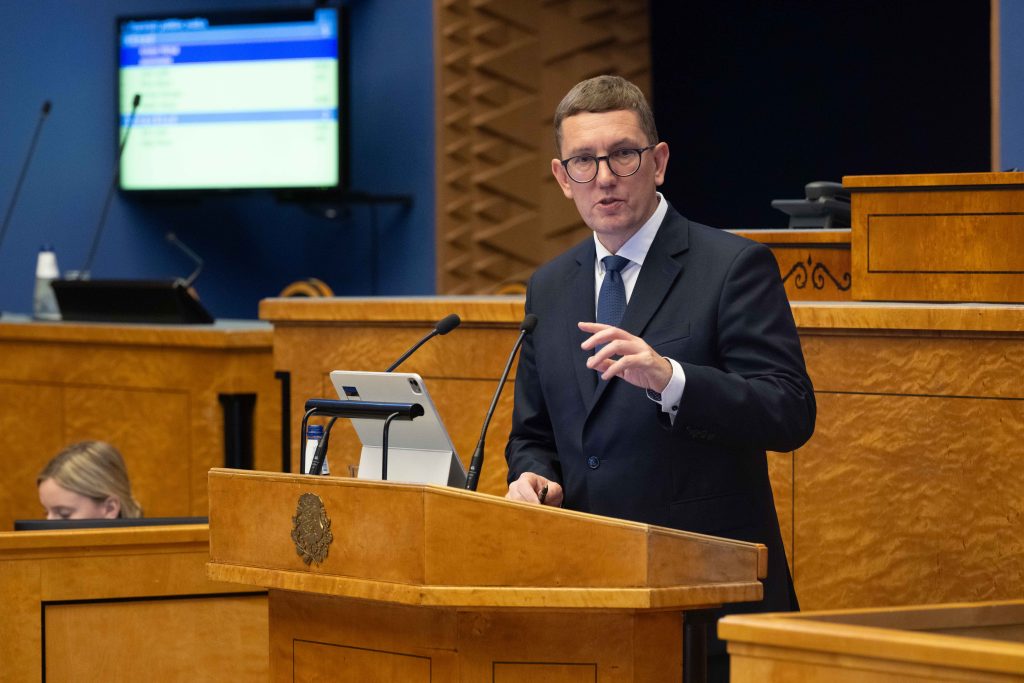
When presenting the budget, Michal said that the government’s aim was to ensure that Estonia was safer, more prosperous and better prepared for the challenges of the future. He stated that next year’s budget was based on six principles: sustainable public finances, strong security, a growing economy, the adoption of new technologies, modern and resilient infrastructure, and good physical and mental health.
“First, we decided to reduce next year’s budget deficit. The initial forecast projected a budget deficit of 4.9 percent of GDP for 2027. The corresponding figure in the summer economic forecast was 4.4 percent. As a result of decisions made by the government, we will bring the deficit down to four percent,” Prime Minister said. He noted that, to achieve this, expenses would need to be cut by an additional approximately €235 million.
According to Michal, the strengthening of security will continue uncompromisingly. “The economy grows in a country whose security is assured,” he said. “If we expect our allies to be prepared to defend Estonia, we must ourselves be prepared to do our part. Therefore, Estonia’s defence spending will remain above five percent of GDP in 2027. It’s a huge effort, but these times call for huge efforts.”
The Prime Minister pointed out that the budget also provided for investment in the economy, education, technology, and infrastructure, so that the future would be more prosperous and offer greater opportunities. “The wage bill for teachers, cultural workers, police officers and rescuers will rise by three per cent next year. The government is allocating a total of over €32 million in the state budget for all salary increases,“ he said.
Extensive investments will be made in infrastructure, and the construction of Rail Baltic will continue. “Our aim is for Rail Baltic to be completed and for trains to start running during the next European Union budget period. Next year, road construction will continue on a larger scale than before the introduction of the vehicle tax. We are channelling an additional nearly €70 million into roads from vehicle tax revenue,” Michal said.
According to the Prime Minister, over €30 million will be invested to boost the adoption of artificial intelligence and new technologies. The budget also focuses on supporting people’s mental and physical health. “We value people, because ultimately the whole point of economic growth and national strength is this: Estonia must be the best place for us to live,” the Prime Minister emphasized.
The total volume of next year’s state budget is €21.3 billion. The volume of budget revenues is €19.4 billion, expenditures approximately €20.2 billion, and investments approximately €1.2 billion.
During the debate, Lauri Laats took the floor to comment on the draft state budget on behalf of the Estonian Centre Party Group, Riina Sikkut on behalf of the Social Democratic Party Group, Urmas Reinsalu on behalf of Isamaa Parliamentary Group, Õnne Pillak on behalf of the Estonian Reform Party Group, Rain Epler on behalf of the Estonian Conservative People’s Party Group and Toomas Uibo on behalf of Estonia 200 Parliamentary Group. Prime Minister Kristen Michal also took the floor.
The Riigikogu concluded the second reading of a Bill
The Bill on Amendments to the Notary Fees Act and Other Acts (941 SE), initiated by Members of the Riigikogu Madis Timpson, Mart Helme, Toomas Uibo, Madis Kallas, Peeter Ernits and Lea Danilson-Järg, will streamline the system of notary fees as a whole, update notary fees which have remained unchanged for years, and abolish the fee for the remote authentication of notarial acts.
The biggest amendment concerns fees for acts related to companies and fees related to real estate transactions. The explanatory memorandum notes that, as fee rates have not been adjusted for years, many notaries find it difficult to cover the costs associated with providing services and maintaining an office. This primarily concerns regions where the value of real estate transactions is lower. The aim of the bill is to create the conditions for notary services to remain regionally available in the future as well.
Under the bill, in the future, notary fees will be, for example, €50 for a power of attorney of a natural person, €120 for a power of attorney of a legal person, €60 for a marital property contract, €55 for a will, €283 for simple succession proceedings, €613 for complex succession proceedings, €503 for highly complex succession proceedings, €250 for the transfer of a share, and €238 for an agreement for the establishment of an easement for road purposes between several neighbours.
The Riigikogu concluded the first reading of a Bill
The Assistant Police Officer Bill (931 SE), initiated by the Government, will establish a new consolidated text of the Assistant Police Officer Act. The bill will develop the assistant police officer system by clarifying and expanding the role of assistant police officers and increasing opportunities to involve them in police work.
Under the bill, assistant police officers will in future be able to assist the police not only in maintaining public order but also in tasks relating to border control, migration monitoring, operations at detention facilities, and support activities. To this end, the training of assistant police officers will become more thorough, systematic, and tiered, and opportunities for specialization will be introduced. In addition, the authority of assistant police officers to employ law enforcement measures in dangerous situations will be expanded.
Alongside the expansion of assistant police officers’ duties and increased training, the regulations governing liability and supervision will become more precise and clearer.
Peeter Ernits took the floor on behalf of the Estonian Centre Party Group during the debate.
The deliberation of three Bills was deferred
The first reading of three Bills – the Bill on Amendments to the Rescue Act and Other Acts (989 SE), initiated by the Government, the Bill on the State’s Second Supplementary Budget for 2026 (1019 SE), initiated by the Government, and the Bill on Amendments to the Medicinal Products Act (917 SE), initiated by the Social Democratic Party Parliamentary Group and Members of the Riigikogu Andre Hanimägi, Tanel Kiik and Züleyxa Izmailova, – was deferred to the agenda for Wednesday’s sitting due to the end of the working hours of the plenary.
Verbatim record of the sitting (in Estonian)
Photos (Erik Peinar / Chancellery of the Riigikogu)
Video recording will be available to watch later on the Riigikogu YouTube channel.