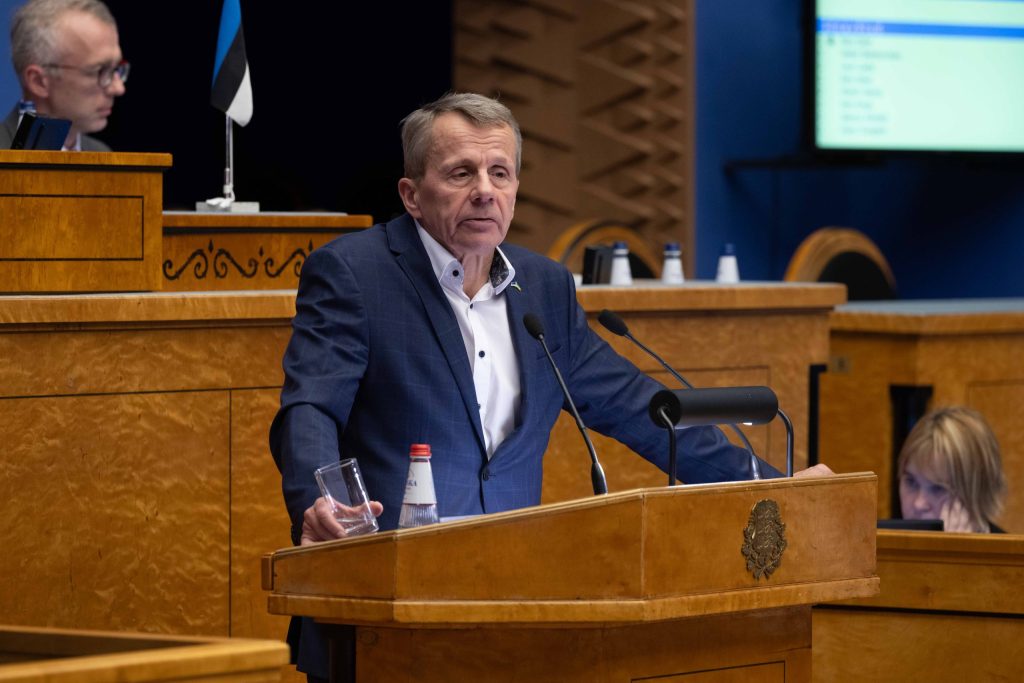
The first reading of the State Budget for 2027 Bill took place at today’s plenary sitting of the Riigikogu. The deliberation of the bill was adjourned due to the end of the working hours of the sitting and will continue tomorrow.
Under the State Budget for 2027 Bill (1037 SE), initiated by the Government, the total volume of next year’s state budget is EUR 21.3 billion. The budget’s revenue volume is EUR 19.4 billion, and expenditure is approximately EUR 20.2 billion, and the volume of investments is approximately EUR 1.2 billion.
Budget deficit will be significantly reduced in the budget which will entail an additional EUR 250 million cut to state expenditure. Estonia’s defence spending will continue to remain above 5 percent of GDP. The 10 percent cut in state expenditure, agreed upon for the years 2025–2027, will also continue. The budget deficit will increase the debt burden for next year by EUR 2.3 billion, to 28.3 percent of GDP.
Economic growth of 2.5 percent is expected for this year, and growth of 2.3 percent for the following year, 2027. The nominal general government budget deficit will decrease by 0.5 percentage points compared to next year’s economic forecast, reaching 4 percent of GDP. Tax burden will decrease to 35.2 percent next year (it was 35.5 percent in 2026 and 36.2 percent in 2025).
The total volume of investments will decrease by 9.6 percent—from EUR 1.3 billion to EUR 1.18 billion— over the year primarily due to the rescheduling of investments between years. The total volume of financing transactions will increase in 2027 compared to the previous year. The comparison also takes into account the 2026 supplementary budget, which increased financing transactions by 9.2 percent, mainly due to a rise in loan liabilities and the disposal of shareholdings.
In terms of economic content, the largest share of expenditure in the 2027 state budget is accounted for by other operating expenditure, amounting to EUR 5.82 billion, and other subsidies, amounting to EUR 5.68 billion.
The breakdown of expenditure by economic content is broadly similar compared to 2026. The share of other operating expenses, social benefits, as well as interest expense and other financial expenses in total expenses will increase by approximately one percentage point. The share of management expenses will increase by approximately 0.2 percentage points. At the same time, the share of other subsidies and labour costs will fall by approximately one percentage point. The share of VAT costs and funds classified as state secrets will remain at approximately the same level.
In 2027, social security contributions will account for 29 percent of the state budget’s revenue, and VAT for nearly a quarter. Income taxes will account for one-fifth, and non-tax revenues will make up about one-seventh.
Expenditures in the state budget are presented according to both their economic content and an activity-based approach.
Andrei Korobeinik (Centre Party), Martin Helme (Estonian Conservative People’s Party), Aivar Kokk (Isamaa) and Riina Sikkut (Social Democratic Party) took the floor on behalf of their parliamentary groups during the debate.
The deliberation of the bill was adjourned due to the end of the working hours of the sitting and will continue tomorrow.
Verbatim record of the sitting (in Estonian)
Video recording will be available to watch later on the Riigikogu YouTube channel.