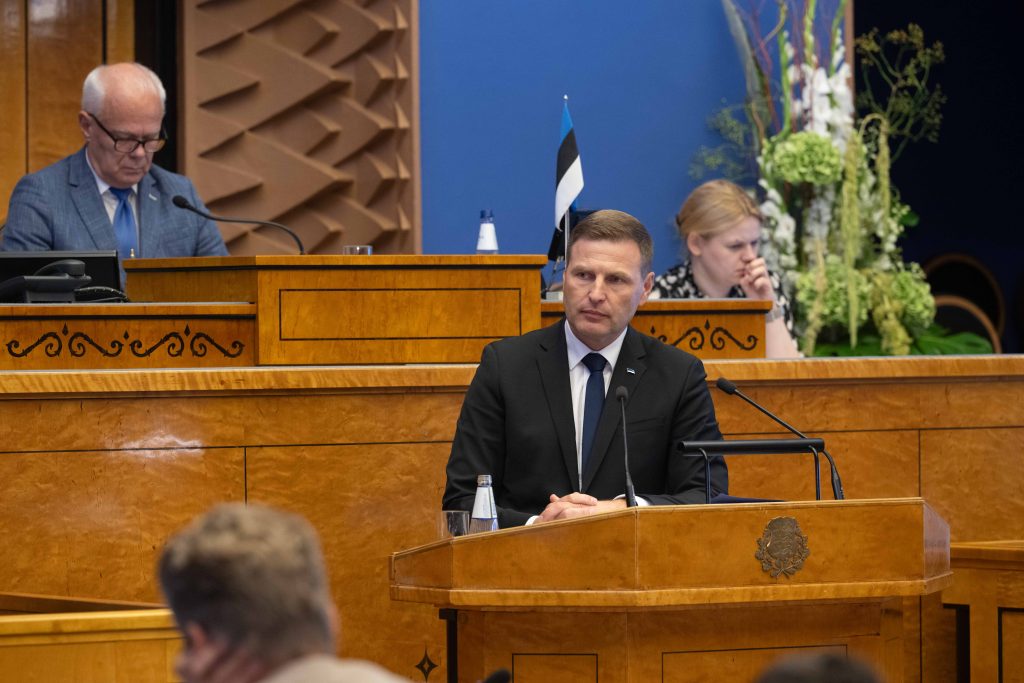
At today’s plenary sitting, the Riigikogu heard a political statement by the Minister of Defence on developments in national defence and concluded the first reading of two bills.
Minister of Defence Hanno Pevkur emphasised that the aim of increased defence spending was to safeguard freedom and peace. “We have decided to direct a portion of this defence expenditure toward supporting Ukraine’s fight for freedom, because we cannot speak of developing Estonia’s defence capabilities without Ukraine,” he said. He pointed out that the most important lesson was that one cannot start preparing for war when the war begins.
“After four years at the Ministry of Defence, I can confidently say: Estonia is stronger, Estonia is better armed, Estonia is better protected, and Estonia has never been as closely linked to its allies as it is now. But we are not ready, because national defence is never finished,” Pevkur said. He outlined how our defence capability had improved over the last four years.
“The last few weeks have been rather turbulent for Estonia’s national defence – and for me personally as well. I decided to take political responsibility and hand over the baton as Minister of Defence. The political heat has been particularly intense in recent weeks, yet I leave with my head held high, knowing that I have contributed my utmost to the development of Estonia’s national defence and to aiding Ukraine,” Pevkur said.
The minister noted that ammunition worth hundreds of millions of euro had been supplied to Ukraine with Estonia’s help. “I believe that with this, we have saved hundreds, if not thousands, of Ukrainian lives. It is regrettable that some companies have failed to fulfil their promises, and I sincerely hope that Datasel itself realises that its actions mean the loss of a Ukrainian defender every single day. “
Pevkur expressed the hope that precisely that realization had prompted Datasel to send a letter to members of both the government and the Riigikogu, affirming its desire to resolve the dispute through negotiations. “If they can also prove it through their actions, that would be very good,” he said. He added that if the European taxpayer or Estonia had been defrauded during the provision of aid, it was up to the prosecutor’s office and investigative bodies to establish that.
Minister of Defence also emphasised that freedom entailed responsibility – for individuals, politicians, civil servants, and the media alike. He stated that it was necessary to distinguish the essential from the non-essential, to set aside populism and the deliberate spreading of Kremlin propaganda regarding national defence, to act like a statesman rather than undermining our unity, and to focus on how to provide greater assistance to Ukraine.
During the debate, Anastassia Kovalenko-Kõlvart took the floor on behalf of the Estonian Centre Party Group, Martin Helme on behalf of the Estonian Conservative People’s Party Group, Urmas Reinsalu on behalf of Isamaa Parliamentary Group and Raimond Kaljulaid on behalf of the Social Democratic Party Parliamentary Group.
The Riigikogu concluded the first reading of two Bills
The Bill on Amendments to the Citizenship Act and Amendments to Other Associated Acts (932 SE), initiated by the Government, provides that, in the future, children born in Estonia to stateless parents will acquire Estonian citizenship through naturalization if at least one of the parents has legally resided in Estonia for at least five years by the time of the child’s birth and the other parent also resides in Estonia on the basis of a residence permit.
Under current law, children born in Estonia to stateless parents remain stateless. The Minister of the Interior said at the sitting that about seven such children were born each year. As a result of the amendment, it will be possible to apply for Estonian citizenship by naturalization for children up to the age of 15, that is, for a total of around one hundred children born over the last 15 years.
The bill also aims to ensure that applicants for Estonian citizenship have a genuine and direct link to the Estonian state, and to verify that they comply with Estonian laws and adhere to its constitutional order. The bill will specify the requirement to reside permanently in Estonia when applying for Estonian citizenship and also specifies the provisions concerning the revocation of Estonian citizenship and the conditions under which a person is deemed to have ceased to be an Estonian citizen.
During the debate, Martin Helme took the floor on behalf of the Estonian Conservative People’s Party Group and Helir-Valdor Seeder on behalf of Isamaa Parliamentary Group. Minister of the Interior Igor Taro also took the floor.
The Estonian Conservative People’s Party Group and Isamaa Parliamentary Group moved to reject the Bill at the first reading. 22 members of the Riigikogu voted in favour of the motion and 61 voted against. Thus, the motion was not supported, and the first reading of the Bill was concluded.
The aim of the Bill on Amendments to the Medicinal Products Act (903 SE), initiated by Member of the Riigikogu Diana Ingerainen, is to improve opportunities for healthcare professionals, including nurses, to access up-to-date and evidence-based information on prescription medicines.
Under the amendment, the Medicinal Products Act will be amended to allow pharmaceutical advertising organized by pharmaceutical companies to be directed at nurses, in addition to physicians, assistant pharmacists, and pharmacists. The amendment will enable pharmaceutical companies to involve nurses in their advertising and public information activities; the role of nurses in advising on the use of medicines and monitoring treatment regimens for patients with chronic conditions has grown significantly in recent years.
The Bill on Amendments to the Higher Education Act (873 SE), initiated by the Estonian Conservative People’s Party Group, was also on the agenda. The first reading was deferred due to the absence of the presenter.
Verbatim record of the sitting (in Estonian)
Photos (Erik Peinar / Chancellery of the Riigikogu)
Video recording will be available to watch later on the Riigikogu YouTube channel.