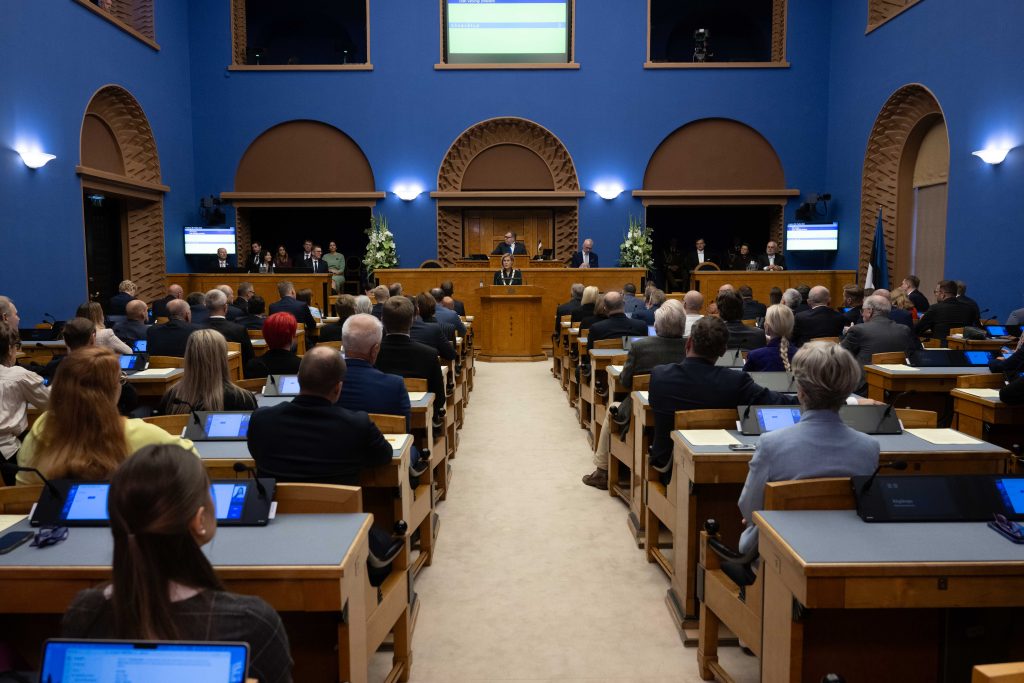
The inauguration ceremony of the President of the Republic, Ülle Madise, took place in the Riigikogu, and responses to six interpellations were heard.
The sitting began with a formal ceremony of the inauguration of the President of the Republic of Estonia, which opened with a speech by President Alar Karis.
President-elect Ülle Madise took the oath of office, after which the chain of office was placed around her neck. Then the new President of Estonia delivered a speech before the Riigikogu.
Following the formal ceremony, the Riigikogu approved the agenda for the work week, under which responses to six interpellations were heard at today’s sitting.
Minister of Infrastructure Kuldar Leis replied to the interpellation concerning the future of Rail Baltic (No. 1030), submitted by Members of the Riigikogu Lauri Laats, Anastassia Kovalenko-Kõlvart, Vadim Belobrovtsev, Aleksei Jevgrafov and Vladimir Arhipov.
The interpellators requested an overview of the timetable and funding for the construction of Rail Baltic.
Leis explained that the basis for reviewing and updating the Rail Baltic construction timetable in Estonia had been laid by the agreement reached at the meeting of the Prime Ministers of the Baltic States on 22 September, according to which Rail Baltic would be completed by 2034, making maximum use of funds from the next European Union budget period.
“Construction work that has already begun in Estonia, including at the Ülemiste joint terminal, will not be halted, and work on the Tallinn–Pärnu main route is continuing as planned over a distance of more than 100 kilometres. However, it is sensible to update the pace and sequence of the subsequent construction phases so as to make maximum use of European Union grants during the next European Union budget period, thereby reducing the disproportionate burden on the state budget, including loan-based financing, and to align the completion of the cross-border rail link with the corresponding pace of construction in Latvia,” Minister of Infrastructure said.
Leis added that the prime ministers of the three Baltic states had agreed that the main Rail Baltica route, as part of the cross-border link, would be opened to traffic during the European Union’s next budgetary period, 2028–2034, whilst adhering as closely as possible to the previously agreed timetable when implementing the construction phases of the various national sections of the route. “Within Estonia, the Tallinn–Rapla–Pärnu link is scheduled for completion by 2032 at the latest, which will enable, for example, public transport services to be provided even before the cross-border link is fully completed,” Leis noted.
According to the minister, based on current knowledge—that is, during the 2027–2030 State Budget Strategy process—the investment requirement for the first phase of Rail Baltic in Estonia totals approximately €3.55 billion. Regarding the 2034 schedule, the consumer price index will be added to it. During November, Rail Baltic Estonia will present new forecast figures based on the year 2034, which will also serve as the basis for planning and applying for funding for the European Union’s new budgetary period. These figures will be updated accordingly during the subsequent state budget procedure and budget strategy process. External funds from the European Union’s next budget period, 2028–2034, in particular the CEF or Connecting Europe Facility, supplemented by revenue from the European Union’s CO₂ trading system and Estonian national co-financing, are envisaged as a key source of funding for the construction.
Leis said that the Rail Baltic timetable, as well as the funding and cross-border risks, were assessed on an ongoing basis. “The risk in question does not exist under the current government, nor does the government deem it appropriate to draft guidelines for future governments regarding specific risk scenarios; this is because, should a risk materialize, each government would make decisions within its remit based on the political considerations and priorities of the governing coalition at that time, as well as the outcomes of consultations with European Union institutions, culminating in relevant discussions and decisions in the Riigikogu,” the minister explained.
Minister of Infrastructure Kuldar Leis also replied to the interpellations concerning the technical specifications and operational resilience of a ferry (No. 993) and infrastructure works on the Tallinn–Tartu railway (No. 1078).
Minister of Social Affairs Karmen Joller replied to the interpellations concerning the lawfulness, proportionality, and supervision of the viewing of health data (No. 1019), the development of the hospital network and Tallinn Hospital (No. 1049),and the reduction of funding for advocacy for people with disabilities (No. 1069).
The interpellation concerning assisted suicide and legal clarity (No. 1060) was excluded from the agenda for the day at the request of the interpellators. It had been submitted to Minister of Social Affairs Karmen Joller.
Helmen Kütt and Madis Kallas took the floor during the open microphone.
Verbatim record of the sitting (in Estonian)
The sitting ended at 8.46 p.m.
Photos (Erik Peinar / Chancellery of the Riigikogu)
Video recording of the sitting will be available to watch later on the Riigikogu YouTube channel.