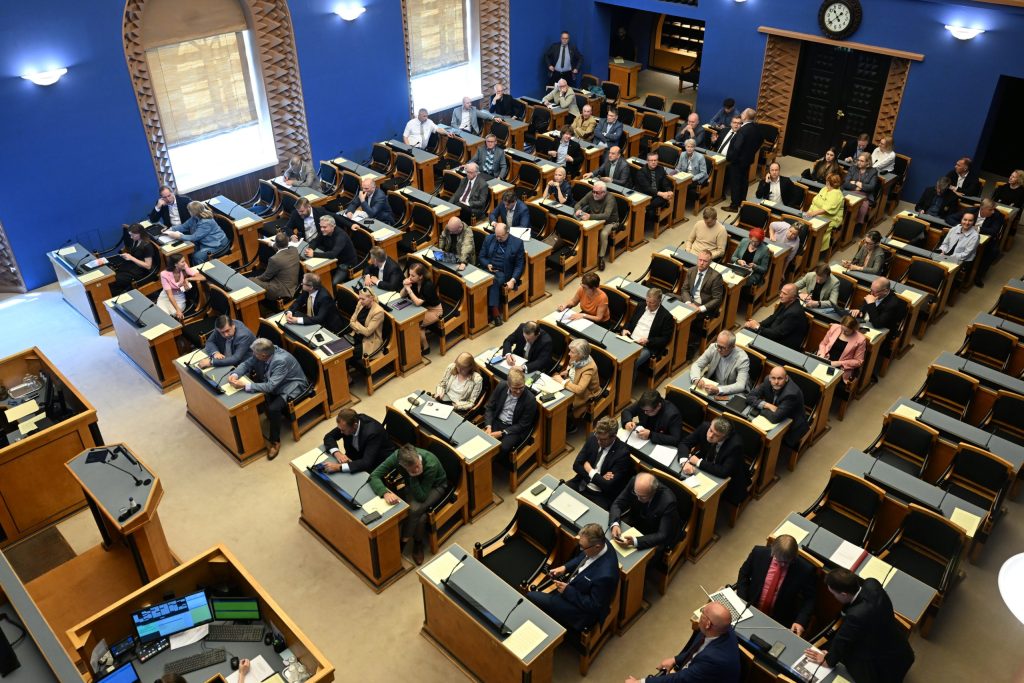
The Riigikogu passed the Crisis Situation and National Defence Act (668 SE), initiated by the Government. Its aim is to increase crisis preparedness by creating a unified legal space. The Act combines three existing Acts on national defence and crisis law—the Emergency Act, the State of Emergency Act and the National Defence Act—into a single whole in order to improve crisis preparedness and the resolution thereof.
The Act increases clarity regarding roles during a crisis, i.e., who does what during a crisis. This way, state agencies, municipalities, critical entities, and other critically important companies will know their role in preparing for and resolving crises. The principle remains that everyone prepares to perform their duties in different crises, and crisis resolution also begins at the same level.
The Prime Minister, as the head of a crisis situation, will intervene in the performance of crisis tasks by agencies if a decision affects the achievement of the goal of resolving the crisis situation or the unity and coordination of the government’s activities in resolving the crisis situation. In terms of military defence, the Defence Forces will have greater freedom of action in the event of an immediate threat, including in order to bring allies to Estonia more quickly.
Local governments are assigned specific crisis tasks. They include ensuring the provision of essential services such as water supply, sewage disposal, district heating, and road maintenance; preparing evacuation sites and supporting evacuation; providing essential social and educational services; and informing local residents.
To increase clarity of roles, the government will create a nationwide crisis plan that will bring together preparations for and resolution of crises, and on the basis of which other agencies will draw up their own plans.
During the proceedings, extensive amendments were introduced into the bill, including amendments to several chapters and provisions, as well as the title and the date of entry into force of the bill. According to an amendment, the Act will enter into force on 1 October instead of 1 July so that the executive branch has time to prepare the necessary implementing acts.
Among other things, the bill was amended to include the responsibilities of the Riigikogu and the President of the Republic, the existing national security concept was transformed into a security strategy, and the composition of the National Defence Council was specified. The procedure for the appointment of the Commander of the Defence Forces will also change: in the future, the appointment of the Commander of the Defence Forces will require the consent—that is, substantive and binding approval—of the National Defence Committee of the Riigikogu, preceded by a presentation by the candidate for Commander of the Defence Forces before the plenary assembly of the Riigikogu. Among other amendments, a separate chapter on the treatment of prisoners of war was included in the bill.
Mati Raidma from the Reform Party Group, Kalev Stoicescu from Estonia 200 Parliamentary Group, Riina Sikkut from the Social Democratic Party Group and Urmas Reinsalu from Isamaa Parliamentary Group took the floor during the debate.
64 members of the Riigikogu voted in favour of passing the Act and 14 voted against.
Annual report by Chief Justice of the Supreme Court
The Chief Justice of the Supreme Court Villu Kõve gave an overview of courts administration, administration of justice and uniform application of Acts in Estonia at today’s sitting. He summed it up as follows: “Independent, impartial, and high-quality administration of justice is guaranteed in Estonia.” He acknowledged however that the burden on the system was growing and that proceedings were taking longer.
According to Kõve, the number of court cases is on an upward trend, “The number of court cases has begun to rise compared to earlier, which has not been the case before.” He added that the situation was not critical, but the trend was still worrying.
Regarding the performance of the courts, he noted that it had declined and cases were piling up, “We can’t resolve as many cases in a year as keep coming up.” Furthermore, the length of proceedings has been increasing for the sixth year running.
Kõve specifically highlighted the high rate of appeals in administrative cases, “This number is nearly 39% in administrative court proceedings. That’s too high a number.” He pointed to the increasing workload in the judicial system.
Regarding the next generation of judges, he described the problem in stark terms, “It must be acknowledged that we do not have as many candidates as there are judicial positions available in the court of first instance.” According to him, the job of a judge is no longer attractive enough, even though the position comes with benefits.
Based on international comparisons, Kõve admitted that the Estonian system may not be as efficient as previously thought, “A seemingly archaic court session in an old, worn-out courthouse can resolve matters much more efficiently and quickly than in our flashy, high-tech digital proceedings.” He cited Norway and Ireland as examples, where a large share of disputes is resolved out of court or through simpler procedural models.
As the main problems, he named the delays in proceedings and the workload of judges, “Judges are often tired and stressed.” He also highlighted the problem of trust between the state and judges, “A deeper concern is that we have a lack of basic trust between the state and judges. “
Kõve emphasized the need to make changes to the system even if they are unpopular, “One must be prepared to make painful and unpopular choices for the sake of a better future.”
Above all, he expects the legislature to make clear decisions and implement reforms, “We are waiting for the Riigikogu to adopt a package of amendments to courts administration and procedure.” He also considered it important to motivate judges and ensure more stable funding for the courts.
In conclusion, the Chief Justice of the Supreme Court noted that reforms were inevitable, “Streamlining the management of courts and concentrating responsibility will be essential in the interests of the entire system.” He called on the Riigikogu to support the development of the judicial system.
Pipi-Liis Siemann from the Reform Party Group and Anti Poolamets from the Estonian Conservative People’s Party Group took the floor during the debate. Peeter Ernits presented a comment on behalf of the Centre Party Group.
Today’s sitting was also attended by the Speaker of the Albanian Parliament, Niko Peleshi, who was greeted with applause by members of the Riigikogu.
Verbatim record of the sitting (in Estonian)
Photos (Erik Peinar / Chancellery of the Riigikogu)
Video recording will be available to watch later on the Riigikogu YouTube channel.