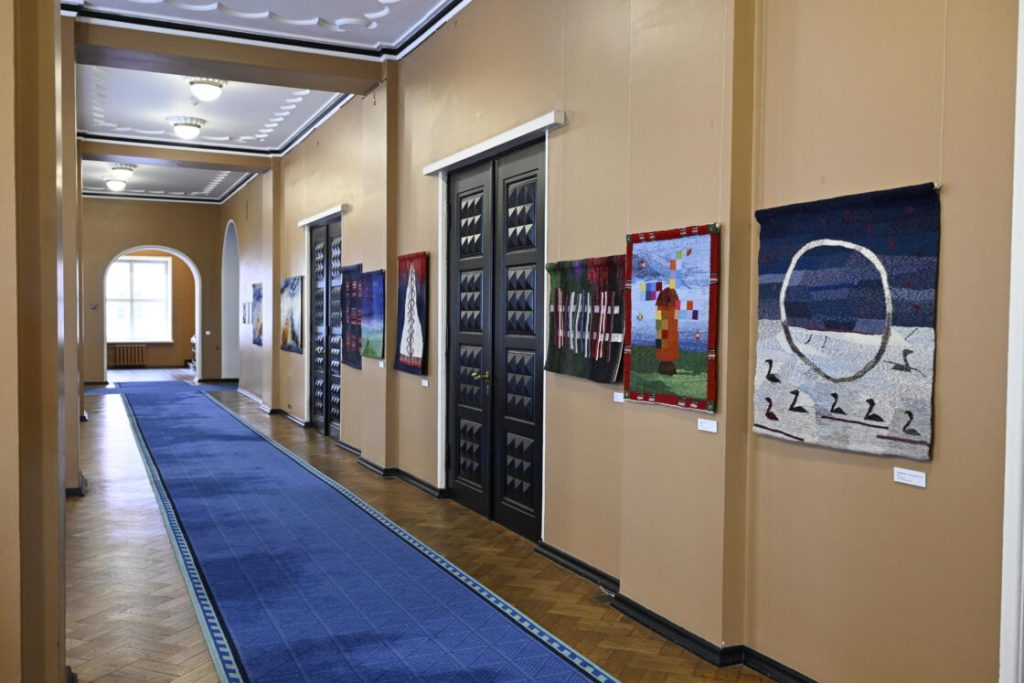
Lauri Hussar believes that on the eve of the anniversary of the restoration of our country’s independence, it is especially meaningful to view works into which the memories, values, and creativity of our nation are woven. “These tapestries tell the stories that have helped Estonia survive and develop. By preserving our heritage and adding new layers to it, we are contributing to ensuring that Estonia’s story continues,” said Hussar.
Plaited tapestry is one of the most distinctive forms of expression in textile heritage and textile art. Its roots reach into traditional Estonian rural culture, where rugs served not only practical purposes but also carried symbolic meanings. In the exhibition, the numerous tapestries, each on which carries its own message, enter into a dialogue with one another. Every life forms a unique pattern, shaped by personal life events, actions, relationships, emotions and thoughts. The same is true of the patterns woven into these tapestries: intertwined colours, shapes and symbols tell stories of home, nature, people and the passage of time.
The tapestry art created by Anu Raud brings together the legacy of Estonian folk art, personal landscapes of memory, and a profound respect for rural life, transforming the tapestries into visual narratives of the continuity of Estonian culture. Her works are distinguished by a rich symbolic language, masterful composition and a remarkable ability to weave everyday objects and traditional motifs into a timeless artistic whole. Anu Raud has been a mentor and an example for an entire generation of textile artists and craftspeople who draw inspiration from national heritage.
Christi Kütt is a lecturer, one of the first graduates of the Estonian native textile programme, and a master tapestry designer. She reinterprets the heritage of traditional Estonian tapestries in a modern style, weaving stories, symbols and personal reflections into her work. Her tapestries are more than just textiles; they are visual expressions of both the wisdom of our ancestors and the worldview of today.
The creators of the tapestries on display are all connected with Viljandi Culture Academy, where the study programme of native textile was opened in 1994 on the initiative of Anu Raud. Later this grew into the Estonian Native Crafts programme. The programme is offered by the centre for the study and development of material cultural heritage, and seeks to preserve, research and creatively advance Estonia’s traditional craft culture, connecting inherited knowledge with the needs of modern life. Students specialising in textile, construction, metalwork or circular technologies can study all main local craft techniques, skills, and materials. From the beginning, the design and weaving of plaited tapestries have formed an integral part of textile studies.
The tapestries are displayed in the Art Gallery of Toompea Castle and on the walls next to the Session Hall of the Riigikogu until 15.10.2026. The exhibition can be visited from Monday to Thursday from 10 a.m. to 4 p.m. Visitors need to present an identity document to enter Toompea Castle. Please let us know in advance if you plan to visit the exhibition by emailing [email protected] or calling +372 631 6300.
Photo gallery of the tapestries and opening of the exhibition (new photos will be added after the opening; photos by Erik Peinar / Chancellery of the Riigikogu)