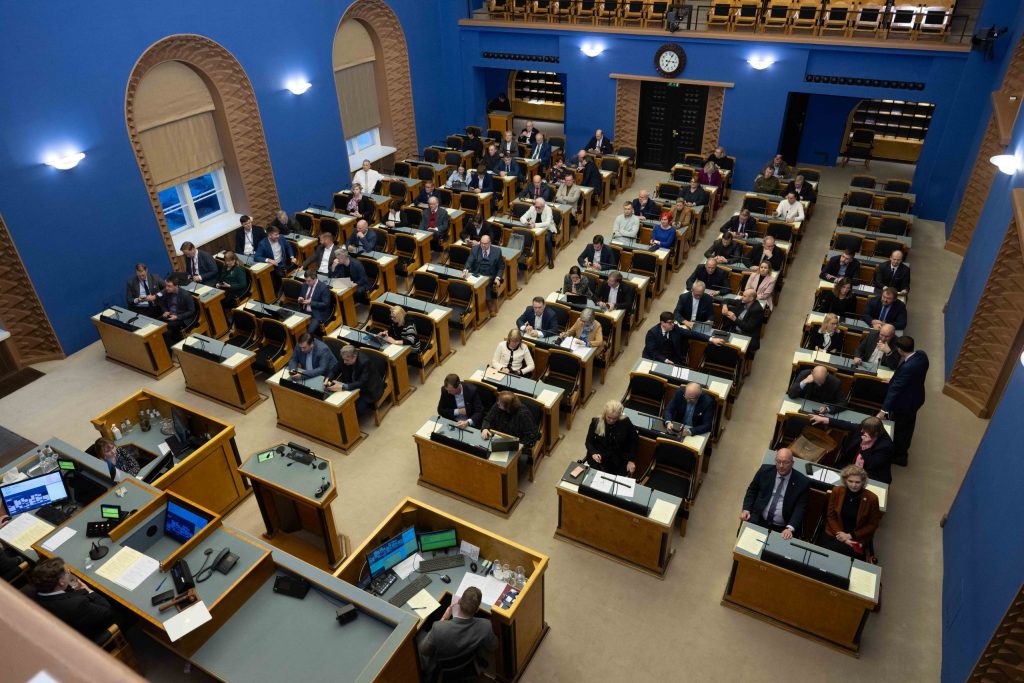
The Act on Amendments to the State Budget Act and the Act on Amendments to the State Budget Act (736 SE), initiated by the Government, implements the renewed framework for fiscal surveillance in the European Union and specifies the role and tasks of the Fiscal Council.
The structure of the annual state budget Act is changed to increase the understandability and transparency of the budget. The breakdown of the state budget is made more comprehensive and the detailed annex to the Act is abolished, with a significant part of it being brought into the main body of the Act. Rules are also provided for the size of the government reserve, and the conditions for granting state loans are specified.
Ministers will also have an obligation to inform the Finance Committee of the Riigikogu of any ongoing budget changes and to provide explanations about them. The conditions for granting subsidies from the state budget and the links between the budgets of local authorities and the state budget are also specified.
According to the Act, the limits of the current general government balance rule will be maintained, which means that the structural deficit can be up to one percent of GDP if the debt level is below 30 percent of GDP, and up to 0.5 percent if the debt level increases above 30 percent.
The Act strengthens the role of the Fiscal Council in overseeing the fiscal framework and planning. The Act also provides for the procedure for implementing, applying for and extending the exemption clause.
It is provided that the 2026 state budget will include both an activity-based and an economic content view and that a view of the consolidated budgets of institutions will be added to it. The requirements for indicators are specified so that in the future it will be easier for the Riigikogu and the public to assess the purposefulness, effectiveness, and efficiency of budgetary expenditures.
Ministers’ rights remain within the limits set by the current State Budget Act, i.e. the right to amend the state budget is limited by the budgets for programme activities.
The Act amends the provisions concerning financial guarantees for local authorities. If, after the start of the fiscal year, the Riigikogu or the government enacts legislation that results in an increase in local government expenditure or a reduction in revenue, the additional expenditure will have to be compensated to the local government, provided that the amendments concern local government tasks. The distribution principles of the equalization fund will be determined in the state budget in the future and will not need to be established in sectoral Acts. In the future, the distribution principles of the support fund will be set out in a Regulation on the support fund instead of the state budget.
The size of the government reserve will be capped at three percent of the total amount of state budget expenditures and investments, and the transfer of unused reserve balance will be discontinued. The Act specifies that the interest rate on a loan granted by the state may not be lower than the rate that the state itself would pay for a similar loan, and a risk margin must be added to this.
The amendments will come into force on 29 December this year and the new budget structure will already apply to the 2026 state budget.
During the debate, Martin Helme took the floor on behalf of the Estonian Conservative People’s Party Group, Lauri Laats on behalf of the Estonian Centre Party Group, Urmas Reinsalu on behalf of Isamaa Parliamentary Group, Riina Sikkut on behalf of the Social Democratic Party Group and Annely Akkermann on behalf of the Estonian Reform Party Group.
53 members of the Riigikogu voted in favour of passing the Act and 33 voted against.
The Riigikogu passed the Act on Amendments to the Securities Market Act (690 SE), initiated by the Government. Its aim is to make the Estonian capital market more attractive to companies and to simplify the raising of capital in the case of small-scale securities issues.
The Act raises the threshold for the obligation to draw up a prospectus from the current EUR 8 million to EUR 12 million. This means that a simpler information document will be sufficient for public offerings of securities of up to EUR 12 million. Issuers are also given greater flexibility in choosing the language of the prospectus, and the regulatory burden on investment service providers is reduced. In addition, the Act creates the possibility for the Financial Supervision Authority to impose fines for market abuse in proportion to the company’s turnover.
79 members of the Riigikogu voted in favour of passing the Act and one was against.
The Riigikogu approved the Act on Amendments to the Names Act and the State Fees Act (719 SE), initiated by the Government. It allows for applications to change first names and surnames to be submitted via the online environment of the population register and, in certain cases, decisions on changing names and entries concerning changing names to be made automatically.
While a person can currently submit an application to change their name either on site at one of the four vital statistics offices or in a digitally signed form, the Act replaces the latter option with submitting an application in a secure online environment. The compliance of data with the conditions established in the legislation will be checked using databases, and if all the prerequisites for changing the name are met a decision will be made and an entry will be made in the population register automatically.
If an automatic decision and entry cannot be made, the application to change the name will be forwarded to an official who will continue the procedure pursuant to the usual procedure. According to the Act, the official will have to make a discretionary decision where, for example, a person wants a first name that has not been previously accepted in the population register or a surname that has not appeared in their family according to the register data.
According to a provision added by the Riigikogu, a person who has been convicted of committing a crime against sexual self-determination against a minor cannot change their name.
73 members of the Riigikogu voted in favour of passing the Act and one was against.
The Act on Amendments to the Gambling Act and Other Acts (728 SE), initiated by 16 Members of the Riigikogu, is intended to increase funding for sports and culture through gambling tax revenues.
The aim of the Act is to update the regulations applicable to gambling and its organization in order to increase the reliability and transparency of the business environment in Estonia. The Act provides that the gambling tax will be reduced in stages by half a percentage point per year from six percent to four percent. According to the initiators, the goal is to design a taxation system where a certain base amount remains in the state budget and additional revenue is generated at the expense of actual market growth.
The explanatory memorandum refers to the report of the Foresight Centre “The Future of Private Funding in the Field of Culture and Sports”, the summary of which states that a tax on remote gambling could generate additional revenue to finance culture and sports. According to a simulation conducted on the basis of market participants’ estimates, tax revenue from remote gambling could multiply by 2029, according to a more optimistic forecast. According to the report, harnessing this potential will require both increasing the country’s capacity in procedural acts and creating an attractive tax rate and design compared to other countries.
Among other things, the Act is intended to correct the definition of remote gambling, raise the age limit for players of gambling games and the amount of the fine applied for violating the Gambling Act, and create possibilities for suspending operating permits for organising gambling and using crypto assets in gambling.
During the procedure, the parliament made amendments to the bill, which, among other things, specify the application for and issue of activity licenses for organising gambling and give the Financial Intelligence Unit the right to obtain reporting data of gambling operators from the Tax and Customs Board in order to exercise risk-based supervision. The amendments will also oblige the Ministry of Finance to conduct an analysis by 1 February 2029 at the latest to assess the achievement of the objective of the Act, its accompanying impact, and the effectiveness of the regulation.
During the debate Anastassia Kovalenko-Kõlvart took the floor on behalf of the Estonian Centre Party Group, Urmas Reinsalu on behalf of Isamaa Parliamentary Group, Riina Sikkut on behalf of the Social Democratic Party Group and Varro Vooglaid on behalf of the Estonian Conservative People’s Party Parliamentary Group.
51 members of the Riigikogu voted in favour of passing the Act and 31 voted against. There was one abstention.
According to the Act on Amendments to the Social Welfare Act and Other Acts (732 SE), initiated by the Government, the remote sign language interpreting service and the speech-to-text reporting service, previously funded by the European Social Fund, are established as public services.
The regulation regarding own contribution to technical aids and regarding the technical aids ensured by care service providers are specified in order to increase legal clarity. According to the explanatory memorandum, the amendments regarding subsistence allowance will make applying for the allowance simpler and fairer. The amendments also include support for families and employment, and fairer and more transparent organisation of compensation for housing cost reimbursement.
The right to establish the rate of the pensioner’s living alone allowance is granted to the minister in charge of the policy sector. The data contents transmitted to the social protection information system are specified for the calculation of the cross-pillar pension. In addition, the rules for distributing social tax are harmonized, ensuring equal treatment for employees with partial or no working capacity as regards pension entitlement.
During the proceedings, the Riigikogu made an amendment to the Bill according to which a person to whom the Social Insurance Board offers a special care service place will have to decide within ten working days whether to accept the place or not, and to notify the Board thereof. An amendment was also made to make it clear how to calculate the subsistence allowance if the applicant or a member of their family is in conscript service during the month in which the subsistence allowance is applied for.
The parliament also included a provision in the Bill according to which the local government may not take into account the small savings of the applicant and his or her family members when determining subsistence allowance, since a small buffer does not equal livelihood. Limits are placed on discretionary decisions in order to harmonize the practice and reduce disputes: the amount of savings may be three times the estimated subsistence minimum published by Statistics Estonia, which is currently EUR 346, for the first member of the family and one and a half times this amount for each subsequent member of the family.
77 members of the Riigikogu voted in favour of passing the Act. There was one abstention.
The Act on Amendments to the Act on Amendments to the Simplified Business Income Taxation Act and the Income Tax Act and the Repeal of the Security Tax, and the Income Tax Act (734 SE), initiated by the Government, cancels the increase in the income tax rate and the business account tax rate planned for 2026 and extends the possibility of making income-tax-free donations and gifts to support Ukraine.
The Act repeals legislative amendments that have not yet entered into force which would have raised the income tax rate from 22% to 24% and the tax rate on the corporate income received in a business account from 20% to 22% from the beginning of the new year. According to the explanatory memorandum to the Act, the tax rate increases are abandoned in order to keep the tax burden at a moderate level, stimulate economic growth and domestic consumption, and facilitate people’s livelihoods.
In order to continue supporting Ukraine, the special tax exemption regime for donations to eight charitable associations will be extended for two years, that is, until 31 December 2027. According to the Act, resident legal entities can make income-tax-free donations and gifts to support Ukraine to NPO Estonian Refugee Council, NPO Mondo, the Ukrainian Cultural Centre, the National Defence Promotion Foundation, the Estonian Red Cross, the Estonian Rescue Association, NPO Tallinn Old Town Rotary Club, and NGO Freedom Convoy.
During the debate, Lauri Läänemets took the floor on behalf of the Social Democratic Party Group, Aivar Sõerd on behalf of the Estonian Reform Party Group, Rain Epler on behalf of the Estonian Conservative People’s Party Group, Aivar Kokk on behalf of Isamaa Parliamentary Group and Lauri Laats on behalf of the Estonian Centre Party Parliamentary Group.
70 members of the Riigikogu voted in favour of passing the Act and 14 voted against.
The Riigikogu also passed the Act on the State’s Supplementary Budget for 2025 (733 SE), initiated by the Government. It reduces this year’s state budget expenditure by EUR 19.9 million and investments by 12 million, while increasing financing transactions by 72.3 million.
The reduction in costs and investments is primarily related to decisions made in the state budget strategy process. In addition, the Act increases the budget of the area of government of the Ministry of Defence by 39 million for both assistance to Ukraine and defence-related procurements. In financing transactions, the share capital of Elering is increased by 45 million in the area of government of the Ministry of Climate. In the area of government of the Ministry of Economic Affairs and Communications, EUR 27.3 million is transferred from research and development and innovation expenses to financing transactions in order to provide innovation loans to companies.
According to the state budget adopted last December, this year the state revenues will amount to EUR 17.7 billion, expenditure to 18.2 billion, investments to 873 million and financing transactions to 679 million. In June this year, the Riigikogu adopted a supplementary budget increasing revenues, expenditures, and investments in order to support the strengthening of comprehensive national defence.
Aivar Kokk took the floor on behalf of Isamaa Parliamentary Group during the debate.
49 members of the Riigikogu voted in favour of passing the Act and 17 voted against.
The Riigikogu approved the Resolution of the Riigikogu “Approval of the 2024 Consolidated Report of the State” (720 OE), submitted by the Government.
The report approved gives an overview of the achievement of the goals of the state budget, and of the financial position, financial performance and cash flow of the state in 2024. The consolidated report provides the Government with the opportunity to explain its activities during the accounting year and submit the necessary information to the Riigikogu for making new budgetary decisions. It provides the Riigikogu with the opportunity to audit the activities of the Government. The consolidated annual report of the state includes the audit report of the National Audit Office.
According to the data of the consolidated annual accounts of the state, the state had EUR 26.7 billion worth of assets as at the end of 2024 and the assets increased by EUR 2.6 billion over the year. At the same time, the consolidated liabilities of the state amounted to 20.78 billion euro which is 2.33 billion euro more than the year before.
49 members of the Riigikogu voted in favour of passing the Resolution and 12 voted against.
Four Bills passed the second reading
The main aim of the Bill on Amendments to the Waste Act and Amendments to Other Associated Acts (657 SE), initiated by the Government, is to increase the use of secondary raw materials contained in municipal waste. The amendments will create the conditions for timely achievement of the recycling targets established in the European Union.
The bill will increase the responsibility of local governments in organizing waste management. A specific performance indicator will be set for local governments – a target for separate collection of municipal waste. The organisation of waste transport and the ordering of the waste handling service will be changed. The collection of paper and cardboard packaging will also be combined with the collection of waste paper.
The Bill will specify the principles for the formation of the waste transport fee and make them clearer to ensure transparent and stable financing of the sector. It is provided that local governments will be able to collect the waste transport fee themselves and a certain portion of the fee will be used to cover waste management costs. This portion may be up to 50 percent of the waste transport fee. The fee can only be used for the organization and development of waste management.
The gradual increase in the amount of separately collected and recycled waste will enable the development of the recycling industry in Estonia, as ensuring high-quality waste streams and stable separate collection is an important prerequisite for making investments and developing the industry.
During the proceedings, aspects of the Bill concerning reporting on waste were specified and simplified. For example, a provision was included in the Bill according to which, when registering waste collection, in order to reduce the administrative burden, information on the quantities of waste handled would have to be submitted in a summarized form, distinguishing only between non-hazardous and hazardous waste, and no longer by types of waste.
Lauri Laats from the Estonian Centre Party Group, Mart Maastik, Urmas Reinsalu and Aivar Kokk from Isamaa Parliamentary Group, Rain Epler and Arvo Aller from the Estonian Conservative People’s Party Group and Yoko Alender from the Estonian Reform Party Parliamentary Group took the floor during the debate. Non-attached Member of the Riigikogu Peeter Ernits also participated in the debate.
The Estonian Conservative People’s Party Group, Isamaa Parliamentary Group and the Estonian Centre Party Group moved to suspend the second reading of the Bill. 13 members of the Riigikogu voted in favour of the motion and 51 voted against. Thus, the motion was not supported, and the second reading of the Bill was concluded.
The Bill on Amendments to the Penal Code and the Code of Criminal Procedure (695 SE), initiated by the Government, will bring Estonian law into line with four European Union directives in respect of which the European Commission has initiated infringement proceedings against Estonia.
Among other things, the Bill highlights more clearly the exceptional nature of the grounds for refusal to provide information on the deprivation of liberty of a person, includes in the Act the right of a minor suspect or accused person to receive information about the general course of the proceedings, and provides for more frequent mandatory verification of the justifiability of committal in custody in cases where a person is accused of committing a crime as a minor.
During the proceedings, the provision concerning the possibilities for postponing notification of committal in custody was narrowed. A suspect or accused person has the right to notify a person of their choice of their committal in custody. According to an amendment made to the bill, notification can only be delayed if this is necessary to prevent significant harm to the criminal proceedings. The original text of the Bill was broader and provided that notification could also be postponed in the interests of preventing a crime or establishing the truth in criminal proceedings.
The Bill on Amendments to the Public Transport Act (725 SE), initiated by the Government, will amend the procedure for keeping records of service provider cards in the public transport register. The aim of the Bill is to consolidate economic activity data subject to special requirements into a single register in order to ensure more efficient data management, reduce administrative costs and increase security.
Currently, service provider cards can be applied for and processed in the register of economic activities, but physical cards are issued, managed, and published in the public transport register. Such fragmentation increases the administrative burden on the state and businesses. In addition, the public transport register is an outdated and poorly maintained system, which means that hosting data in this environment poses serious security risks, and other Transport Administration systems located in the same cluster are also at risk.
Therefore, the current practice of displaying service provider cards to the public will be discontinued, and the application for the cards, the issuance of the cards, and record-keeping will be transferred to the register of economic activities. This will reduce duplicate management of registers, improve data security, and simplify administration for both the state and businesses.
At the second reading, the Riigikogu decided to make amendments to the bill regarding the provision of a photo on a taxi driver’s service card. The original Bill had provided that, in future, service cards would no longer need to include a photo of the driver. The lead committee had found that a photo was necessary and had included a provision in the Bill according to which the issuer of a service provider card may make a query to the identity documents database and obtain a photo for inclusion on the service provider card digitally via X-Road.
The Bill on Amendments to the Cybersecurity Act and Other Acts (Transposition of the Network and Information Security Directive 2) (739 SE), initiated by the Government, will transpose into Estonian law the Network and Information Security Directive 2 which aims to harmonize the rules for managing cyber threats and enhance the level of cybersecurity in the EU.
According to the explanatory memorandum, the transposition of the directive will increase the number of entities subject to cybersecurity requirements in Estonia by approximately 3,000, to 6,500. The entities subject to the requirements will have to implement security measures and to notify the supervisory authority of any cyber incidents with a significant impact. According to the explanatory memorandum, the harmonization of the requirements will enhance the level of cybersecurity for organizations important to society and the economy and improve the competitiveness of businesses.
In addition, the Bill will designate the Information System Authority as the competent authority, whose tasks will include the supervision of the cybersecurity of electricity networks on the basis of a European Commission regulation.
During the second reading, the Riigikogu specified the definitions related to supervision in the Bill so that they would be clearly defined and unambiguous. The bill was also amended to enable the government to take into account the importance of a company’s field of activity when implementing security measures.
A Bill passed the first reading
The aim of the Bill on Amendments to the Permanently Inhabited Small Islands Act (685 SE), initiated by nine members of the Riigikogu, is to grant the status of a permanently inhabited small island to small islands where at least one person permanently resides.
According to the current Act, a permanently inhabited small island has at least five inhabitants. In the opinion of the initiators of the bill, this results in unequal treatment of those living on small islands with fewer than five permanent inhabitants. According to the initiators, the amendment would also help prevent fictitious registrations on small islands.
In addition, according to the initiators of the bill, it would help to ensure that, on small islands, the general assembly could always be convened within a reasonable period of time and that it would have a quorum. The explanatory memorandum explains that more people have registered on the islands than actually reside there permanently, which makes it difficult to convene a general assembly that would have a quorum as at least half of the permanent inhabitants must be present.
According to the bill, the island governor would have the right to convene a new meeting with the same agenda in seven days if the required quorum is not present. There would be no quorum requirement of 50% participation in a repeat meeting.
Three drafts were dropped from the proceedings
The Riigikogu rejected at the first reading the Bill on Amendments to the Code of Criminal Procedure (731 SE), initiated by Isamaa Parliamentary Group. It was intended to establish that authorisations to forgo notification of the conduct of covert operations would be issued by a pre-trial investigation judge instead of a prosecutor. According to the initiators, the amendment would strengthen the credibility of the procedure for issuing surveillance permits and its compliance with the principles of administration of justice and would help to increase public confidence in the fairness and transparency of criminal proceedings.
According to the initiators, the relevant permits are currently issued by the prosecutor who is also the representative of the prosecution in criminal proceedings. This may raise doubts about their impartiality as they may wish to use the results of surveillance to support the prosecution. According to the initiators, however, the pre-trial investigation judge is presumed to be an impartial party to the proceedings who has no conflict of interest.
The lead committee moved to reject the Bill at the first reading. 49 members of the Riigikogu supported the rejection and 27 were against it. Thus, the Bill was dropped from the legislative proceedings.
Parliament also rejected the Draft Resolution of the Riigikogu “Making a Proposal to the Government of the Republic” (738 OE), submitted by the Social Democratic Party Group. It was intended to make a proposal to the Government to develop support measures to support the pork sector.
The explanatory memorandum pointed out that African swine fever had put the pork sector under severe pressure and put its future at risk. According to the proposers, the sector needs information on what measures the government intends to implement and when. It was noted that decisions would need to be made quickly, as without state support, businesses would have to make difficult decisions about whether to continue or cease production.
As support measures, the proposers asked to consider the creation of a crisis fund, the creation of subsidies for the restoration of production potential and labour costs, as well as the containment of the wild boar population and the detection of African swine fever in wild boars, and the increase of biosafety.
At the final vote, 21 members of the Riigikogu supported the draft Resolution. A majority of the votes of the members of the Riigikogu, that is, at least 51 votes in favour would have been needed for the Resolution to be passed. Therefore, the draft Resolution did not receive the support needed to be passed and was dropped from the proceedings of the Riigikogu.
The purpose of the Bill on Amendments to the Status of Members of the Riigikogu Act (673 SE), initiated by the Estonian Centre Party Group, was to link the payment of remuneration and allowances to members of the Riigikogu to their participation in plenary sittings and committee meetings.
According to the bill, the salary of a member of the Riigikogu should have been reduced if he or she attended less than 85 percent of the plenary sittings and meetings of the committees of which he or she is a member. The bill was intended to provide that if a member of parliament attends fewer sittings, their salary would be reduced by 15%; if their attendance falls below 70%, their salary would be reduced by 30%; and if their attendance falls below 50%, their salary would be reduced by 50%. Similarly, their expense allowances would also decrease based on their participation in work.
According to the bill, the minutes of the votes in plenary sessions and committees would have been the basis for calculating participation in work. At the same time, justified absences would have been permitted and the Board of the Riigikogu would have decided on them.
Vadim Belobrovtsev took the floor on behalf of the Estonian Centre Party Group during the debate.
The lead committee moved to reject the Bill at the first reading. 38 members of the Riigikogu voted in favour of the motion and seven voted against. Thus, the motion was supported, and the Bill was dropped from the legislative proceedings.
The sitting ended at 9.08 p.m.
Verbatim record of the sitting (in Estonian)
Video recording will be available to watch later on the Riigikogu YouTube channel.