Skip

Committees

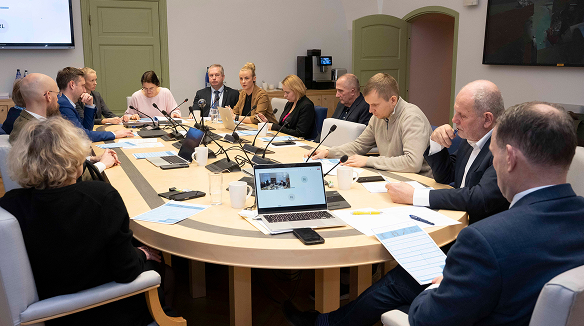
A large part of the work of the Riigikogu takes place in committees. The standing committees cover state matters in their fields of specialisation, and their main task is discussing and preparing Bills. Select committees are formed to perform specific functions. If an issue of significant importance needs solving, a committee of investigation or a study committee is formed.

Standing committees

There are 11 Standing committees in Riigikogu. Each standing committee deals with the Bills of a specific field. Until 2004 the Riigikogu had ten standing committees. When Estonia joined the European Union in 2004, it got one more standing committee – the European Union Affairs Committee.

European Union Affairs Committee

The European Union Affairs Committee has a deciding and coordinating role in working with the issues of the European Union in the Riigikogu.

Environment Committee

The Environment Committee works with draft legislation on environmental policy, environmental protection, the use of natural resources and conservation.

Cultural Affairs Committee

The Cultural Affairs Committee works with draft legislation on education and culture.

Rural Affairs Committee

The Rural Affairs Committee works with rural and agricultural policy.

Economic Affairs Committee

The Economic Affairs Committee directs legislative work and supervises the activities of the Government in fields that are connected to economy, or directly influence it.

Constitutional Committee

The Constitutional Committee discusses the protection of fundamental rights in general and proceeds draft legislation on constitutional institutions.

Finance Committee

The Finance Committee works with draft legislation on finance policy, such as the state budget, taxation and banking.

National Defence Committee

The National Defence Committee works with draft legislation that regulates national security and defence.

Social Affairs Committee

The Social Affairs Committee works with draft legislation dealing with labour, social welfare, social security and health care.

Foreign Affairs Committee

The Foreign Affairs Committee participates in the shaping of the foreign policy and the development of the principles of the foreign relations of Estonia, and monitors the foreign policy activities of the Government.

Legal Affairs Committee

The work of the Legal Affairs Committee includes legislative drafts regulating private law, criminal law and internal security.
Select committees, committees of investigation and study committees

Select committees, committees of investigation and study committees are formed to perform specific functions. These committees do not discuss Bills and their term of office may be shorter than that of the Riigikogu. You can learn more about the work of the Riigikogu Anti-Corruption Select Committee.

A Resolution of the Riigikogu sets out the composition of these committees, including an alternate member for each committee member, and the functions and the procedure for reporting on the activities of the committee. A member of the Riigikogu may be a member of a select committee, committee of investigation or study committee, but unlike being a member of a standing committee, this is not mandatory.

Select committees

The Riigikogu forms a select committee in order to perform functions arising from Acts or international agreements. During all the Riigikogu terms, the Security Authorities Surveillance Select Committee has existed as a select committee, with the aim to supervise the lawfulness of the security police and surveillance activities.

Committees of investigation

A committee of investigation is formed in order to investigate the circumstances relating to a matter of public interest. A committee of investigation presents an interim report on its activities at least once a year and hands its final report to the Riigikogu upon the termination of its activities.

The 15th Riigikogu formed the Committee of Investigation to investigate the influence activities of the Russian Federation, the methods of financing them, and the risks associated with them.

Study committees

A study committee may be formed to analyse a problem of significant importance. Examples of this are the Study Committee on the Development of Estonian Language Instruction and the Study Committee to Solve the Demographic Crisis that were formed by the 14th Riigikogu.

What is the role of the chairman of a committee?

  • Chairs the sittings of the committee;
  • Represents the committee and directs and organises its work;
  • Submits the working plan and draft agenda of the committee sittings;
  • Decides who is invited to the discussion of the items on the agenda;
  • Decides whether to invite representatives of state agencies and other persons to take part in committee sittings.

In the absence of the chairman, these duties are performed by the deputy chairman. Members of the Government of the Republic have the right to participate in committee sittings with the right to speak.

Members of the Riigikogu in Committees

Each member of the Riigikogu is a member of one standing committee.

The exception is the European Union Affairs Committee, which includes members from all other standing committees. Only the President and Vice-Presidents of the Riigikogu are not members of any committee.

Seats in standing committees are distributed by the Board of the Riigikogu between the parliamentary groups according to their size. The larger the parliamentary group, the more seats they receive. The parliamentary groups themselves decide who will work in which committee.