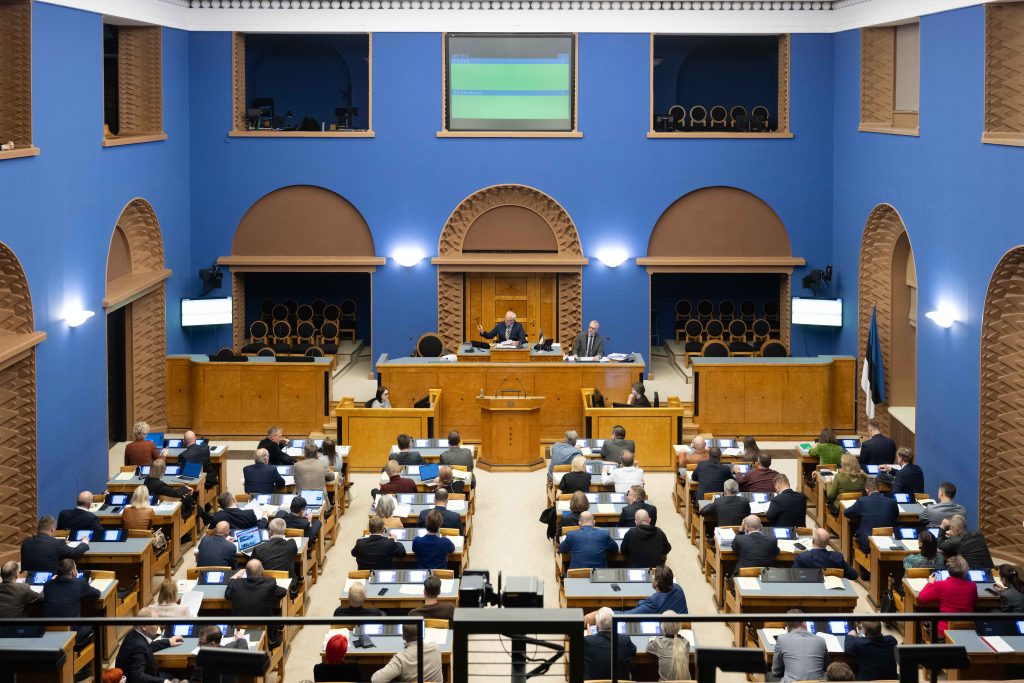
At the sitting that started at 2pm on Wednesday and lasted until Thursday morning, the Riigikogu passed three Acts, concluded the second reading of the Bill on next year’s state budget and four other bills, and the first reading of six drafts. The deliberation of three bills will continue at a new sitting starting at 10am.
The Riigikogu passed the Act on Amendments to the Citizenship Act and Amendments to Other Associated Acts (932 SE), initiated by the Government. It provides that, in the future, children born in Estonia to stateless parents will acquire Estonian citizenship through naturalization if at least one of the parents has legally resided in Estonia for at least five years by the time of the child’s birth and the other parent also resides in Estonia on the basis of a residence permit. Under current law, children born in Estonia to stateless parents remain stateless.
The Act also aims to ensure that applicants for Estonian citizenship have a genuine and direct link to the Estonian state, and to verify that they comply with Estonian laws and adhere to its constitutional order. The Act specifies the requirement to reside permanently in Estonia when applying for Estonian citizenship, as well as the provisions concerning the revocation of Estonian citizenship and the conditions under which a person is deemed to have ceased to be an Estonian citizen.
Evelin Poolamets from the Estonian Conservative People’s Party Group and Helir-Valdor Seeder from Isamaa Parliamentary Group took the floor during the debate.
60 members of the Riigikogu supported the passing of the Act and 15 voted against.
The Riigikogu passed the Insurance Undertaking Crisis Prevention and Resolution Act (925 SE), initiated by the Government. It transposes two European Union insurance directives into Estonian law. The aim is to establish a framework for early intervention and crisis resolution in the financial difficulties of insurance undertakings and to update insurance regulation in order to strengthen financial stability, protect policyholders, and make the regulation more proportionate and future-proof.
The Act simplifies the requirements and market entry conditions particularly for small and non-complex insurance undertakings. For example, they will not have to draw up a liquidity risk management plan or climate change scenarios, and their risks and solvency will be assessed every two years, rather than annually. Nor will they need to assess macroeconomic factors.
The amendments update the capital and investment rules for insurance undertakings to encourage long-term equity investments and reduce the impact of market fluctuations.
Risk management and supervision will also be strengthened, and greater attention will be paid to taking climate and sustainability risks into account. Insurance undertakings will be required to develop climate change scenarios if climate change-related risks have a significant impact on them. Insurance undertakings will also have to draw up action plans on how to measure, monitor and reduce environmental, social, and other sustainability-related risks. In addition, insurance undertakings will have to increase the diversity of the composition of their management bodies.
A regulation of crisis resolution in the insurance sector will create the opportunity to intervene early in the case of an insurance undertaking in difficulty in order to restore the insurance undertaking’s financial position before serious problems arise and, if necessary, implement measures that protect policyholders and financial stability. Crisis resolution will be initiated only if other solutions are insufficient and it is necessary in the public interest.
Urmas Reinsalu from Isamaa Parliamentary Group took the floor during the debate.
53 members of the Riigikogu were in favour of passing the Act, 13 were against and there was one abstention.
The Riigikogu passed the Act on Amendments to the Value-Added Tax Act (992 SE), initiated by the Government. It transposes amendments to the European Union’s VAT Directive which aim to reduce the administrative burden on businesses operating across borders.
The amendments expand the scope of the use of the special scheme for distance sales so that businesses will be able to fulfil their VAT obligations arising in other Member States through their country of establishment and will not have to register for VAT separately in each country. From 1 July 2028, the special scheme may be used more broadly for the sale of goods to consumers in another Member State, for example, for sales of goods at trade fairs, exhibitions, and markets; for the sale of goods that require installation or assembly; and for sales taking place on board watercraft or aircraft. From 2027, the special regime will be extended to natural gas transmitted via the network, as well as to electrical, thermal and cooling energy.
VAT rules for platform services are also changed. In the future, the place where the turnover from the underlying transaction arises will be the place of the provision of an online marketplace service. For example, in future, a service provided by an accommodation-booking platform will be taxed in the country where the accommodation service is provided, rather than in the client’s country of residence.
In addition, the Act eliminates the option to use a VAT taxable period longer than a calendar month and raises the tax-exempt threshold for goods transferred for advertising purposes from EUR 10 to EUR 21.
During the second reading, amendments were made to the Act to provide that therapeutic services provided by qualified specialists would be exempted from VAT even when they are provided outside a healthcare facility holding an operating licence.
58 members of the Riigikogu supported the passing of the Act.
The Bill on next year’s state budget passed the second reading
The State Budget for 2027 Bill (1037 SE), initiated by the Government, passed the second reading in the Riigikogu. According to the it, next year the volume of state budget revenues will be EUR 19.4 billion, expenditures nearly EUR 20.2 billion, and investments nearly EUR 1.2 billion.
According to the bill, state budget revenues will increase by EUR 850.7 million, or 4.6 percent, next year. Total expenditure will increase by 658 million or 3.4 percent over the year, while the total volume of investments will decrease by 9.6 percent.
According to the bill, the nominal general government budget deficit will decrease by 0.5 percentage points compared to next year’s economic forecast, reaching four percent of GDP. The debt burden will increase by EUR 2.3 billion compared to this year, reaching 28.3 percent of GDP. The tax burden will decrease by 0.3 percentage points, from 35.5 percent this year to 35.2 percent. Defence spending is set at EUR 2.33 billion, or five percent of GDP, next year.
Members of the Riigikogu and parliamentary groups had submitted 95 motions to amend the Bill for its second reading. The Finance Committee had incorporated three of them in part and had not incorporated the rest. The Finance Committee itself had submitted an amendment to the bill, consisting of several parts, that included specifications within and between the areas of government of the various ministries, as well as another amendment that allocated an additional EUR 7.47 million from the government reserve to improve the availability and quality of special care services.
Aleksandr Tšaplõgin, Anastassia Kovalenko-Kõlvart, Vladimir Arhipov, Aleksei Jevgrafov, Lauri Laats, Vadim Belobrovtsev and Andrei Korobeinik from the Centre Party Group, Lauri Läänemets, Helmen Kütt and Riina Sikkut from the Social Democratic Party Group, Helle-Moonika Helme and Rain Epler from the Estonian Conservative People’s Party Group, Mart Maastik, Aivar Kokk, Lea Danilson-Järg, Andres Metsoja, Priit Sibul, Tõnis Lukas, Urmas Reinsalu and Helir-Valdor Seeder from Isamaa Parliamentary Group, Aivar Sõerd from the Reform Party Group and Toomas Uibo from Estonia 200 Parliamentary Group took the floor during the debate. Non-attached Members of the Riigikogu Kalev Stoicescu, Kalle Grünthal, Ants Frosch, Enn Eesmaa, Meelis Kiili, Leo Kunnas, Tanel Kiik, Andre Hanimägi and Peeter Ernits also took the floor.
The Centre Party Group, the Estonian Conservative People’s Party Group, Isamaa Parliamentary Group and the Social Democratic Party Parliamentary Group moved to suspend the second reading of the Bill, but the plenary did not support the motion. 47 members of the Riigikogu supported suspension of the deliberation but 50 were against.
The 2027 State Budget Bill will also have to pass a third reading in order to be adopted. Motions to amend the Bill for the third reading can be submitted until 25 November at 5.15 p.m.
Four other Bills passed the second reading
The Bill on Amendments to the Alcohol Act and Other Acts (reduction of bureaucracy) (853 SE), initiated by the Government, passed its second reading. Its purpose is to reduce the administrative burden on economic operators in various sectors.
According to the explanatory memorandum, alcohol retail trade companies, communications undertakings, transporters of explosives, travel agencies, manufacturers and importers of precious metal articles, and, with regard to the amendments concerning the Consumer Disputes Committee, all traders who provide services to consumers or sell goods, will be released from observing excessively bureaucratic requirements. In addition to reducing requirements, the Bill will amend several statutory fees.
Amendments to the Alcohol Act will, among other things, eliminate the requirement for sales areas for the retail sale of alcoholic beverages in e-commerce and at public events, and replace the obligation to have a cash register with a requirement to record the times of transactions. In the Electronic Communications Act, the validity periods of radio and frequency licenses will be harmonised, and reporting requirements will be reduced. The amendments to the Explosives Act will simplify the procedure for the domestic transport of explosives by replacing the licence obligation with a notification requirement.
In addition, the Bill will enhance the work of the Consumer Disputes Committee, make the registration of sponsor’s marks for precious metal articles a one-time process, and simplify the procedure for travel companies for submitting documents to the Consumer Protection and Technical Regulatory Authority.
The Public Libraries Bill (877 SE), initiated by the Government, passed its second reading. It will reform the organisation of the public library network. Under the bill, all public libraries in each local authority will be brought under a single management structure, and a unified nationwide library database will be introduced to organise their operations.
Whilst the coordination of public libraries’ national responsibilities is currently the remit of the 15 county libraries, under the bill all local authority public libraries will become equal partners of the National Library of Estonia, which will assume responsibility for the national administrative tasks relating to public libraries. The goal is to strengthen the integrity of the library network, the availability of services, and user convenience. To improve user convenience, a single nationwide database will be implemented to replace the existing three separate systems; public libraries will join this database, and research, specialist, and school libraries may also join if they wish.
The organization of the public library network remains the responsibility of local governments, but the principles governing its organization will become more flexible. According to the bill, the organization of the library network will have to be based on the number of residents, population density and structure, as well as local needs. The National Library of Estonia will begin to take on national responsibilities in stages, becoming the central coordinator for the development of nationwide services.
The tasks of the National Library will include, among other things, the creation, management, and development of nationwide services, the collection and analysis of reports, as well as professional consulting and the coordination of training. The National Library will also take over the task of centralised procurement of publications. Public libraries remain responsible for selecting publications to be acquired for their collections. If desired, public libraries will be able to acquire publications themselves using funds allocated by the local government.
The Cultural Affairs Committee had made amendments to the bill for the second reading, which, amongst other things, specified the qualification requirements for librarians. Under an amendment, a librarian will generally have to hold a higher education degree in the field; in the absence of this, they will have to hold a higher education degree in another field and have a professional qualification as a librarian. At the same time, the bill will allow the local authority to also take into account a person’s previous work experience and competencies acquired during the course of their work. This means, for example, that it will be possible to employ an experienced librarian who does not hold a professional qualification but is willing to acquire the necessary education or qualification.
Other amendments will make the verification of readers’ details more flexible and specify the regulations governing library databases. The dates on which the Act is due to come into force will also be postponed to give libraries, local authorities and the National Library of Estonia more time to prepare for and implement the changes.
Tõnis Lukas from Isamaa Parliamentary Group, Liina Kersna from the Reform Party Group, and Anti Allas from the Social Democratic Party Group took the floor during the debate. Non-attached Member of the Riigikogu Peeter Ernits also took the floor.
Isamaa Parliamentary Group moved to suspend the second reading of the Bill, but the motion was not supported. 12 members of the Riigikogu supported suspension of the deliberation but 42 were against.
The Bill on Amendments to the Labour Market Measures Act and Amendments to Other Associated Acts (972 SE), initiated by the Government, passed the second reading. It will amend the conditions for receiving labour market services, unemployment insurance benefits, and work ability allowances in order to increase the activity of job-seekers and support their faster return to the labour market.
The bill will specify the conditions for registration as unemployed, the associated obligations, and the grounds for termination of such registration; it will update the definition of ‘suitable work’; and it will direct the services provided by the Unemployment Insurance Fund more than before towards people who are ready to take up employment.
The bill will also bring the Social Tax Act into line with the amendments to the employment programme by removing the reference to the abolished work practice service.
The Platform Work Bill (1003 SE), initiated by the Government, also passed the second reading. It will transpose the European Union Platform Work Directive into Estonian law. The aim of the bill is to improve the working conditions of people working through digital labour platforms, such as couriers and ride-hailing drivers, and their opportunities to protect their rights.
Platform work often employs automated systems that help allocate tasks, determine pay, and evaluate workers. The bill is intended to increase the transparency and fairness of automated organisation of work. Under the bill, platforms will have to explain to workers in an understandable manner which automated systems the platforms use and how they affect the workers. For example, a person needs to know how their pay is determined and whether a client’s rating or a refusal of an order will reduce the amount of work offered to them in the future. This helps them better understand how their job opportunities and income are determined.
It will also be provided that an automated system must not collect sensitive data or draw conclusions based on such data. For example, it will not be permitted to analyse a worker’s emotional or psychological state or private conversations, to collect data at times when the person is not performing platform work, or to draw conclusions about their health, disability, religion, political views or trade union membership.
The bill will also ensure worker’s control over important decisions. It will be provided that any decision to restrict, suspend or terminate an account will have to be made by a human being. If an automated system makes or supports decisions such as restricting, suspending, or terminating an account, refusing payment, or changing contractual status, the platform will have to provide the worker with a reason for the decision. A platform worker may contest such automated decisions and request that a human review the decision. The request will have to be responded to within 14 days, the decision will have to be substantiated, and in the event of an unfair decision, the decision will have to be rectified or, if that is not possible, compensation will have to be provided for any damage.
Urmas Reinsalu, Aivar Kokk, Helir-Valdor Seeder, Priit Sibul and Mart Maastik from Isamaa Parliamentary Group and Signe Riisalo from the Reform Party Parliamentary Group took the floor during the debate. Non-attached Members of the Riigikogu Peeter Ernits and Kalle Grünthal also took the floor.
Isamaa Parliamentary Group moved to suspend the second reading of the Bill, but the plenary did not support the motion. 12 members of the Riigikogu supported suspension of the deliberation but 37 voted against it.
Six drafts passed the first reading
The Bill on Amendments to the Value Added Tax Act (1069 SE), initiated by the Government, passed the first reading in the Riigikogu. It will amend the conditions for the refund of value-added tax on goods and services purchased in Estonia by diplomats, foreign missions, personnel of foreign armed forces and international military headquarters, and other eligible persons, effective from the new year.
According to the bill, it will be possible to claim a VAT refund only on the basis of an invoice that includes the buyer’s details. So far, a regular cash register receipt has also sufficed. The amendments will also raise the minimum invoice amount required for a VAT refund from EUR 64 to EUR 160 in order to reduce the number of refund applications and the workload on the authorities.
The bill will exclude tobacco products from the VAT concession and specify that purchases made for personal needs will have to be related to a diplomatic mission in Estonia.
The Draft Resolution of the Riigikogu “Approval of the 2025 Consolidated Report of the State” (1033 OE), initiated by the Government, passed the first reading. The report approved by it gives an overview of the achievement of the goals of the state budget, and of the financial position, financial performance and cash flows of the state in 2025.
The consolidated report provides the Government with the opportunity to explain its activities during the accounting year and submit the necessary information to the Riigikogu for making new resolutions regarding the budget. It provides the Riigikogu with the opportunity to audit the activities of the Government. The consolidated annual report of the state includes the audit report of the National Audit Office.
According to the data of the consolidated annual accounts of the state, the state had EUR 27.48 billion worth of assets as at the end of 2025 and the assets increased by EUR 715.6 million over the year. At the same time, the consolidated liabilities of the state amounted to EUR 21.46 billion which is EUR 682.6 million more than the year before.
The Bill on Amendments to the Military Service Act (961 SE), initiated by Members of the Riigikogu Meelis Kiili, Leo Kunnas, Alar Laneman, Peeter Tali, Vladimir Arhipov, Enn Eesmaa, Kristo Enn Vaga and Raimond Kaljulaid, passed the first reading. It is intended to reinstate the age limit and special pensions for active servicemen.
In addition, the bill will provide for further social guarantees relating to post-traumatic stress disorder and other mental health disorders resulting from service, and incapacity for work, for servicemen and persons transferred to the reserve. The bill is based on the principle that the state looks after its people throughout their entire service career and active servicemen and veterans whose health has been impaired whilst serving Estonia are not left without support.
The Bill on Amendments to the Animal Protection Act (970 SE), initiated by Members of the Riigikogu Tiit Maran, Jaak Valge, Leo Kunnas, Anastassia Kovalenko-Kõlvart, Andrei Korobeinik, Züleyxa Izmailova, Reili Rand, Helmen Kütt, Heljo Pikhof, Lauri Läänemets, Madis Kallas, Riina Sikkut, Anti Allas, Andre Hanimägi, Kalev Stoicescu, Jaak Aab and Enn Eesmaa, passed the first reading. It is intended to ban from 2035 the cage keeping of hens intended for laying.
The aim of the bill is to improve the welfare of laying hens, as cages restrict their ability to move and their natural behavioural patterns. According to the initiators, the welfare of farm animals and poultry is increasingly influencing people’s purchasing behaviour and there is a growing demand for eggs from cage-free hens.
According to the explanatory memorandum, entrepreneurs need a transition period to reorganize their activities, because they will have to restructure their production and switch to alternative methods of keeping laying hens. Poultry farming currently accounts for approximately five percent of Estonia’s total agricultural production.
As another amendment, the bill will provide that, starting from 2027, animal keepers who begin keeping laying hens may not build or put into use cages. This means that entrepreneurs starting egg production will have to build and equip their production system to be put into use in such a way that it would be possible to keep laying hens cage-free.
Tiit Maran from the Social Democratic Party Group took the floor during the debate.
The Bill on Amendments to the Gambling Tax Act and Other Acts (984 SE), initiated by Isamaa Parliamentary Group, passed the first reading. It is intended to repeal the legislative amendments providing for a phased reduction in the gambling tax. According to the initiators, tax reductions for online casinos are unjustified and harm public finances.
Urmas Reinsalu from Isamaa Parliamentary Group took the floor during the debate.
The Bill on Amendments to the Courts Act (national defence court) (979 SE), initiated by Members of the Riigikogu Meelis Kiili, Leo Kunnas, Alar Laneman, Vladimir Arhipov, Enn Eesmaa, Peeter Tali, Priit Sibul and Anti Poolamets, passed the first reading. It is intended to establish a legal basis for the establishment of a national defence court.
According to the initiators, the aim of establishing a national defence court is to ensure the functioning of the state and the continuity of the administration of justice during a national defence crisis, a state of emergency, and a state of war. To this end, the composition of the national defence court will combine the legal expertise of professional judges with the military experience and domain-specific competence of officer-judges.
The bill will define the competence of the national defence court as a general area of competence and leave the drafting of more detailed regulations for a later stage. According to the bill, the national defence court will be able to perform judicial functions during peacetime only in cases provided for by law.
Four drafts were dropped from the proceedings
The Riigikogu rejected the Draft Resolution of the Riigikogu “Making a proposal to the Government of the Republic to develop principles for the regionally balanced allocation and use of European Union funds for the 2028–2034 programming period” (957 OE), submitted by the Social Democratic Party Group.
The draft proposal aimed for the Government to develop principles, methodologies, and an action plan for the regionally balanced allocation and utilization of funds from the EU’s 2028–2034 programming period—measures designed to ensure greater regional balance in the use of EU funds and to help reduce regional development disparities within Estonia. According to the presenters, regional development disparities are increasingly affecting Estonia’s economic growth potential, social cohesion, and national security.
Lauri Läänemets from the Social Democratic Party Group and Evelin Poolamets from the Estonian Conservative People’s Party Group took the floor during the debate. Peeter Ernits made a speech on behalf of the Centre Party Parliamentary Group.
30 members of the Riigikogu supported the draft Resolution and 47 voted against it in the final vote.
The Riigikogu rejected the Draft Resolution of the Riigikogu “Making a proposal to the Government of the Republic to restore the school sport support for young people” (944 OE), submitted by the Centre Party Group. It called on the Government to restore the school sport support for young people. According to the presenters, school sports play an important role in the development of both children’s physical activity habits and healthy lifestyles.
At the final vote, 21 members of the Riigikogu supported the draft Resolution and 40 were against.
The Riigikogu rejected at the first reading the Bill on Amendments to the Language Act and Other Acts (964 SE), initiated by Isamaa Parliamentary Group. It was intended to update the legal framework in the field of language in order to strengthen the status of the Estonian language as the official language, as well as the position and visibility of the Estonian language in the service sector.
The bill was intended, among other things, to expand language requirements for platform workers who communicate directly with service recipients. It was also intended to provide for a requirement for taxi drivers to have proficiency in the official language as a prerequisite for obtaining a service provider card, and to provide that instruction in hobby schools takes place in Estonian.
Urmas Reinsalu from Isamaa Parliamentary Group took the floor during the debate.
The Cultural Affairs Committee moved to reject the Bill at the first reading. 36 members of the Riigikogu supported the rejection and nine were against it.
The Riigikogu also rejected at the first reading the Bill on the Repeal of the Motor Vehicle Tax Act and the Repeal of the Registration Fee for Passenger Cars in the Road Traffic Act (1010 SE), initiated by Member of the Riigikogu Kalle Grünthal. It was intended to repeal the motor vehicle tax and the registration fee for passenger cars in order to reduce the tax burden on Estonian residents.
The Finance Committee moved to reject the Bill at the first reading. 34 members of the Riigikogu supported the rejection, and four were against it.
The Riigikogu heard the overview by the Auditor General
At Wednesday’s sitting, Auditor General Janar Holm gave the Riigikogu an overview of the use and preservation of state assets in 2025–2026. Holm spoke specifically about the recently published annual report which examines trends in Estonian healthcare for the first time in over four years. Next year, when 10 years will have passed since the administrative reform, the report will focus on regional development.
Jaanus Karilaid took the floor on behalf of Isamaa Parliamentary Group and Tanel Kiik made a speech on behalf of the Social Democratic Party Group during the debate. Anti Poolamets from the Estonian Conservative People’s Party Group and Aleksei Jevgrafov from the Centre Party Group also took the floor.
The deliberation of several Bills will be deferred
The first reading of the Bill on Amendments to the Anti-corruption Act (974 SE), initiated by the Anti-Corruption Select Committee, the Bill on Amendments to the Riigikogu Rules of Procedure and Internal Rules Act and Other Acts (978 SE), initiated by Members of the Riigikogu Jaak Valge, Leo Kunnas and Helir-Valdor Seeder, and the Bill on Amendments to the Value-Added Tax Act (956 SE), initiated by the Centre Party Group, was cancelled due to the absence of the presenters.
The deliberation of three bills is deferred to the agenda for Thursday’s sitting due to the end of the working hours. The next sitting, starting at 10 a.m., will continue with the first reading of the Bill on the Repeal of the Motor Vehicle Tax Act and the Repeal of the Registration Fees for Passenger Cars in the Road Traffic Act (982 SE), initiated by Isamaa Parliamentary Group, the Bill on Amendments to the Security Authorities Act (963 SE), initiated by Members of the Riigikogu Ants Frosch, Meelis Kiili, Leo Kunnas, Henn Põlluaas, Peeter Tali, Alar Laneman, Vladimir Arhipov, Enn Eesmaa, Eerik-Niiles Kross and Priit Sibul, and the Bill on Amendments to the Health Insurance Act (983 SE), initiated by Members of the Riigikogu Lea Danilson-Järg, Aivar Kokk, Helir-Valdor Seeder and Priit Sibul.
The sitting ended when the chair of the sitting declared a recess at 9.28 on Thursday.
Photos (Erik Peinar / Chancellery of the Riigikogu)
Verbatim record of the sitting (in Estonian)
Video recording will be available to watch later on the Riigikogu YouTube channel.