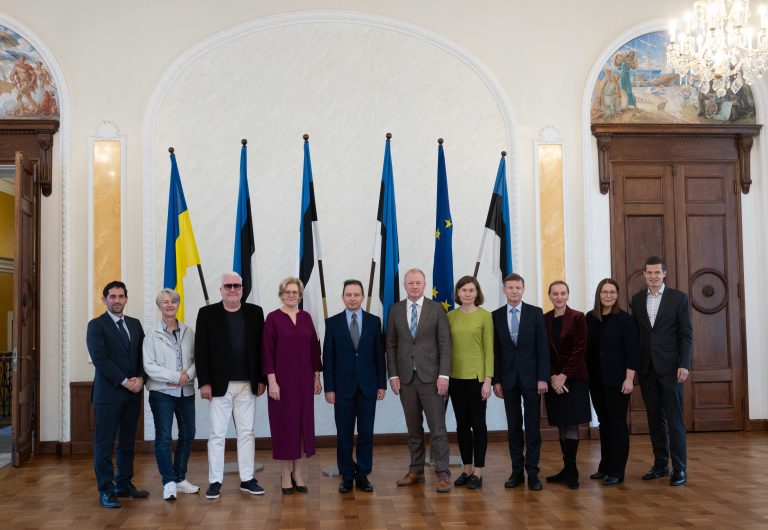
The Finance Committee and the Economic Affairs Committee met with the delegation of the International Monetary Fund (IMF) and gave an overview of the state of Estonia’s financial sector and the economy.
The IMF delegation inquired about the 2027 budget and the medium-term state budget strategy, economic growth, and support for innovation.
The Chairman of the Finance Committee Annely Akkermann, members Aivar Sõerd, Mart Võrklaev, Diana Ingerainen, and Riina Sikkut, and the Chairman of the Economic Affairs Committee Marek Reinaas gave an overview of the factors affecting the state budget, as well as the economic situation.
Akkermann explained that the state budget for the next year would be affected both by the large defence capability package as well as the construction of Rail Baltic. The budget aims to significantly reduce the deficit by cutting an additional EUR 250 million from state expenditure. “The rapid increase in defence spending will take the budget deficit to 4.0% of the GDP next year,” Akkermann predicted. She added that the deficit would be reduced step by step each year, reaching 2.8% of the GDP by 2029.
Estonia’s defence spending will continue to remain above 5 percent of the GDP. The budget deficit will increase the debt burden for next year by EUR 2.3 billion, to 28.3 percent of the GDP,” Akkermann said. The tax burden in Estonia will fall from 36.6% to 35.2%. Due to the significant increase in the budget deficit, next year’s debt burden will grow by EUR 1.7 billion to 25.9% of the GDP.
The Chairman of the Economic Affairs Committee Marek Reinaas quoted the head of the mission who had also recommended reducing the budget deficit by at least 0.5 percent over the coming years, in order to reach the promised three percent. “Several indicators point to a general strengthening of the economy. Economic growth of 2.5 percent is expected this year, and a growth of 2.3 percent for 2027,” Reinaas added.
Akkermann referred to the warning by the head of the mission that reducing the VAT on food might not lead to the desired results.
The IMF monitors the economies of its member countries, including Estonia, in the context of the economic policy consultations that generally take place once a year. The common name “Article IV consultations” derives from Article IV of the IMF’s Articles of Agreement. IMF’s national cooperation partner in Estonia is Eesti Pank (Bank of Estonia), which publishes summaries of the missions on its website.
The mission team specifies the objectives, scope, details, timing, and expected results of the Article IV cycle. It engages in discussions on recent macroeconomic, fiscal and financial developments, prospects, risks, and policies. The mission team is interested in feedback from members of the Riigikogu committees on their analytical and policy agenda before the Article IV consultations.
As this is an interim mission of the IMF, the team will not prepare a summary statement and there will be no press conference at the end of the mission. However, the interim mission is important because it usually prepares the first version of the Article IV report, which is supplemented with additional topics and economic policy messages during the mission. The outcome of the consultation is a report reflecting the IMF experts’ assessment of Estonia’s economic policy. The IMF discusses important economic policy issues with all member states.
The IMF delegation is made up of the head of the mission Metodij Hadzi-Vaskov, senior economist David Bartolini, and economists Jiaming Soh and Cristina Cheptea.
Photos (author Merje Meisalu / Chancellery of the Riigikogu)