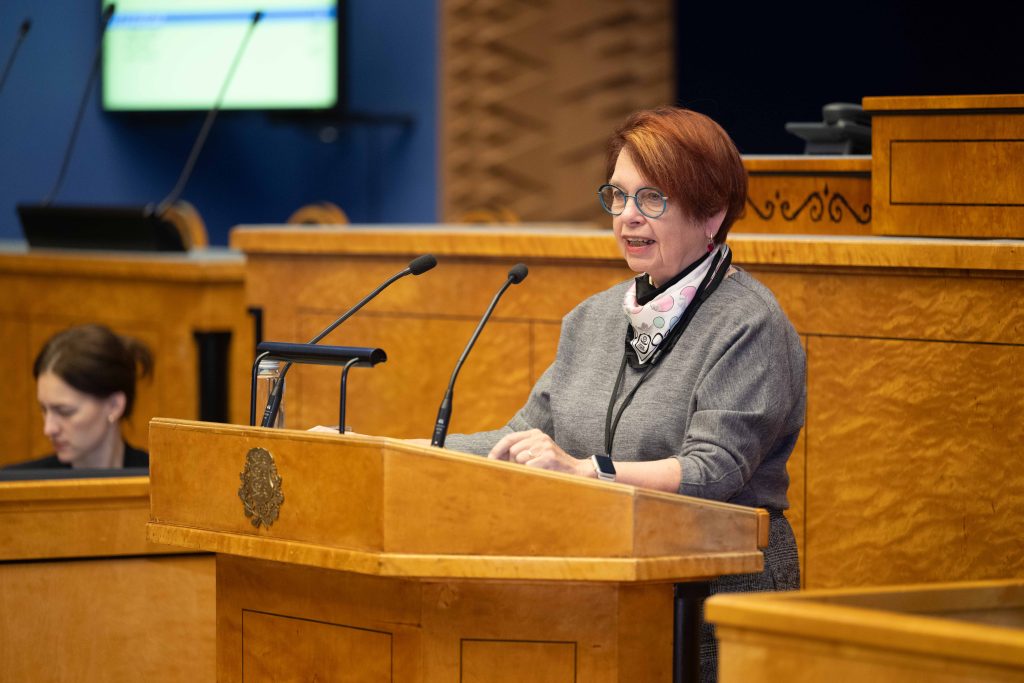
Deliberation of the matter of significant national importance “The use and misuse of health data” was on the agenda of today`s plenary sitting of the Riigikogu.
During the deliberation, presentations were made by the initiator of the debate, Irja Lutsar, a representative of the Estonia 200 Parliamentary Group and a member of the Riigikogu; Lise-Lotte Lääne, Attorney-at-law, Head of the Life Sciences and Healthcare sector group, Law firm Sorainen; Alar Irs, Head of the Heart Clinic, Tartu University Hospital; and Egert Belitšev, Director General of the Police and Border Guard Board.
Irja Lutsar, a member of the Riigikogu Social Affairs Committee, who spoke first, pointed out that data were a major currency in the modern world. “The question is not only who can collect the most data, but rather who collects it in a meaningful way, and more importantly, who can analyse it better and use it for decision-making,” she noted. According to Lutsar, data-driven decisions are always better than those based on emotions. However, people’s privacy must be respected in the process.
Lutsar noted that amendments to two laws concerning data were currently in the legislative proceedings of the Riigikogu. One of them, Bill SE 951, is intended to merge the Estonian Medical Prescription Center’s treatment invoice database with the Health Information System. This would create what could aptly be described as a “super database” of health data. The second bill, SE 999, also known as the so-called Integrated Care Bill, aims to use the Health Information System to identify people with complex health conditions in order to offer them additional services. According to Lutsar, the merging of databases will bring benefits to officials, analysts and researchers. At the same time, she stresses that the use of health data must be based on people`s trust, respect for privacy, and clear rules.
Lutsar believes that a persons’s consent is the best basis for the use of data. At the same time, situations, in which it is impossible to obtain consent must also be taken into account. In such cases, transparency and traceability of the use of data must be ensured to maintain trust between individuals and the state. “The greatest currency between individuals and the state is trust,” she said.
Lise-Lotte Lääne, an attorney-at-law and the Head of the Life Sciences and Healthcare sector group at the law firm Sorainen, began her presentation by stressing that Estonia’s health data system was an internationally acclaimed success story. However, the current debate on the use of health data has highlighted serious problems in understanding and applying data protection principles. “Having now also examined the bills currently in legislative proceedings, I honestly feel that there is a lack of understanding of the fundamental principles governing the processing of personal data. It is a major problem,” she said.
Lääne explained that health data processing is regulated by the EU General Data Protection Regulation, while offence proceedings are subject to a separate legislative framework. Each operation involving health data, including its forwarding and receipt, must have a clear legal basis, with both the data provider and the data user bearing independent responsibility. “The data controller must independently ensure that the transfer is carried out correctly and that it has a valid legal basis. And this is the fundamental issue that, in my view, has remained completely unclear,” she noted.
According to the attorney-at-law, health data is a special category of highly sensitive personal data, the processing of which is generally prohibited except in cases provided for by the law. Lääne also pointed out that health data was not limited to the data collected by healthcare providers, but also included, for example, data from the Biobank and data entered by patients themselves. The speaker said that public debate on the use of health data was necessary, but primarily to find a balance between protecting the data and using it for research, innovation, and improving the quality of healthcare.
In conclusion, Lääne said that the problem was not with the laws in force, but with their incorrect application. According to her, in certain cases, health data has been disclosed in offence proceedings without a sufficient legal basis, and the disclosure of such data should be suspended until the legal grounds are unambiguously clear. She also criticised the bill on official or data privileges currently in legislative proceedings, because it lacked the necessary protection measures and failed to address the actual cause of the crisis of trust. “I truly hope that the damage to public trust can be repaired. I believe this is a good point for moving forward. And I believe that it will only demonstrate Estonia’s strength if we manage to use data securely, because that is our brand in the world,” she said.
Alar Irs, Head of the Heart Clinic at Tartu University Hospital, discussed health data primarily from the perspective of doctors and patients, stressing that its main purpose was to improve people’s health and the quality of care. According to him, health data is used both in the direct care of patients and more broadly to improve the healthcare system, assess quality, conduct research and develop new treatments. In modern healthcare, it is not possible to provide high-quality and safe care based on the data of only one healthcare institution. A comprehensive overview of the patient’s healthcare journey is required. “For most medical specialities, it has long been impossible in everyday medical practice to help people based solely on the information we obtain from them during the particular patient encounter. Well, we can do that, but that would be a far from optimal service to provide to the patient. That would be dangerous and very inefficient,” Irs said.
The Head of the Heart Clinic introduced the concept of a learning healthcare system, in which health data is used to enable the system to continuously analyse and improve its performance. For this purpose, data from different sources needs to be integrated and made available for targeted use. Irs gave the example of assessing the quality of heart failure care, which requires integrating data from multiple sources. Practical experience demonstrates that failure to use data from the Health Information System may result in erroneous conclusions and inefficient decisions in healthcare.
In conclusion, Irs stresses that health data provides an opportunity to address several shortcomings in Estonia’s healthcare system. This requires a well-functioning legal framework, appropriate safeguards and public trust. Although the use of health data entails risks, these have to be assessed alongside the potential benefits for patients and society. “In my view, while considering and regulating the use of health data for non-healthcare purposes, it is essential to prioritise the goal of improving health and to ensure that public trust is not undermined,” he said.
In his presentation, Egert Belitšev, Director General of the Police and Border Guard Board, explained the use of health data in criminal proceedings. He stressed that the police understand the sensitive nature of health data and the importance of its protection. According to him, the Police and Border Guard Board uses the data primarily for two purposes: as evidence in criminal proceedings to establish the circumstances of an offence and to protect vital interests, for example, in case of a risk of suicide, missing persons or people posing an immediate threat. “If the punishable offence involves causing serious bodily injuries, we have to prove that the serious bodily injuries have in fact been inflicted on the victim,” Belitšev said. He confirmed that data was used on the grounds set out in legislation and the health data was obtained from the Health Information System, the databases of the Estonian Health Insurance Fund and directly from healthcare providers. “What I would like to confirm here is that none of these channels gives the Board unrestricted access to all of a person’s health data.”
Belitšev also said that the Police and Border Guard Board had conducted an audit of health data queries made between 1 January and 31 May this year. In total, 2,139 queries were analysed, most of which had been made directly to healthcare providers. The audit demonstrated that the vast majority of queries were lawful and justified. However, deficiencies were identified in 112 cases, while 61 queries were found to be insufficiently justified or not fully compliant with internal rules. The problematic cases primarily involved the use of prescription data to establish the whereabouts of wanted persons, queries for health data before the criminal proceedings had been initiated, and the collection of data for forensic examination in a way that did not comply with the applicable procedure.
According to Belitšev, as a result of the audit, the Police and Border Guard Board discontinued several controversial practices, strengthened internal controls, and introduced additional safeguards, including the two-person rule for queries made without consent. Furthermore, training of officials has been expanded, while control mechanisms and oversight have been automated. “We also identified areas internally where, although the law allowed queries to be made without the person’s consent, our internal rules required the official to obtain consent,” he added.
Belitšev confirmed that, in certain cases, the use of health data was critical in police work. However, it has to be strictly justified, verifiable and transparent in order to maintain public trust and ensure the lawful use of data. “Data protection and the lawful processing of data are among the Police and Border Guard’s priorities for next year, and have in fact been a priority this year as well,” he stated.
Jaanus Karilaid (Isamaa), Toomas Uibo (Estonia 200), Riina Sikkut (Social Democratic Party), and Peeter Ernits took the floor during the debate.
Verbatim record of the sitting (in Estonian)
Photos will be uploaded as soon as possible (photographer: Erik Peinar, Chancellery of the Riigikogu)
Video recording will be available on the Riigikogu YouTube channel.