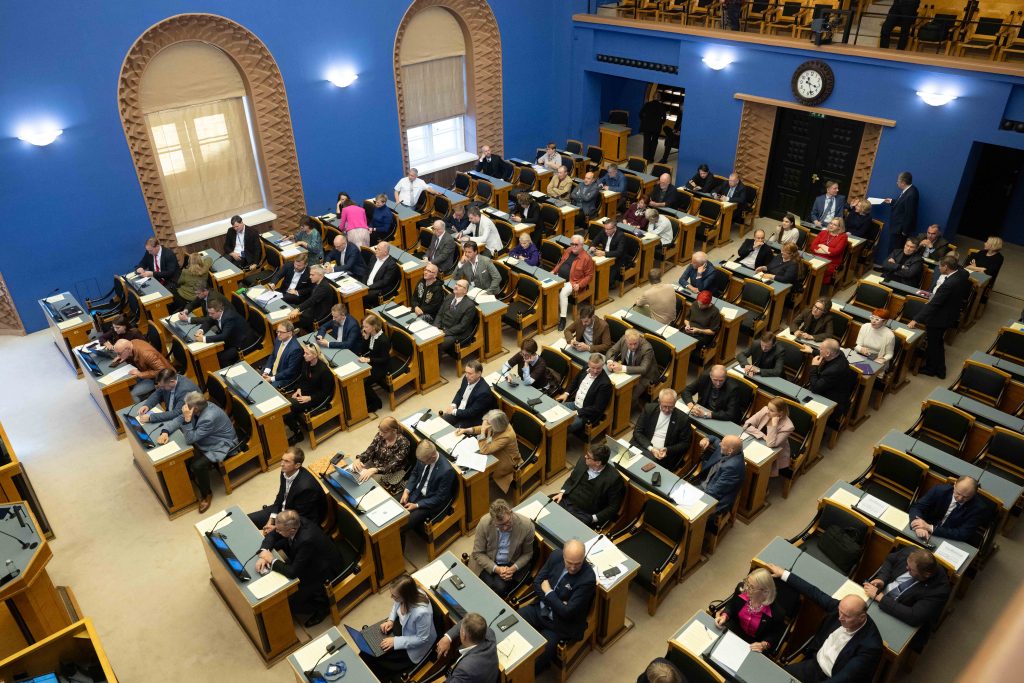
At the beginning of the sitting, the Riigikogu discussed a motion of no confidence in the Government submitted by 34 members of the Riigikogu but did not pass the motion. 34 members of the Riigikogu supported it. At least 51 votes would have been needed to express no confidence in the Government.
Responses to five interpellations were then heard.
Prime Minister Kristen Michal replied to the interpellation concerning the decline in exports and its impact on the economy (No. 994), submitted by Members of the Riigikogu Lauri Laats, Aleksandr Tšaplõgin, Peeter Ernits, Anastassia Kovalenko-Kõlvart, Aleksei Jevgrafov, Andrei Korobeinik, Vladimir Arhipov and Vadim Belobrovtsev.
The interpellators wished to know what the Government considered to be the main reasons for the eight per cent fall in exports of goods of Estonian origin.
Michal explained that it was not possible to draw conclusions about the overall performance of Estonian exports on the basis of statistics for a single month. “As the interpellators also pointed out, they based this question on a single month’s data. In the first eight months of 2026 – which is a longer period – Estonia’s exports grew by 7 per cent year-on-year. Estonian exports depend on demand from foreign markets, as nearly 80% of exports go to European Union markets,” Michal said. He highlighted that the competitiveness of businesses was underpinned by a tax burden lower than the European average, a high level of digitalisation, and Estonia’s competitive tax system. “According to news released today, Estonia’s tax system is the most competitive among OECD countries for the 13th consecutive year,” Michal said.
Michal confirmed that the government was continuously monitoring the situation in economic sectors. The competitiveness of the Estonian economy and its bottlenecks were also analysed in a report by an expert panel, submitted to the Riigikogu in 2024, which highlighted, in particular, the problems facing the manufacturing industry. “The government has drawn up the Industrial Policy 2035 and the Export Action Plan 2025–2028 to strengthen the competitiveness of businesses. We focus on enhancing companies’ export capacity, identifying new markets, and fostering cooperation between the state and businesses,” Prime Minister said. He listed the priority sectors as the timber, food, engineering and metal industries, the defence industry, the maritime sector, and IT, green and health technologies. In these sectors, we are focusing on increasing exports and creating greater added value.
Michal said that the government was focusing on reducing the tax burden, ensuring affordable energy, increasing investment, cutting red tape, and supporting exports to strengthen the competitiveness of Estonian industry. The tax burden will fall from 36.2% to 35.2% over two years, by 2027. We are accelerating the development of renewable energy and the strengthening of the electricity grid to reduce energy costs. The economic growth plan provides for a fast-track procedure for major investments, a reduction in the administrative burden on businesses, and support for research and development and digitalisation. The aim is to increase the productivity of businesses and move towards production with higher added value. The competitiveness of Estonian businesses is also supported by a tax burden that is lower than the European average. According to Eurostat data, Estonia’s tax burden is 35.5% of GDP, compared to the European Union average of 40.4%. In addition, the Tax Foundation has ranked Estonia’s tax system as the world’s most competitive for the 13th year running.
The Prime Minister also replied to the interpellation concerning the decline in the sense of security among Estonian residents and the state’s security policy (No. 995).
Minister of Defence Martin Herem replied to the interpellations concerning “The Framework Agreement for Aerial Loitering Munition” (No. 1046) and the agreement on the development of the Aidu wind farm and the resulting national defence risks (No. 1062).
Minister of Justice and Digital Affairs Liisa Pakosta replied to the interpellation concerning the transfer of prisoners from other countries to Estonia (No. 1020).
The interpellation concerning lobbying meetings (No. 1063), submitted to Minister of Justice and Digital Affairs Liisa Pakosta, was excluded from the agenda for the day at the request of the interpellators.
The sitting ended at 11.18 p.m.
Verbatim record of the sitting (in Estonian)
Photos (Erik Peinar / Chancellery of the Riigikogu)
Video recording will be available to watch later on the Riigikogu YouTube channel.