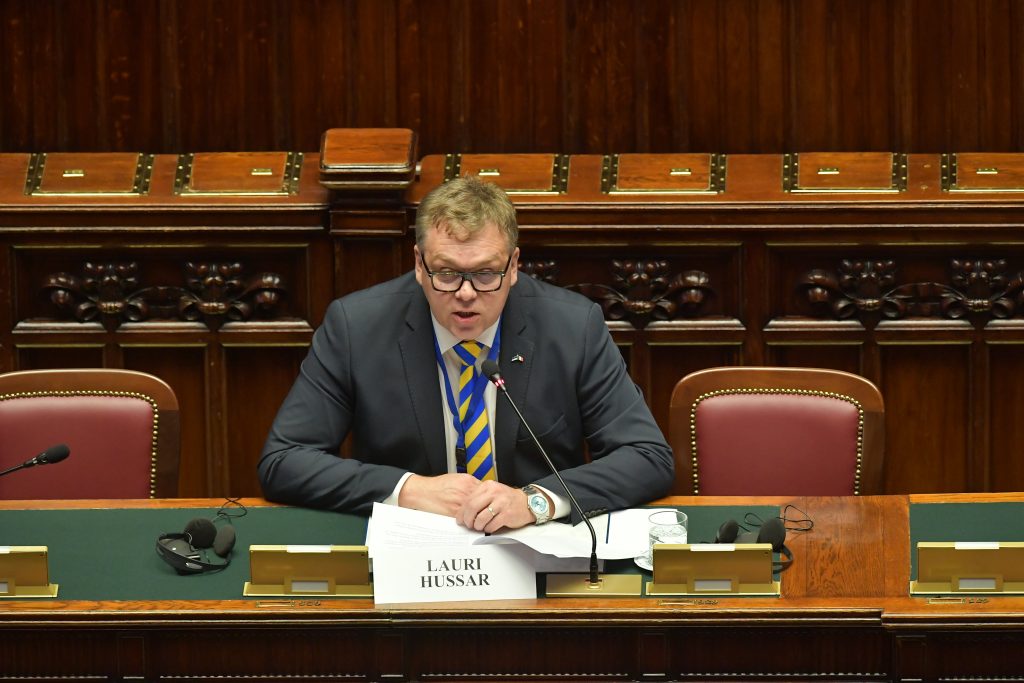
President of the Riigikogu (Parliament of Estonia) Lauri Hussar said at the Conference of Speakers of the Parliamentary Assembly of the Council of Europe (PACE) today that the use of artificial intelligence required rules and accountability, and that it was the role of parliaments to ensure that innovation served the people and strengthened democracy.
In his speech, Hussar addressed the impact of artificial intelligence on the labour market and said that artificial intelligence offered countries significant opportunities, but these would only be realised if the technology served people instead of turning people into servants of technology. “So the question is not simply how many jobs AI will replace, but how it will change jobs and whether workers have the skills needed for adapting,” he said.
Hussar spoke about the Eesti.ai initiative that had been launched at the beginning of this year and aimed to increase the value of people’s work and the economy in Estonia by systematically implementing artificial intelligence. “The principle is simple: instead of asking how an algorithm can replace a worker, we should be asking how artificial intelligence can help that worker become more capable,” he said.
He also spoke about the Estonian education innovation programme AI-Leap (TI-Hüpe), which was designed to help the education system adapt to the age of artificial intelligence, and emphasised the importance of lifelong learning. “We must make it possible for people to retrain, develop new skills and adapt before their current skills become obsolete,” said Hussar said.
He emphasised that technology must enhance human capabilities and that every employee must have the opportunity to understand and challenge decisions affecting them that were made using artificial intelligence. He also underlined that the greatest investment in the adoption of artificial intelligence must be an investment in people.
“The challenge lies not only in developing smart machines, but also in taking responsibility for the systems that have been created and understanding what must remain exclusively human,” Hussar said, and added that artificial intelligence would undoubtedly shape the future of work, but the future of humans must continue to be shaped by human rights, democracy and the rule of law. “And that responsibility rests with us,” the President of the Riigikogu said at the Conference of Speakers.
Hussar was one of the two keynote speakers at the debate on artificial intelligence, together with President of the Senate of the Netherlands Mei Li Vos. The second topic the Speakers discussed today was “Resilient democracies: united against hybrid threats“. Tomorrow’s debate will be dedicated to renewing the rules-based international order and the role of parliaments in addressing and responding to crises. Hussar will take part in this debate and speak about Russia’s war of aggression in Ukraine, which violates international law, and the need to continue supporting Ukraine.
During the Conference, Hussar will have meetings with Chairman of the Verkhovna Rada of Ukraine Ruslan Stefanchuk, President of the Italian Chamber of Deputies Lorenzo Fontana, Speaker of the House of Representatives of the Netherlands Thom van Campen and Speaker of the National Assembly of Hungary Ágnes Forsthoffer.
Speakers and presidents of parliament from the member states of the Council of Europe and its partner and observer countries, as well as the representatives of parliamentary delegations participate in the European Conference of Presidents of Parliament in Rome, Italy.